Landmine One-Arm Bent-Over Bench Row
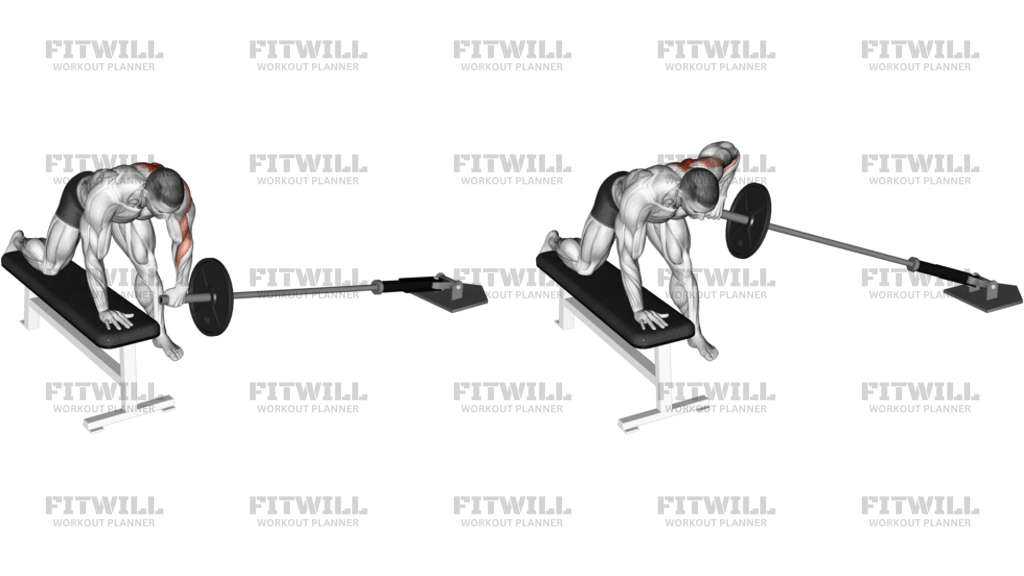
Landmine One-Arm Bent-Over Bench Row is a one-sided rowing exercise that uses a landmine-loaded barbell and a bench for support. It is designed to train the lats through a long pulling arc while the bench keeps your torso quieter than a free-standing row. The setup matters because the inside knee and same-side hand on the bench create a stable base, which lets you pull hard without twisting through the lower back or turning the rep into a hip-driven heave.
The primary work goes to the latissimus dorsi, with the upper back, rear shoulder, biceps, and forearm muscles helping the pull and controlling the bar path. In anatomy terms, the main mover is the latissimus dorsi, with support from the rhomboids, biceps brachii, and forearm flexors. Because the exercise is unilateral, it is especially useful for spotting left-to-right strength differences and for learning how to keep the shoulder blade moving cleanly without shrugging or rotating the torso.
To perform it well, set the bench beside the landmine attachment, place the inside knee and inside hand on the bench, and keep the outside foot planted on the floor. Start with the shoulder hanging long, then pull the handle toward the lower ribs or hip pocket. The elbow should travel back and slightly in, not flare wide. At the top, squeeze the shoulder blade toward the spine without yanking the chest open. Lower the bar slowly until the arm is extended and the shoulder is still packed.
This variation is a good fit for back-focused strength work, accessory volume after deadlifts or presses, or any session where you want a strong lat stimulus without a lot of spinal loading. It also works well for lifters who need a row they can feel in the working side without using much body English. Use a range of motion you can repeat rep after rep, keep the bench support stable, and stop the set if your trunk starts rotating or the bar path becomes jerky.
If the image or setup ever seems different from the name, the bench-supported one-arm landmine row setup should still be treated as the reference here: supported on one knee and one hand, pulling the loaded end of the bar in a controlled arc. The goal is a crisp row that builds the lats and upper back while keeping the torso fixed and the movement clean.
[ Workout Log & Planner ]
Put your next workout in Fitwill
Keep your plan and training log ready when you are.


Instructions
- Place the barbell in a landmine attachment and set a flat bench beside the loaded end so you can support your inside knee and inside hand on the pad.
- Kneel with the inside knee on the bench, place the same-side hand on the bench for balance, and plant the outside foot firmly on the floor.
- Reach down and hold the handle with the outside hand, letting the shoulder hang long and the arm start fully extended.
- Square your hips and keep your chest angled toward the bench instead of twisting open to the working side.
- Brace your midsection, then begin the pull by driving the elbow back toward your hip pocket.
- Keep the elbow close to your torso as the bar travels in a smooth arc toward your lower ribs.
- Squeeze the back of the working side briefly at the top without shrugging or leaning away from the bench.
- Lower the bar under control until the arm is straight again and the shoulder stays packed.
- Reset your brace and repeat for the planned reps, then switch sides.
Tips & Tricks
- Keep the bench close enough to the landmine that the bar can travel up in a clean diagonal without you reaching or leaning.
- Drive the elbow toward the back pocket, not straight up toward the ceiling, to keep tension on the lat instead of the upper trap.
- Let the shoulder blade glide forward at the bottom and then pull it back only as much as needed at the top; do not pin it hard the whole rep.
- Use the free hand on the bench only for balance, not to press your body upward or unload the working side.
- If your torso twists open, reduce the load and shorten the range until you can keep your ribcage and hips square.
- A slightly longer pause at the top can make this row much harder without adding weight.
- Keep the wrist straight so the handle stays stacked over the forearm instead of folding the grip back.
- Exhale as you row and inhale as the bar lowers to help keep the trunk quiet.
- Stop the set when the bar starts bouncing off the bottom or the shoulder rolls forward at the top.
Frequently Asked Questions
What muscles does the landmine one-arm bent-over bench row work most?
It mainly hits the lats, with the upper back, rear shoulder, biceps, and forearms helping the pull and stabilization.
Why is the bench support important in this row?
The bench gives you a stable base so you can focus on the pulling side without turning the set into a torso-swinging row.
Where should the handle travel on each rep?
Pull it in a smooth diagonal toward the lower ribs or hip pocket, with the elbow staying close to your side.
Should my torso rotate when I row?
No. A small amount of natural movement is fine, but the hips and ribcage should stay mostly square to the bench.
What side should go on the bench?
The inside knee and same-side hand usually support you on the bench, while the outside arm does the row.
Is this exercise good for beginners?
Yes, if the load is light enough to keep the bench support, shoulder position, and bar path controlled.
What are common mistakes with this row?
Common problems are shrugging at the top, twisting the torso, bouncing the bar off the bottom, and using too much load.
How can I make the exercise harder without adding much weight?
Slow the lowering phase, add a brief squeeze at the top, or use a slightly longer pause before each pull.