Barbell Banded Bench Squat
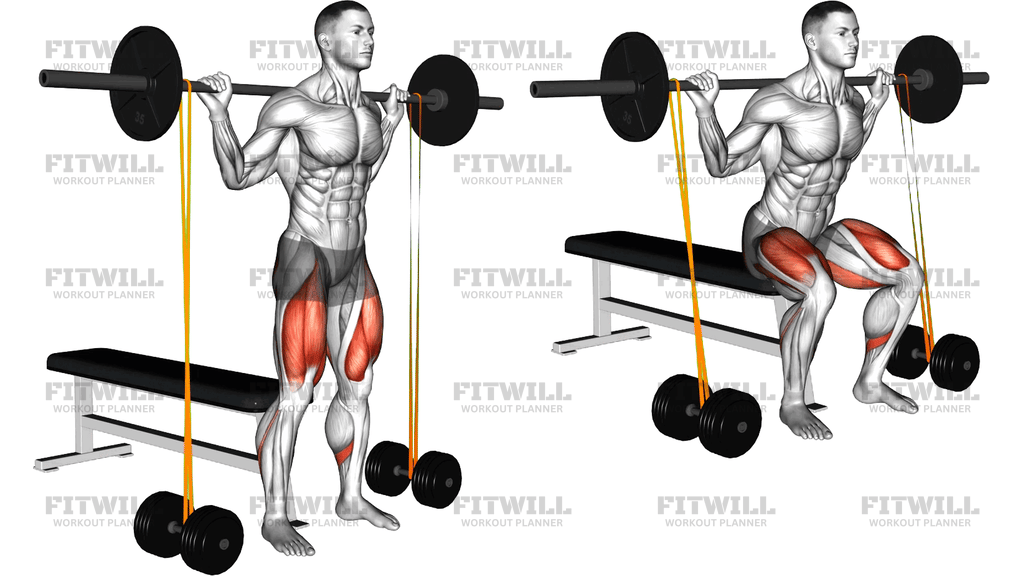
Barbell Banded Bench Squat is a band-resisted squat variation built around a clear depth target and a stronger lockout challenge. The bench behind you gives you a consistent place to stop, while the bands increase resistance as you stand up. That combination makes the exercise useful for teaching squat control, building leg drive, and keeping each rep honest when you want more tension through the top half of the movement.
The setup matters more here than in a basic bodyweight squat, because the barbell, bands, and bench all affect balance. The bar sits across the upper back, the feet stay planted in a stable squat stance, and the band tension should already be present before you descend. If the bands are slack or the bench is too far behind you, the rep loses its purpose and becomes much easier to cheat.
When the rep starts, you sit the hips back and down under control until the glutes make light contact with the bench. The touch point is a pause target, not a place to relax and unload. From there, drive the floor away, keep the knees tracking over the toes, and stand tall without leaning back or bouncing off the bench. The bands will try to speed up the top of the rep, so the finish should stay smooth and deliberate.
This movement is especially useful when you want squat volume with a clear depth standard, or when you want to overload the standing phase without loading the bottom too aggressively. It fits well in a leg day, a strength block, or accessory work after the main squat pattern. Because the band tension changes through the range, clean positioning matters more than using a heavy load.
Use lighter loading than a straight barbell squat and choose band tension that lets you keep your torso braced, your feet flat, and your depth consistent. If the bar shifts, the knees cave, or you have to collapse onto the bench, the setup is too aggressive. Clean reps should feel controlled on the way down and powerful, but still organized, on the way up.
[ Workout Log & Planner ]
Put your next workout in Fitwill
Keep your plan and training log ready when you are.


Instructions
- Place a flat bench behind you and set a barbell across your upper back, resting on the rear delts and upper traps rather than the neck.
- Loop the bands from the barbell sleeves down to secure low anchors, such as heavy dumbbells or another fixed point on the floor, so there is tension before you squat.
- Stand a little in front of the bench with your feet about shoulder-width apart, toes slightly turned out, and your weight spread through the whole foot.
- Take the bar out of the rack, step into your stance, and brace your ribs and abdomen before the first rep.
- Sit your hips back and down under control, keeping your chest proud and your knees tracking in line with your toes.
- Lower until your glutes lightly touch the bench without relaxing onto it or rocking backward.
- Drive through your midfoot and heels to stand, letting the bar rise in a steady path while the bands add tension near the top.
- Finish tall with the glutes tight, then reset your breath and control the next descent.
- Repeat for the planned reps and re-rack the bar with the same controlled setup.
Tips & Tricks
- Set the bench height so it gives you a consistent depth check, but not so high that the squat turns into a partial rep.
- Keep the bands under tension at the top and the bottom; if they go slack, step farther from the anchors or shorten the setup.
- Let the knees travel out in line with the toes instead of collapsing inward as the bands pull the bar upward.
- Touch the bench softly and stay tight through the torso so you do not bounce out of the bottom.
- Keep your eyes forward or slightly down so the chest does not flare and the lower back does not overextend.
- Use a lighter barbell load than you would for a straight squat because the band tension gets hardest near lockout.
- If the bar tips forward, check that it is centered on the upper back and that the feet are not too narrow.
- Exhale as you pass the sticking point on the way up, then reset your breath before the next descent.
Frequently Asked Questions
What does the bench do in Barbell Banded Bench Squat?
The bench gives you a depth target so every rep reaches the same squat depth without collapsing into the bottom.
What muscles does Barbell Banded Bench Squat train?
It mainly works the thighs and glutes, with the core and upper back helping you keep the bar steady.
Should I sit all the way down on the bench?
No. Lightly touch the bench and keep tension in your legs so you can drive back up without rocking or relaxing.
How do the bands change the exercise?
The bands make the top of the squat harder, so the lockout and standing phase demand more force than the bottom.
Where should the bar sit on my back?
Set it across the upper traps and rear delts, not on the neck, so the load stays balanced during the squat.
Is this a good beginner squat variation?
It can be, if the load is light and the band tension is manageable, but a standard squat should feel solid first.
What is the most common form mistake?
People usually crash into the bench, lose brace, or let the knees cave in as the bands get tighter.
Can I use a box instead of a flat bench?
Yes, if the box is stable and gives you the same touch point, but avoid anything that lets you sink or wobble.