Bodyweight Bent-Over Rear Delt Fly
Bodyweight Bent Over Rear Delt Fly is a no-equipment shoulder isolation exercise that uses a hip hinge and wide arm arcs to train the rear delts and the upper back. The movement is built around posture, control, and a steady hinge rather than speed or load, so it works well as a technical accessory in shoulder or upper-back sessions.
The bent-over position matters because it puts the torso in a stable angle where the arms can travel out to the sides without turning the rep into a row. With the chest angled toward the floor, the rear delts have to do most of the work while the mid-back and core keep the body from twisting or swinging. That makes the exercise useful for posture work, shoulder balance, and clean scapular control.
Because this is bodyweight-based, the challenge comes from precise positioning and tempo. A small bend in the elbows, a long neck, and a fixed hinge keep tension where it belongs. If the torso rises as the arms lift, or if the shoulders shrug toward the ears, the exercise shifts away from the rear delts and becomes more about momentum and trap dominance.
Use a range that lets you keep the arms moving in a smooth, controlled arc from the hanging start to the top of the fly. The top position should feel like a deliberate squeeze across the back of the shoulders, not a forced pinching of the shoulder blades. Lowering slowly is just as important as the lift, because the rear delts and upper back stay engaged through the eccentric phase.
This exercise is a good fit for beginners who need a simple rear-delt pattern, but it also works for experienced lifters who want a low-load drill before heavier pressing or pulling. It is especially useful when you want shoulder work without equipment, when your upper back needs extra volume, or when you want a strict accessory movement that reinforces good hinge posture and controlled arm path.
[ Workout Log & Planner ]
Put your next workout in Fitwill
Keep your plan and training log ready when you are.


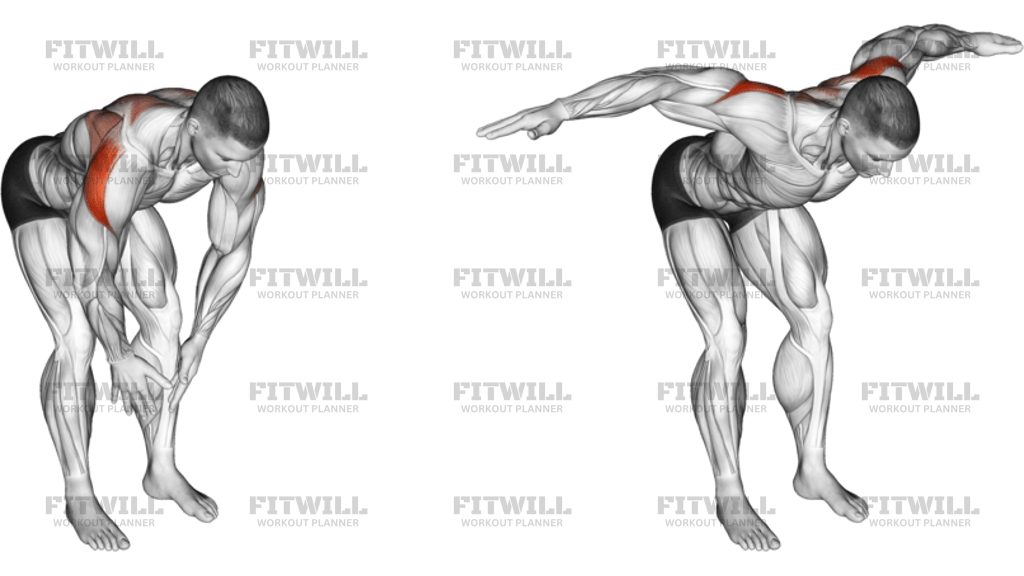
Instructions
- Stand with your feet about hip-width apart and hinge forward at the hips until your torso is nearly parallel to the floor, keeping a soft bend in your knees.
- Let your arms hang straight down from your shoulders with a slight bend in the elbows and your palms facing the floor or slightly inward.
- Set your ribs down, keep your neck long, and hold your torso angle still before you start the first repetition.
- Exhale and lift both arms out to the sides in a wide arc, leading with the elbows instead of the hands.
- Keep the motion smooth as the arms rise until your upper arms reach roughly shoulder height or as high as you can reach without shrugging.
- Pause briefly at the top and squeeze the rear delts and upper back without leaning back or pinching the shoulders hard together.
- Inhale as you lower the arms slowly back to the hanging start position, keeping the same torso angle and elbow bend.
- Repeat for the planned reps, resetting the hinge if your back angle, neck position, or arm path starts to drift.
Tips & Tricks
- Think of reaching out to the sides, not back, so the movement stays on the rear delts instead of turning into a row.
- Keep a small, fixed bend in the elbows; locking the arms straight usually shifts tension and makes the shoulders feel sloppy.
- If your upper traps take over, lower the arms a little less high and keep the neck relaxed instead of forcing the top position.
- Use a slow lowering phase of about two to four seconds to keep tension on the back of the shoulders.
- A slight turn of the thumbs upward can make the arc feel smoother for many people and reduce the urge to shrug.
- Stop the set when your torso starts to rise, because that usually means the hinge is collapsing and the rear delt work is fading.
- Keep pressure through the whole foot so you do not rock onto your toes when the arms lift.
- This movement should feel controlled and local to the rear shoulders; if it becomes a full-body swing, reduce the range and slow down.
Frequently Asked Questions
What muscles does the Bodyweight Bent Over Rear Delt Fly work?
It mainly targets the rear delts, with the mid-back, lower traps, and core helping hold the bent-over position steady.
Is this the same as a dumbbell rear delt fly?
The arm path is similar, but this version uses no external load, so the challenge comes from strict position, tempo, and control.
How far should I lift my arms at the top?
Lift until your upper arms are about level with your shoulders, or slightly below that if going higher makes you shrug.
Should I squeeze my shoulder blades together hard?
No. Let the rear delts and upper back work together, but keep the squeeze controlled instead of forcing a hard pinch.
Can beginners do the Bodyweight Bent Over Rear Delt Fly?
Yes. It is a good beginner rear-delt drill as long as the hinge stays fixed and the reps remain slow and controlled.
Why do I feel this in my traps more than my shoulders?
That usually means the arms are lifting too high, the neck is tensing, or the shoulders are shrugging instead of moving out and away.
What if my hamstrings are tight in the bent-over position?
Keep the torso a little more upright and maintain the same arm arc so you can hold the hinge without rounding your lower back.
How many reps should I use?
Higher-control sets usually work best here, often in the 10-20 rep range, because the exercise is about precision more than load.