Safety Bar Elevated Heel Squat
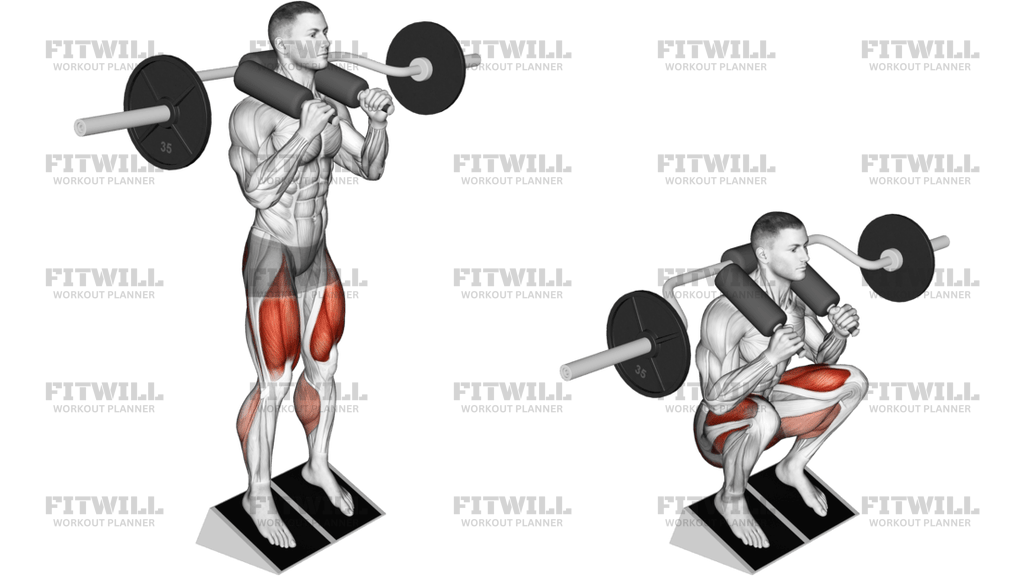
Safety Bar Elevated Heel Squat is a quad-biased squat variation that uses a safety bar and an elevated heel position to help you stay more upright through the rep. The raised heel changes the angle at the ankle and knee, which usually makes it easier to reach depth while keeping the torso tall and the weight centered over the middle of the foot.
This setup is useful when you want to train hard through the thighs without needing a long torso lean or a very aggressive hip hinge. The safety bar also gives you a more secure front-loaded feel through the shoulders and upper back, while the handles let you keep the chest organized instead of fighting for balance with the hands and wrists.
The heel elevation matters more than many lifters expect. With the heels supported on a wedge or plate ramp, the knees can travel forward more naturally, the ankles do less of the limiting work, and the quads stay loaded through a deeper range. That makes Safety Bar Elevated Heel Squat a strong option for lifters who want a more upright squat pattern, for anyone with limited ankle mobility, and for athletes who need a controlled lower-body strength builder without the demands of a front rack.
A clean rep starts before you bend the knees. Set the bar so it sits securely across the upper back and shoulders, place the feet so the heels stay planted on the elevated surface, and brace before descending. From there, the goal is to lower under control, keep the knees tracking in line with the toes, and drive back up without letting the torso collapse forward or the heels drift off the platform.
Use this exercise when you want a precise squat pattern that rewards position, depth control, and steady tension through the thighs. It is not an exercise for bouncing out of the bottom or chasing load at the expense of balance. The best sets look smooth and repeatable, with the bar staying centered, the knees moving cleanly, and the heels supported from the first rep to the last.
[ Workout Log & Planner ]
Put your next workout in Fitwill
Keep your plan and training log ready when you are.


Instructions
- Set the safety bar across your upper back and shoulders, and stand on a heel wedge or elevated plates with your feet about shoulder-width apart and toes slightly turned out.
- Hold the handles, lift your chest, and stand tall so the bar is centered over your midfoot before you unrack it.
- Take one controlled step back, then plant both feet firmly on the elevated surface with your weight spread across the whole foot.
- Brace your abdomen, pull your ribs down, and keep your elbows slightly forward as you start the descent.
- Sit down between your knees while letting the knees travel forward in line with your toes and the torso stay upright.
- Lower until your thighs reach parallel or the deepest position you can control without the heels lifting or the lower back rounding.
- Drive up through the midfoot and forefoot, keeping the knees tracking over the toes as the bar rises straight over the center of the foot.
- Stand tall to finish the rep, then walk the bar back into the rack before relaxing your grip.
Tips & Tricks
- Use a heel wedge height that lets your knees travel forward without your heels drifting toward the edge of the platform.
- Keep the safety bar pads high on the shoulders so the bar does not roll down onto the neck as you squat.
- A slightly narrower stance usually works better here than a wide powerlifting stance because the heel lift already gives the knees room to travel.
- If your torso folds forward, reduce the load and shorten the depth until you can keep the chest stacked over the hips.
- Let the knees move forward and out, but keep them tracking over the toes instead of collapsing inward at the bottom.
- Use a controlled lowering phase so the heel wedge supports the setup instead of turning the rep into a bounce.
- Keep pressure through the big toe, little toe, and heel of the elevated foot so the arch does not cave as you stand.
- If the handles pull you forward, reset your upper back tension before the next rep instead of forcing the rep with the arms.
- Pause for a moment at the bottom if you need to verify balance and position before driving up.
- Stop the set when the heels start lifting or the bar drifts off center, because both are signs the setup has broken down.
Frequently Asked Questions
What muscles does Safety Bar Elevated Heel Squat train most?
It mainly targets the quadriceps, with the glutes, adductors, and core helping to stabilize the squat.
Why are my heels elevated in Safety Bar Elevated Heel Squat?
The raised heel lets the knees travel forward more easily, which helps you stay upright and puts more emphasis on the thighs.
How should the safety bar sit on my body?
It should rest across the upper back and shoulders, not on the neck, with the handles in front so you can keep the chest tall.
How deep should I go in Safety Bar Elevated Heel Squat?
Go as deep as you can while keeping the heels supported, the knees tracking over the toes, and the lower back from rounding.
Is Safety Bar Elevated Heel Squat good for beginners?
Yes, if you start light and learn the heel-supported balance first. The fixed hand position and upright torso make it easier to learn than many barbell squat variations.
What is the biggest mistake in Safety Bar Elevated Heel Squat?
Letting the heels drift off the wedge or plates is a common problem, because it usually turns the squat into a forward-falling rep.
Can I use Safety Bar Elevated Heel Squat instead of a front squat or hack squat?
Yes. It can fill a similar quad-focused role, especially if you want a more upright squat without the wrist and shoulder demands of a front rack.
What should I do if I feel this more in my lower back than my thighs?
Reduce the load, keep the ribs stacked over the pelvis, and limit depth until you can stay upright through the whole rep.