Kettlebell Bottoms Up To Knee Turkish Get-Up
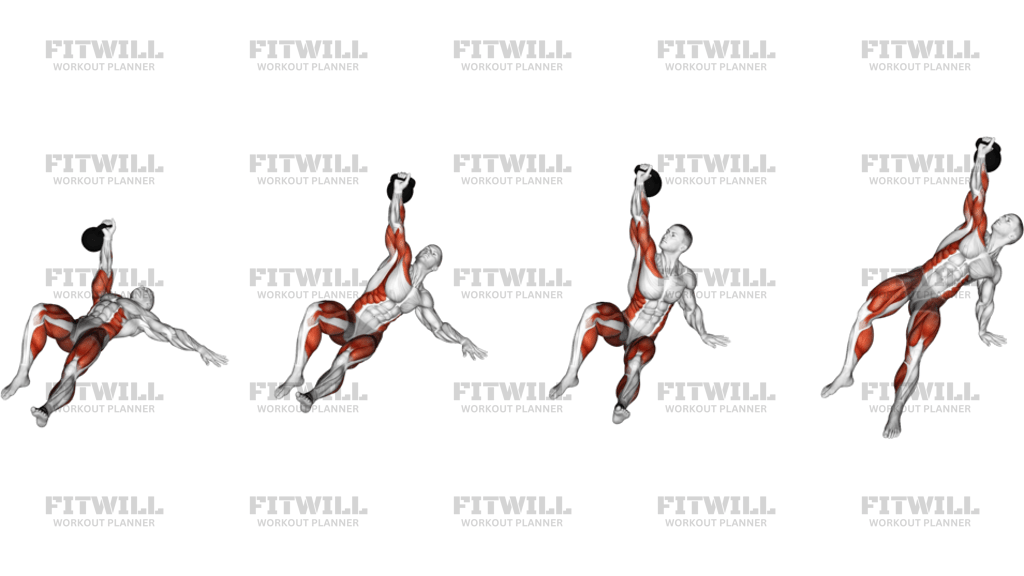
Kettlebell Bottoms Up To Knee Turkish Get-Up is a partial Turkish get-up performed with the kettlebell inverted, so the bell sits above the handle while the arm stays stacked overhead. That bottoms-up position makes the exercise much less forgiving than a regular get-up: the wrist has to stay neutral, the elbow must stay locked, and the shoulder has to keep the bell balanced while the body changes shape under it. The movement is usually trained with a light kettlebell because the limiting factor is control, not raw strength.
The exercise is best thought of as a stability and coordination drill rather than a power lift. It asks the shoulder, rotator cuff, upper back, obliques, and hips to work together while the body rolls, posts on the elbow and hand, and arrives in a half-kneeling or knee-tall position. The image sequence shows the repeated checkpoints that matter most: a stacked overhead arm, a steady torso, and a controlled transition from the floor to the knee without letting the bell tip or the torso twist out of line.
Setup matters because the bottoms-up hold magnifies every small mistake. Start on your back with the kettlebell locked out above the shoulder, the bell facing the ceiling, and the forearm vertical. Keep the eyes on the bell and move slowly enough that each support change is deliberate. If the kettlebell drifts in front of the shoulder, the wrist collapses, or the ribs flare, the repetition stops being a stability drill and becomes a compensation exercise.
Use this variation when you want a low-load way to train shoulder control, trunk stiffness, and clean floor-to-kneeling transitions. It fits well in a warm-up, accessory block, or core session, especially for lifters who need better overhead stability. The bottoms-up position also makes it easy to self-limit: if the bell starts wobbling or the wrist loses position, the load is too heavy or the pace is too fast.
The rep should finish with the torso tall, the working arm still vertical, and the body organized in the knee or half-kneeling position before you reverse the path. Keep the movement smooth and quiet, breathe through each transition, and choose a load that lets you keep the bell upright from the first floor position to the final kneeling position.
[ Workout Log & Planner ]
Put your next workout in Fitwill
Keep your plan and training log ready when you are.


Instructions
- Lie on your back with the kettlebell in one hand, the bell upside down, the wrist straight, and the arm locked out above the shoulder.
- Bend the same-side knee with the foot flat on the floor and keep the opposite leg long and slightly angled away from the body.
- Fix your eyes on the kettlebell and keep the knuckles pointed up so the bell stays stacked over the wrist.
- Roll onto the opposite elbow while keeping the kettlebell vertical and the shoulder packed down away from the ear.
- Press up onto the hand, then sit tall without letting the bell drift forward or toward your face.
- Drive through the planted foot, lift the hips, and sweep the straight leg back under control into a half-kneeling position.
- Finish with the torso upright, ribs stacked, and the kettlebell still held overhead in the bottoms-up position.
- Pause at the knee, then reverse the steps one at a time back to the floor with the same control.
Tips & Tricks
- Use a very light kettlebell; bottoms-up get-ups usually need far less load than a regular get-up.
- If the bell starts to tip, slow the transition and re-stack the wrist, elbow, and shoulder before moving again.
- Keep the free arm ready to help with balance during the roll and the hand-to-knee transition.
- Do not let the working rib cage flare as you sit up or kneel; keep the torso stacked under the bell.
- A short, controlled exhale helps stabilize the trunk when you roll to the elbow, press to the hand, and sweep the leg through.
- Plant the foot close enough that you can bridge and rotate without twisting the low back.
- Stop the set if the wrist bends back, the elbow softens, or the bell starts drifting away from vertical.
- Treat the half-kneeling position as a real finish, not a quick pass-through, so each rep ends under control.
Frequently Asked Questions
What does the bottoms-up position change in this get-up variation?
It makes the kettlebell much harder to control, so the wrist, shoulder, and trunk have to stay stacked the whole time.
Can beginners perform this exercise?
Yes, but only with a very light kettlebell and a slow pace. Many beginners should learn the regular get-up path first.
Where should the kettlebell sit during the rep?
The bell should stay upside down above the wrist with the forearm vertical and the arm locked out overhead.
What muscles work hardest here?
The shoulder stabilizers, rotator cuff, triceps, obliques, glutes, and deep core have to coordinate to keep the bell steady and the body organized.
Why does the exercise stop at the knee or half-kneeling position?
Stopping there lets you train the hardest control points without needing to stand all the way up, which keeps the movement safer and more technical.
What should I do if the kettlebell wobbles?
Lower the load, slow down, and make sure the wrist, elbow, and shoulder are stacked before you continue.
Is this more of a strength or mobility drill?
It is mainly a stability and coordination drill. It can improve overhead control and transition skill, but it should not be forced into a mobility test.
What is the biggest mistake to avoid?
Rushing through the floor transitions and letting the bell drift out of the vertical stack are the two most common problems.
Can I swap in a regular kettlebell if the bottoms-up version feels unstable?
Yes. A regular Turkish get-up or a bottoms-up press with less range can be a better regression until the overhead stack is solid.