Landmine Romanian Deadlift Version 2
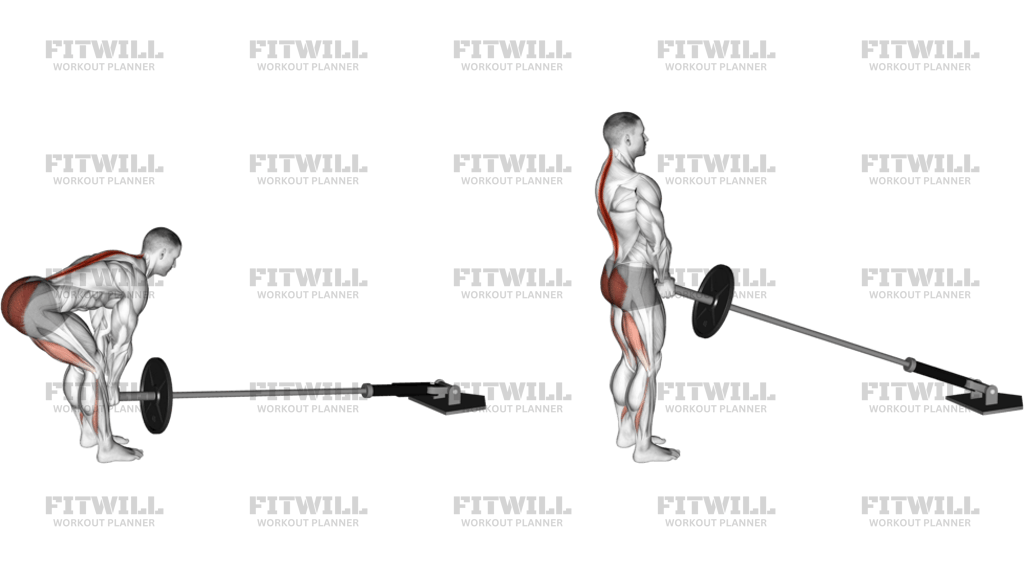
Landmine Romanian Deadlift Version 2 is a hip-hinge exercise performed with the free end of a barbell anchored in a landmine attachment. The setup creates a guided arc instead of a fully free bar path, which can make it easier to keep the load close to the body and maintain a clean hinge. In the image, the lifter stands over the loaded end, folds at the hips, and keeps the bar near the legs as the torso tips forward and then returns to standing.
This movement is most useful when you want to train the back side of the body without turning the rep into a squat. The main training feel should come from the hips and hamstrings, with the glutes and spinal erectors helping to finish the rep and keep the trunk organized. Because the load stays connected to the bar end, grip and upper-back tension also matter, especially when the weight gets heavy or the set gets long.
The setup is what makes this exercise work well. Feet should stay about hip-width apart, knees softly unlocked, and the bar should start close to the shins or just in front of the thighs depending on your anchor height. From there, the athlete keeps the ribs down, braces the trunk, and pushes the hips back instead of dropping the chest. That hinge pattern keeps the spine long and lets the hamstrings lengthen under load instead of forcing the lower back to do the work.
On the way down, the free end of the bar should stay close to the body and travel in a controlled arc. Lower only as far as you can keep pressure through the whole foot, the torso braced, and the spine neutral. The return should be driven by hip extension rather than a yank from the shoulders or a lean-back at the top. A solid rep finishes tall, with the hips fully extended and the glutes working, but without overextending the lower back.
This exercise fits well in strength blocks, accessory work, hinge-pattern warmups, and lower-body sessions where you want a stable loading option that is still demanding. It is also a practical choice for lifters who want a more controlled hinge than a conventional barbell Romanian deadlift. The big payoff comes from repeatable reps: a consistent setup, a controlled eccentric, and a clean hip drive on every rep.
[ Workout Log & Planner ]
Put your next workout in Fitwill
Keep your plan and training log ready when you are.


Instructions
- Anchor the landmine securely and load the free end of the barbell. Stand facing the loaded end with feet about hip-width apart and the bar close to your shins or just in front of your thighs.
- Grip the bar with both hands, keep your arms straight, and set your shoulders down so the upper back stays packed instead of rounded forward.
- Unlock your knees slightly, brace your trunk, and keep your ribs stacked over your pelvis before you start the hinge.
- Push your hips straight back while letting the torso tip forward. Keep the bar close to your legs as you descend.
- Lower until you feel a strong stretch in the hamstrings and can still hold a neutral spine. Do not chase extra depth if the low back starts to round.
- Drive through the whole foot and extend the hips to stand back up. Let the bar travel in the same close path on the way up.
- Finish tall with the glutes tight and the ribs still down. Avoid leaning back or shrugging the shoulders at lockout.
- Reset by hinging back under control for the next rep, then repeat with steady breathing and the same bar path each time.
Tips & Tricks
- Keep most of your pressure through the midfoot and heel so the movement stays like a hinge instead of tipping onto the toes.
- If the bar drifts away from the body, the hinge usually turns into a back-dominant pull. Let the sleeve skim close to the thighs and shins.
- Maintain a small knee bend from start to finish. Let the hips move, but do not turn the rep into a squat.
- Stop the descent when the hamstrings are loaded and the spine is still organized. Depth is only useful if position stays clean.
- Think about pulling the hips back before you think about lowering the chest. That cue usually keeps the lower back from taking over.
- Do not over-squeeze the bar with the arms. The hands should hold the load, but the hips should do the work.
- Exhale as you stand and keep the ribs from flaring at the top. A clean lockout is tall, not arched back.
- If grip fails before the posterior chain does, use straps so the set still trains the hinge instead of just the forearms.
Frequently Asked Questions
What does Landmine Romanian Deadlift Version 2 train most?
It mainly trains the hips and hamstrings, with the glutes and spinal erectors helping to finish each rep. Your upper back and grip also work to keep the bar path controlled.
How is this different from a regular barbell Romanian deadlift?
The landmine fixes one end of the bar, so the free end moves in a guided arc. That usually makes the exercise feel more stable and keeps the load easier to manage close to the body.
Where should I feel the stretch during the rep?
You should feel the stretch mainly through the back of the thighs and the hinge line at the hips. If the low back is taking over, shorten the range and reset your brace.
Should my knees bend a lot during this exercise?
No. Keep a soft knee bend and hold that angle while the hips move back and forward. Too much knee bend turns it into a squat pattern.
Can beginners use the landmine version?
Yes. It is often a good hinge variation for beginners because the bar path is more controlled, as long as the load is light enough to keep the spine neutral.
How low should I go on the way down?
Go only as low as you can while keeping the bar close, the ribs stacked, and the back flat. Stop when the hamstrings are fully loaded before the pelvis tucks under.
What is the most common mistake with this movement?
Rounding the back and chasing depth is the biggest problem. The rep should stay like a hip hinge with the torso controlled, not a reach toward the floor.
Can I use straps or lifting hooks?
Yes, if your grip gives out before the hips do. That lets you keep the set focused on the hinge instead of cutting it short for the forearms.