Standing Back Rotation Stretch
Standing Back Rotation Stretch is a standing trunk mobility drill that opens the upper back while keeping the hips, feet, and legs mostly grounded. With the arms folded across the chest, you rotate the ribcage away from the pelvis to create a controlled stretch through the thoracic spine, obliques, and the muscles around the shoulder girdle. It is less about making a big dramatic twist and more about finding a smooth, repeatable rotation that you can breathe into.
The setup matters because the movement is only useful when the lower body stays organized. A steady stance, soft knees, and a tall spine let the torso rotate without collapsing into the low back or rolling the shoulders forward. The image shows the chest held high with the elbows drawn in, which helps keep the arms quiet while the mid-back does the work. That makes this a practical choice when you want to improve rotational comfort, posture awareness, or warm the trunk before more demanding training.
Perform each rep by turning the chest first, then letting the shoulders follow as a unit. The pelvis should stay mostly square to the front so the twist comes from the ribs and upper spine instead of a whipping motion through the hips. Move only as far as you can keep the stretch clean, then pause briefly and breathe out to soften the tight spots. If the low back pinches, reduce the range and keep the rotation higher through the ribcage.
This exercise fits well in a warm-up, recovery session, or mobility block for people who sit a lot, lift heavily, or need cleaner thoracic rotation for pressing, pulling, squatting, and overhead work. It can also be used between heavier exercises as a reset when the trunk starts to feel stiff. The goal is a controlled stretch, not speed or force.
Done well, Standing Back Rotation Stretch should feel smooth through the sides of the torso and the back of the ribs, with the neck relaxed and the breathing steady. Use it to create better rotation tolerance, then carry that taller, looser torso into the rest of the workout.
[ Workout Log & Planner ]
Put your next workout in Fitwill
Keep your plan and training log ready when you are.


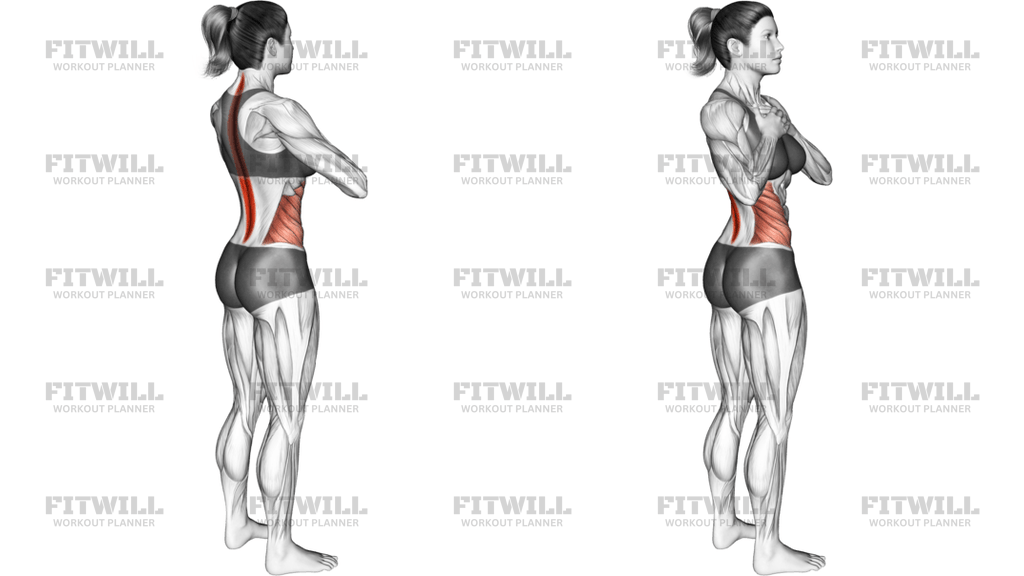
Instructions
- Stand tall with your feet about hip-width apart and your knees softly unlocked.
- Fold your arms across your chest so your elbows stay tucked close to your ribs.
- Brace lightly through your midsection and keep your chin level instead of reaching your head forward.
- Rotate your ribcage slowly to one side while keeping both feet planted and your hips mostly square.
- Turn until you feel a controlled stretch through the upper back and side body, not a sharp pull in the low back.
- Pause for a breath or two at the end range and keep the shoulders relaxed instead of shrugging up.
- Return to center under control, letting the chest unwind before the hips move.
- Repeat to the other side and keep both sides smooth and even.
- Use slow, deliberate reps and stop the set if you lose control of the pelvis or start bouncing.
Tips & Tricks
- Think about rotating the ribcage over a still pelvis; if your hips spin with you, the stretch becomes much less targeted.
- Keep the elbows hugged in so the shoulders do not drift forward and cheat the twist.
- A small knee bend helps you stay balanced and prevents the stretch from turning into a stiff standing reach.
- Exhale into the end range; a long breath out often lets the upper back soften without forcing the motion.
- If the low back feels like the main limiter, shorten the range and make the turn higher through the ribs.
- Do not throw the arms open to gain extra rotation; that usually reduces the quality of the thoracic stretch.
- Move slowly enough that you can feel the tight side of the torso lengthen instead of just “snapping” from side to side.
- Use this as a reset between heavy pressing or pulling sets when your torso feels locked up.
- A mild stretch sensation is the goal; any pinching in the spine means the twist is too aggressive.
Frequently Asked Questions
What does Standing Back Rotation Stretch target most?
It mainly targets the thoracic spine and the muscles around the ribs, with support from the obliques, lats, shoulders, and upper back.
Should my hips rotate during the stretch?
Only slightly. The pelvis should stay mostly forward so the rotation comes from the ribcage and upper back.
Why are my elbows crossed over my chest?
That position keeps the arms quiet and makes it easier to rotate the torso without overusing the shoulders.
Can I do this if my low back is tight?
Yes, but keep the range smaller and make the motion higher through the ribs. If you feel pinching in the lumbar spine, stop and reduce the twist.
Is this more of a warm-up or a strength exercise?
It is primarily a mobility and stretching drill, so it works best in a warm-up, recovery block, or between lifting sets.
What is the biggest form mistake?
The most common mistake is letting the hips and feet swing with the turn, which shifts the stretch away from the upper back.
How long should I hold each side?
A short pause of one to three calm breaths is usually enough before returning to center.
Can beginners do Standing Back Rotation Stretch?
Yes. It is beginner-friendly as long as the person keeps the motion slow, the knees soft, and the twist pain-free.