Barbell Knee Raise Step-Up
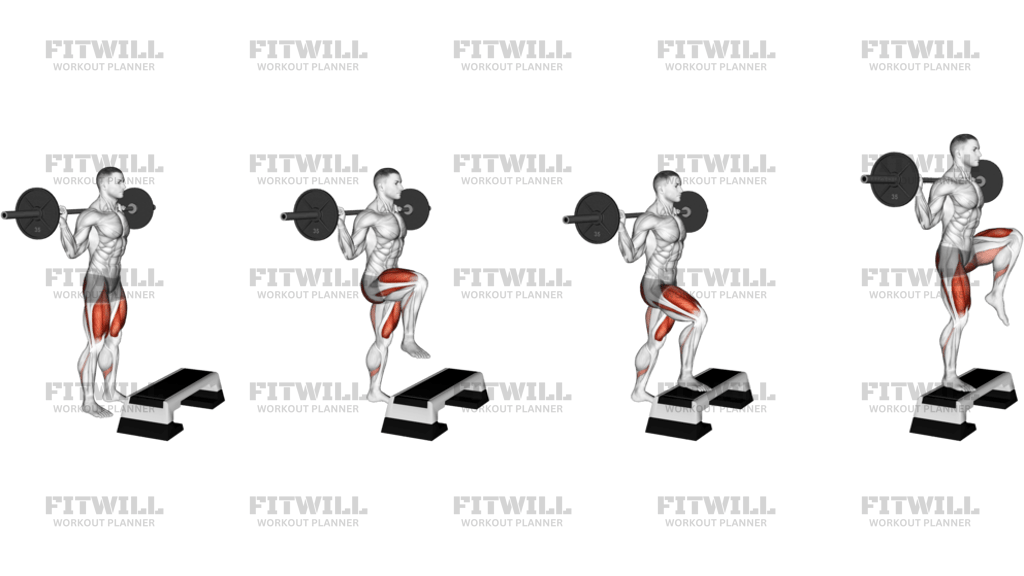
Barbell Knee Raise Step-Up is a loaded unilateral lower-body exercise built around a step-up and a strong knee drive. One foot stays on the box or platform while the other leg drives up into a high knee position, so the working side has to produce force through the foot, hip, and trunk at the same time.
This movement is useful when you want more than a plain step-up. The front leg does most of the work through the quadriceps and glute, while the raised knee adds a hip-flexion demand and makes the torso work harder to stay tall and balanced. The barbell also increases the need for upper-back positioning and midline control.
Setup matters a lot here. The bar should sit securely across the upper traps, not on the neck, and the step height should let you stand up without collapsing the pelvis or bouncing off the back leg. A box that is too high turns the rep into a hip hike and momentum drill instead of a clean leg drive.
Each rep should look smooth: plant the whole foot on the step, press through the midfoot and heel, stand tall, then lift the free knee until the thigh is clearly up in front of you. Lower under control and reset without rushing. If you alternate sides, keep the same box position and body angle on both legs so one side does not get an easier pattern than the other.
Use this exercise for lower-body strength, single-leg control, and knee-drive mechanics in accessory work or athletic training. It can be beginner-friendly with a light barbell or even just a bodyweight rehearsal first, but only if balance and step height are appropriate. Stop the set if the torso starts leaning hard, the standing knee caves inward, or the step-down becomes a drop instead of a controlled lowering.
Fitwill
Log Workouts, Track Progress & Build Strength.
Achieve more with Fitwill: explore over 9600 exercises with images and videos, access built-in and custom workouts, perfect for both gym and home sessions, and see real results.
Start your journey. Download today!




Instructions
- Set a stable box or step in front of you and load the barbell across your upper traps as you would for a back squat.
- Stand with one foot fully planted on the step and the other foot on the floor, chest tall and ribs stacked over the pelvis.
- Brace your trunk before you move so the bar stays level and your torso does not tip toward the stepping leg.
- Press through the whole foot on the step to stand up until the working leg is straight and the hips are fully extended.
- Drive the free knee up in front of you to a high marching position without shrugging the shoulders or leaning back.
- Pause briefly at the top to show control, then lower the raised leg back toward the floor under tension.
- Keep the standing knee tracking over the toes as you step down and reset to the starting position.
- Repeat all reps on one side before switching, or alternate legs if that is how your program is written.
Tips & Tricks
- Choose a step height that lets you stand up without pushing off the floor leg or twisting your hips.
- Keep the bar resting on the upper traps with the elbows slightly down, not jammed into the neck.
- Use the planted foot as a tripod so the heel, big toe, and little toe stay connected to the platform.
- Think about driving the floor away rather than swinging the back leg to start the rep.
- Bring the knee up in front of the hip, not out to the side, so the torso stays square.
- Lower slowly enough that you can feel the front leg absorb the descent instead of dropping off the box.
- Exhale as you stand and inhale before the next repetition while you reset your brace.
- If your balance wobbles, reduce load or height before adding more weight.
Frequently Asked Questions
What does Barbell Knee Raise Step-Up train most?
It mainly trains the quads and glutes of the stepping leg, with the hip flexors and core working hard during the knee drive.
Should the bar sit like a squat bar or a front-rack hold?
This version uses a back-squat style bar position across the upper traps so you can keep both hands fixed and focus on the step-up.
How high should the step be?
Use a height that lets you press up smoothly without hip hiking, leaning forward, or pushing off the floor leg.
What is the biggest form mistake on the knee raise?
The most common error is swinging the free leg for momentum instead of standing tall first and then lifting the knee.
Do I alternate legs or finish one side first?
Either works if your program is clear, but finishing one side first usually makes it easier to keep the reps clean and balanced.
Is this exercise okay for beginners?
Yes, if the step is low and the bar is light enough to keep balance, posture, and the step-down controlled.
What should I feel at the top of the rep?
You should feel the stepping leg fully extended and the raised thigh driven up in front of you while the torso stays upright.
Can I use dumbbells instead of a barbell?
Yes, dumbbells or a lighter bodyweight version are good substitutions if the barbell position limits your balance or shoulder comfort.