PVC Overhead Squat
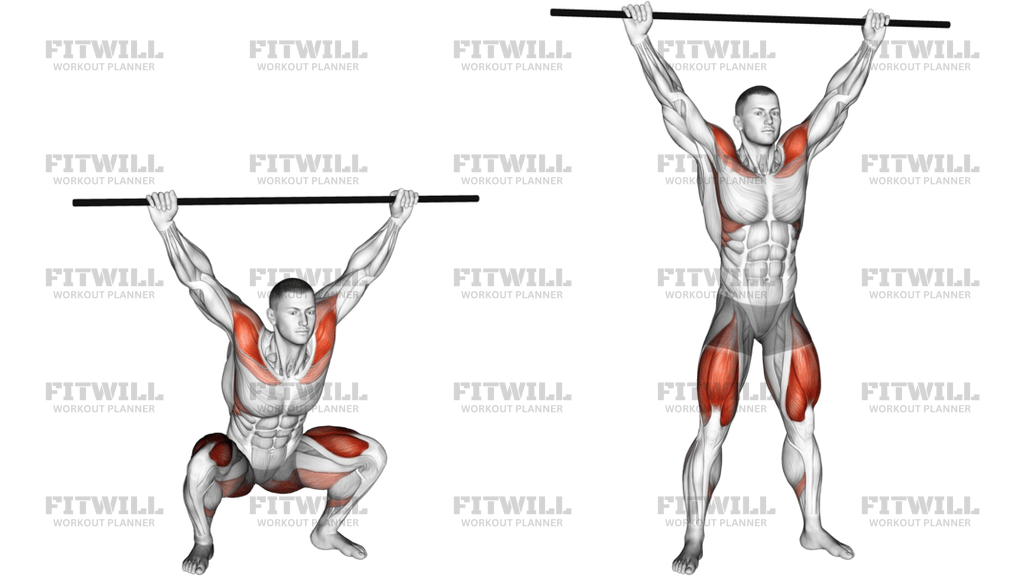
PVC Overhead Squat is a bodyweight squat pattern performed with a PVC pipe held overhead to teach shoulder mobility, thoracic extension, and lower-body control at the same time. The image shows the lifter starting and finishing with straight arms, the pipe stacked over the shoulders, hips, and midfoot while the body stays tall through the squat.
This variation is less about loading the legs and more about exposing mobility and balance limits. It asks the ankles, hips, upper back, and shoulders to work together while the trunk stays braced and the pipe remains fixed in the overhead position. The main training value comes from clean positions: heels rooted, knees tracking over the toes, chest lifted, and the bar path staying over the center of the feet.
A good rep begins before the descent. Grip the PVC slightly wider than shoulder width, lock the elbows, and rotate the shoulders so the pipe sits just behind the ears. From there, take a controlled breath, brace the torso, and sit the hips down between the heels without letting the arms drift forward. If the torso collapses or the pipe tips, the squat is too deep for the current mobility or stance.
At the bottom, keep the feet flat and the knees open enough to match the line of the toes. Drive up by pushing the floor away, keeping the chest proud and the pipe directly overhead until you stand tall again. The rep should look smooth rather than forced, with no bouncing, no lean, and no need to rescue the overhead position on the way out of the hole.
PVC Overhead Squat works well as a warm-up drill, movement screen, or technique builder before barbell squats, overhead lifts, or snatch work. It is also useful when you want to train squat depth and shoulder positioning without external load. Because the pipe is light, the quality standard should be high: every rep should look identical, and any breakdown in balance, arm position, or heel contact is a sign to shorten the range or reset the stance.
Fitwill
Log Workouts, Track Progress & Build Strength.
Achieve more with Fitwill: explore over 9600 exercises with images and videos, access built-in and custom workouts, perfect for both gym and home sessions, and see real results.
Start your journey. Download today!




Instructions
- Stand with feet about shoulder width apart and hold a PVC pipe overhead with a slightly wider-than-shoulder-width grip.
- Lock your elbows, spread the hands against the pipe, and keep the bar stacked over your shoulders and midfoot.
- Set your ribs down, brace your core, and take a steady breath before you descend.
- Sit the hips straight down between your heels while keeping the pipe fixed overhead.
- Let the knees travel in line with the toes and keep both heels planted as you lower.
- Descend only as far as you can maintain an upright torso, open chest, and stable overhead position.
- Pause briefly in the bottom without relaxing the brace or letting the pipe drift forward.
- Drive through the whole foot to stand up, returning to full hip and knee extension with the pipe still overhead.
- Reset your breath and posture before the next rep if balance or shoulder position changes.
Tips & Tricks
- Use a grip wide enough that you can keep the pipe behind your ears without bending the elbows.
- If the torso pitches forward, shorten the depth before adding more ankle or hip demand.
- Keep the wrists neutral and press up on the pipe as if you are trying to separate it apart.
- A slight outward knee track usually helps the hips stay open and the chest stay tall.
- Make the descent slow enough to notice when the heels want to lift or the arms want to drift forward.
- If your shoulders fatigue before your legs do, treat the set as a mobility drill, not a strength set.
- Breathe in before each rep and avoid dumping the breath at the bottom, where position is hardest to hold.
- Barefoot or in flat shoes can make balance feedback easier if ankle mobility is the limiting factor.
- Stop the set when the pipe is no longer stacked over the midfoot, even if the legs still feel fresh.
Frequently Asked Questions
What does the PVC Overhead Squat train?
It trains squat mechanics, overhead stability, shoulder mobility, thoracic extension, and lower-body control together.
Why use a PVC pipe instead of a barbell?
The light pipe lets you focus on position and range of motion without the fatigue or loading demands of a barbell.
How wide should my hands be on the pipe?
Use a grip slightly wider than shoulder width, then adjust until you can keep the pipe stacked overhead without bent elbows.
Where should the pipe stay during the squat?
It should stay over your shoulders, hips, and midfoot, not drift forward in front of your body.
What is the most common mistake?
The biggest mistake is losing the overhead stack and leaning forward as you descend into the squat.
Can beginners use this exercise?
Yes. Beginners often use it as a mobility and technique drill before moving to a loaded overhead squat.
Should my heels stay down?
Yes. If the heels rise, reduce depth or narrow the stance slightly until the feet stay planted.
How do I make the movement easier?
Use a wider grip, squat to a higher depth, and focus on keeping the chest up and the pipe directly overhead.