Resistance Band Hammer Curl
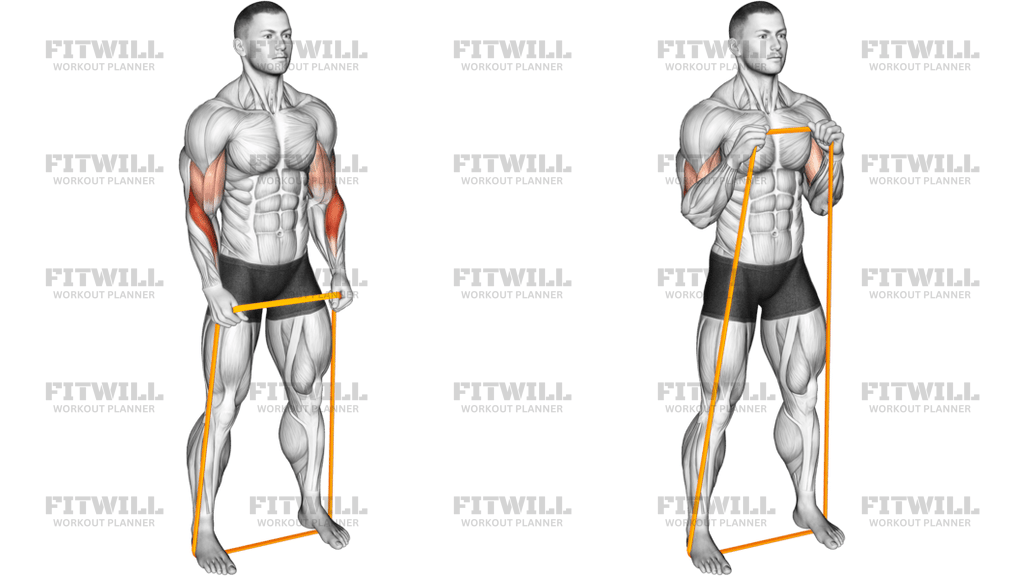
Resistance Band Hammer Curl is a standing arm exercise performed with the band anchored under both feet and the hands held in a neutral, hammer-style grip. The movement trains elbow flexion against continuous band tension, which makes it useful for building the brachioradialis, biceps, and forearm muscles without needing a bench or machine.
The setup matters because the band only works well when the stance is stable and the handles or band ends start evenly tensioned. Stand tall on the middle of the band, keep your feet about hip-width apart, and let your arms hang beside your thighs with your palms facing in. That neutral grip is what makes this a hammer curl instead of a standard supinated curl, and it also keeps the wrists from bending back as you lift.
Each repetition should be driven by the elbows, not by the shoulders or lower back. Curl the hands forward and up toward the front of the shoulders while keeping the upper arms close to the ribs. At the top, the forearms should be nearly vertical and the wrists should stay stacked over the elbows. Lower the band slowly until the arms are almost straight again so the tension stays on the working muscles instead of disappearing at the bottom.
This exercise fits well in arm-focused sessions, upper-body accessories, or warmups where you want a simple standing curl with predictable resistance. It is also a good option when you want more forearm emphasis than a traditional curl provides. The biggest form keys are staying tall, resisting the urge to swing the torso, and choosing a band that lets you keep clean wrist and elbow positions for the full set.
Use lighter band tension when the goal is groove, control, or higher reps, and use firmer tension only if you can keep the shoulders quiet and the descent controlled. Done well, the hammer curl should feel smooth and local to the front of the upper arms and forearms, not jerky through the lower back or neck.
[ Workout Log & Planner ]
Put your next workout in Fitwill
Keep your plan and training log ready when you are.


Instructions
- Stand on the middle of the resistance band with both feet about hip-width apart and hold one end of the band in each hand.
- Let your arms hang beside your thighs with your palms facing in, wrists straight, and shoulders relaxed.
- Set your chest tall, ribs down, and elbows close to your sides before you start the curl.
- Exhale and curl both hands upward by bending the elbows, keeping the palms facing each other the whole time.
- Raise the hands toward the front of your shoulders without letting the elbows drift forward or the torso lean back.
- Squeeze briefly at the top when the forearms are nearly vertical and the wrists stay stacked over the elbows.
- Inhale and lower the band slowly until the arms are almost straight and the band is still under light tension.
- Repeat for the planned number of repetitions, then step off the band carefully to release tension.
Tips & Tricks
- Keep the palms facing in from the first rep to the last; if the wrists rotate forward, the curl turns into a different variation.
- If the band is too easy at the bottom, shorten the band under your feet or stand wider rather than swinging the torso.
- Think about lifting the knuckles toward the shoulders, not throwing the elbows forward to chase a higher finish.
- A slower lowering phase will usually light up the forearms more than a fast drop or a partial bounce at the bottom.
- Keep the shoulders quiet; shrugging usually means the band is too heavy or the curl is starting from a poor stance.
- Use a band tension that lets you keep the wrists straight, because bent wrists shift work away from the forearms and irritate the joints.
- Stop just short of the point where the band loses tension completely so the set stays smooth and controlled.
- If one side rises faster, reset your foot placement so both ends of the band start with the same tension.
Frequently Asked Questions
What muscle does Resistance Band Hammer Curl target most?
It mainly targets the brachioradialis and forearms, with the biceps helping during the curl.
Can beginners perform this exercise?
Yes. It is beginner-friendly if you choose a light band and keep the elbows and wrists under control.
How do I set up the band correctly?
Stand in the middle of the band with both feet, then hold the ends at your sides with your palms facing in and your arms straight.
What should my wrists do during the curl?
Keep them neutral and stacked over the forearms. Bending the wrists back shifts tension away from the target muscles.
Why keep the palms facing each other?
That neutral grip is what makes it a hammer curl and it keeps the forearms and brachioradialis working hard.
What is the most common mistake?
Swinging the torso or letting the elbows drift far forward is the most common way to turn the rep into a body swing.
How heavy should the band be?
Use enough tension to challenge the top half of the curl, but not so much that you lose wrist position or start leaning back.
Can I use this as an accessory exercise?
Yes. It works well after bigger pulling or upper-body lifts when you want focused arm and forearm work.