Weighted Seated Neutral Wrist Curl
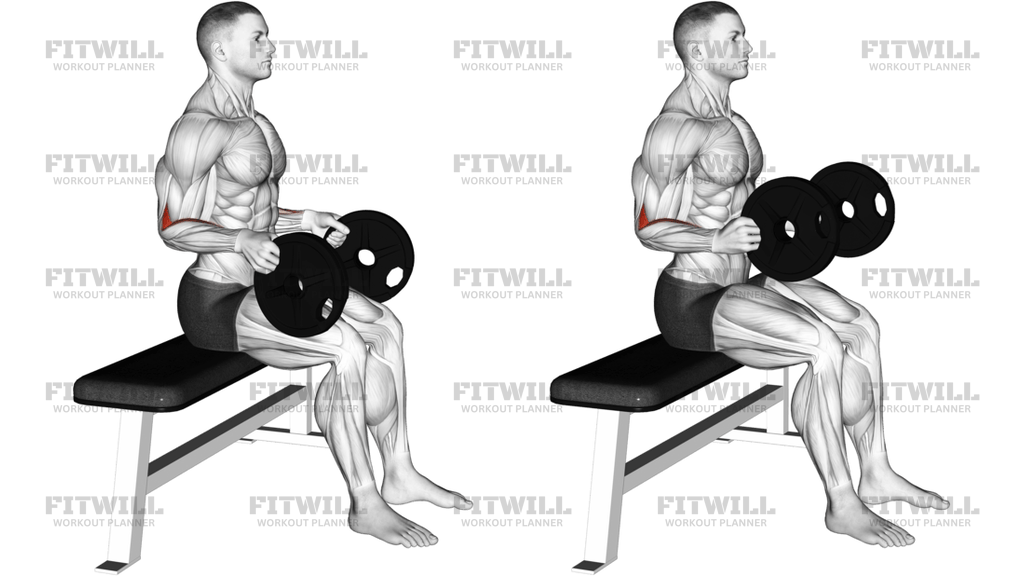
Weighted Seated Neutral Wrist Curl is a seated forearm isolation exercise built around a very small but very precise range of motion. With your forearms supported on your thighs and your hands held in a neutral, thumbs-up position, the movement asks the wrist flexors and surrounding forearm muscles to do the work without turning the set into a biceps curl or a shoulder-driven swing. That makes it useful for anyone who wants stronger grip endurance, more resilient wrists, or a simple accessory movement that does not demand a lot of overall fatigue.
The setup matters because the bench and thigh support are what keep the exercise honest. When you sit tall on a flat bench and let the wrists hang just beyond the knees, the forearms become a fixed platform and the hands can move cleanly through wrist flexion. If the elbows slide, the torso rocks, or the dumbbells drift too far away from the knees, the movement stops feeling like a wrist curl and starts becoming a body-English lift.
Use a controlled neutral grip and think about curling the hands upward rather than lifting the whole arm. The top of the rep should be a short, clear squeeze where the knuckles travel toward the forearms, followed by a slow return to neutral. The range is intentionally small, so quality matters more than amplitude; the set should feel local to the forearms, with the shoulders staying quiet and the wrists tracking in line instead of bending side to side.
Weighted Seated Neutral Wrist Curl fits well after pulling work, on arm days, or anywhere direct forearm training makes sense. It is also beginner-friendly because the bench gives immediate feedback on setup, but the exercise can still bother the wrists if the load is too heavy or the lowering phase is rushed. Keep the reps smooth, use a weight that lets you maintain the same wrist path from the first rep to the last, and stop the set if the hands begin to lose their neutral line.
For progression, small jumps in load, longer pauses at the top, or a slower lowering phase usually work better than trying to force a bigger range. The goal is steady tension through the forearms, not a dramatic movement. Done well, Weighted Seated Neutral Wrist Curl builds useful support strength for lifting, carrying, hanging, and any activity that asks the wrists to stay controlled under load.
Fitwill
Log Workouts, Track Progress & Build Strength.
Achieve more with Fitwill: explore over 9600 exercises with images and videos, access built-in and custom workouts, perfect for both gym and home sessions, and see real results.
Start your journey. Download today!




Instructions
- Sit on a flat bench with both feet flat on the floor and your knees bent, then hold a dumbbell in each hand with a neutral, palms-facing-in grip.
- Rest your forearms across the tops of your thighs and let your wrists hang just past your knees so the hands can move freely.
- Pin your elbows into the inner thighs, lift your chest, and keep your shoulders relaxed instead of reaching forward.
- Start with the dumbbells hanging in a neutral wrist position and keep your grip firm without squeezing so hard that the forearms tense up early.
- Curl the weights upward by flexing only the wrists, bringing the knuckles toward the forearms while the forearms stay glued to the thighs.
- Squeeze briefly at the top of the curl without letting the elbows slide or the shoulders help finish the rep.
- Lower the dumbbells slowly until the wrists return to neutral, keeping the motion smooth and controlled on the way down.
- Breathe out as you curl up and breathe in as you lower, then reset the wrists before starting the next rep.
- When the set is finished, bring the dumbbells back to your thighs and stand up without jerking the weights.
Tips & Tricks
- Keep the wrists just beyond the knees so the dumbbells can move without rubbing the thighs on every rep.
- If your elbows slide apart, squeeze them back into the inner thighs before starting the next rep.
- Use a weight that lets you pause cleanly at the top; this exercise should never need a hip swing or shoulder shrug to finish.
- A slow lowering phase usually does more for forearm development than trying to heave the dumbbells higher.
- Keep the hands stacked in a neutral line; if they start rolling inward or outward, reset the grip.
- Let the motion stay local to the wrists so the biceps and front delts do not take over the set.
- If the dumbbells feel awkward, a lighter pair usually works better than forcing a larger handle size or heavier load.
- Stop a rep short of any sharp wrist pinch and shorten the range slightly if the end position feels jammed.
Frequently Asked Questions
What muscles does Weighted Seated Neutral Wrist Curl work?
It mainly targets the forearm flexors and the smaller muscles that help the wrist stay steady in a neutral grip.
How do I set up the dumbbells for Weighted Seated Neutral Wrist Curl?
Sit on a flat bench, rest your forearms on your thighs, and let the dumbbells hang just past your knees with the palms facing each other.
Should my forearms stay on my thighs the whole time?
Yes. Keeping the forearms anchored on the thighs is what isolates the wrists and keeps the set from turning into a cheat curl.
How heavy should Weighted Seated Neutral Wrist Curl be?
Light to moderate loads work best. If you cannot pause at the top without the elbows shifting, the weight is too heavy.
Is a neutral grip better than a palm-up wrist curl?
Neutral grip is often a little easier on the wrists and lets you train the forearm flexors without forcing a fully supinated hand position.
Can beginners do Weighted Seated Neutral Wrist Curl?
Yes. It is beginner-friendly as long as the bench support is solid and the load stays light enough to keep the wrists aligned.
Why do my shoulders feel involved during this exercise?
That usually means the elbows are drifting forward or the weight is too heavy. Reset the forearms on the thighs and keep the shoulders quiet.
Can I do this one arm at a time?
Yes. One-arm reps can make it easier to keep the wrist path clean and can help if one side is weaker or less coordinated.