Hip Clam Shell
Hip Clam Shell is a side-lying hip isolation exercise that trains the glute medius, glute minimus, and deep external rotators to open the top knee without letting the pelvis roll backward. It is usually done on the floor with the hips stacked, knees bent, and the feet kept together so the motion comes from the hip rather than from the low back or torso. Because the range is small, the quality of the setup matters more than the size of the lift.
This movement is useful when you want better hip stability for squats, lunges, running, single-leg work, or general pelvic control. The working side should feel like it is rotating open from the hip socket while the trunk stays quiet. If the waist lifts, the shoulders twist, or the lower knee separates far from the top knee, the set has turned into compensation instead of hip abduction and external rotation.
Start by lying on one side with the head supported, knees bent comfortably, and the hips stacked. Keep the heels touching and the feet relaxed, then brace lightly through the abdomen so the torso does not sway as the knee opens. The top leg should travel only as far as you can keep the pelvis still. A clean rep looks small, deliberate, and controlled, not forced.
At the top of each rep, pause briefly and feel the outside of the hip doing the work before lowering under control. Breathe steadily, avoid holding tension in the neck, and keep the movement smooth enough that you could repeat it for multiple reps without losing position. If you need extra challenge, add a light mini-band or slow the lowering phase, but only after you can keep the side-lying shape clean.
Hip Clam Shell is commonly used in warm-ups, activation blocks, rehab-style accessory work, and lower-body programs that need better glute firing and hip control. It is beginner-friendly because the load is low and the motion is easy to learn, but it still rewards careful form. The best version of the exercise is the one that keeps the pelvis stacked, the feet together, and the working hip in charge of the movement.
Fitwill
Log Workouts, Track Progress & Build Strength.
Achieve more with Fitwill: explore over 9600 exercises with images and videos, access built-in and custom workouts, perfect for both gym and home sessions, and see real results.
Start your journey. Download today!




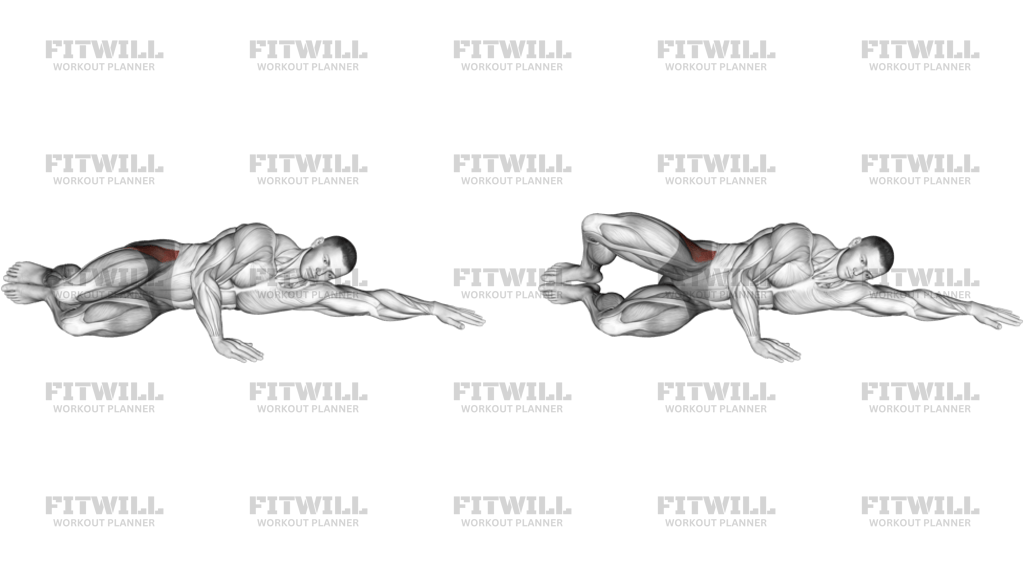
Instructions
- Lie on your side on the floor or mat with your hips and shoulders stacked, knees bent about 90 degrees, and your heels together.
- Rest your head on your bottom arm or hand and keep your top hand on the floor in front of your chest for balance.
- Lightly brace your abdomen so your torso stays still and your lower back does not arch.
- Keep both feet touching and lift the top knee upward by rotating from the hip, not by rolling your pelvis back.
- Open the knee only as far as you can keep the hips stacked and the feet together.
- Pause for a moment at the top and feel the outside of the working hip contract.
- Lower the top knee slowly until the knees meet again, keeping tension in the hip.
- Breathe out as the knee opens and breathe in as you return to the start.
- Complete all reps on one side, then switch sides and repeat with the same control.
Tips & Tricks
- If the top hip rolls backward, shorten the range until both hip bones stay stacked.
- Keep the heels glued together; separating the feet usually turns the rep into a pelvis twist.
- A smaller, cleaner opening is better than a wide, sloppy one that uses momentum.
- Feel for the outside of the upper glute, not the low back, at the top of the rep.
- Let the bottom leg stay quiet and relaxed instead of pressing it into the floor.
- If your neck tenses up, move the head support or use a folded towel so you can stay relaxed.
- A light mini-band above the knees can add challenge, but only after you can control the unbanded version.
- Slow the lowering phase to make the set harder without changing the body position.
- Stop the set when the pelvis starts rocking or the knees start drifting apart.
Frequently Asked Questions
What muscles does the Hip Clam Shell train most?
It primarily targets the glute medius, glute minimus, and deep hip external rotators on the working side.
Do I need a band for this exercise?
No. The bodyweight version is usually enough to learn the side-lying position and clean hip rotation before adding a mini-band.
How far should the top knee open?
Open it only until you can keep the pelvis stacked and the feet together. If the hips roll backward, the range is too large.
What is the most common mistake on clam shells?
Most people open the knee by rotating the whole torso or pelvis instead of isolating the hip. The body should stay quiet while the top thigh moves.
Where should I feel the rep?
You should feel it along the outside of the upper hip and glute area on the side that is opening.
Is this exercise good before squats or running?
Yes. It is often used to wake up the lateral hip and improve pelvic control before lower-body training or running drills.
Can I make the movement harder without heavier equipment?
Yes. Add a mini-band above the knees, slow the lowering phase, or hold the top position briefly.
Why does my lower back feel involved?
That usually means the pelvis is rolling or the ribs are flaring. Re-stack the hips, reduce the range, and keep the brace light but steady.