Long Lever Decline Sit-Up
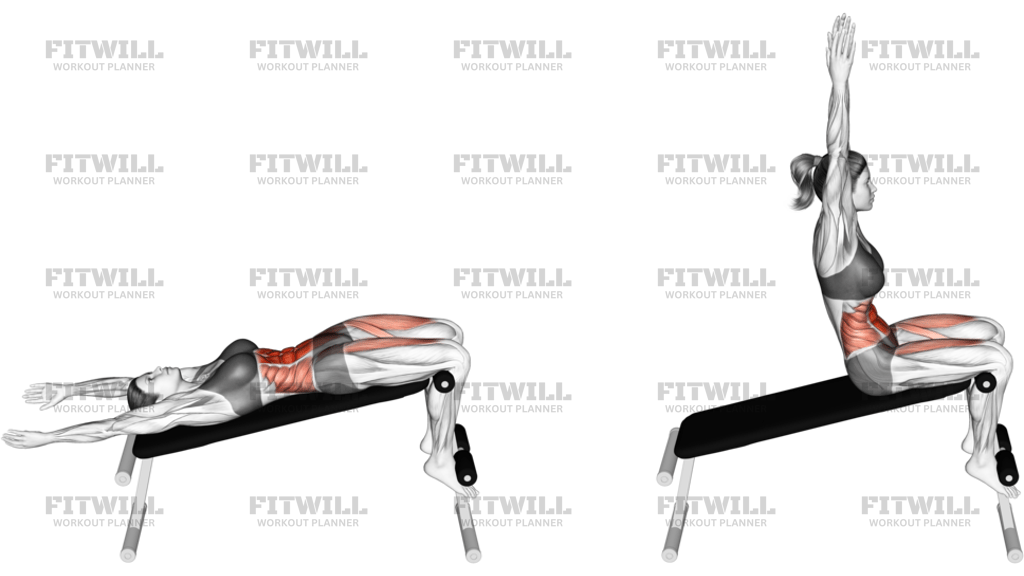
Long Lever Decline Sit-Up is a weighted bodyweight-style core exercise performed on a decline bench or leverage machine with the ankles secured and the torso working against gravity. The long lever comes from reaching the arms overhead, which makes the sit-up more demanding than a standard decline sit-up because the trunk has to control a longer lever through the entire curl and return.
This exercise is useful when you want direct trunk flexion strength, better control through spinal flexion, and a harder ab-focused sit-up variation without needing much external load. It emphasizes the abdominal wall while the hip flexors, obliques, and deeper stabilizers help keep the torso organized as you move from a reclined position to a tall seated finish. The slower and cleaner the rep, the more the core has to do the work.
The setup matters a lot. Lock your ankles under the rollers or pads, lie back fully on the decline bench, and reach both arms straight overhead so your rib cage and pelvis stay long before the first rep begins. If your feet are not secure or your lower back is already arched hard before you start, the movement tends to turn into a swing instead of a controlled sit-up.
To perform Long Lever Decline Sit-Up well, curl your rib cage toward your pelvis rather than yanking yourself up with speed. Keep the chin slightly tucked, keep the arms long overhead or in line with the ears, and rise until you are tall through the torso without leaning back at the top. Lower with the same control, one segment at a time, until your shoulders and upper back return to the bench.
It fits well in core sessions, accessory blocks, or abdominal finishers when you want a sit-up pattern that is hard enough to train strength but still easy to judge for quality. Use a smaller range, shorter lever, or less steep decline if your lower back pops off the bench or your hip flexors dominate the rep. Long Lever Decline Sit-Up should feel like a controlled trunk curl, not a throw from the hips or a neck-driven crunch.
[ Workout Log & Planner ]
Put your next workout in Fitwill
Keep your plan and training log ready when you are.


Instructions
- Set the decline bench to a moderate angle and lock your ankles firmly under the rollers or pads.
- Lie back with your shoulders and head supported, your lower back resting on the bench, and both arms reaching straight overhead.
- Set your feet before each rep so you feel secure and your hips stay anchored to the pad.
- Brace your abs, lightly tuck your pelvis, and keep your ribs from flaring before you begin the curl.
- Exhale as you peel your shoulders and upper back off the bench and bring your rib cage toward your pelvis.
- Continue sitting up until your torso is tall and your arms stay long overhead instead of dropping forward to help you swing.
- Pause briefly at the top without leaning back or jerking through the hips.
- Lower slowly, one vertebra at a time, until your shoulders and upper back return to the bench with control.
- Reset your breath at the bottom and repeat for the planned number of reps before carefully stepping off the bench.
Tips & Tricks
- Keep the arms overhead for the full rep if you want the true long-lever version; bending the elbows shortens the lever and makes the set easier.
- Think of curling the ribs toward the pelvis instead of throwing the chest upward, which keeps the abs in charge of the movement.
- If your feet slide or your knees open up, lower the bench angle or reset your ankle position before continuing.
- Exhale through the hardest part of the sit-up so the torso can stay tighter instead of overextending at the top.
- Do not yank the head forward; the chin should stay slightly tucked while the upper back does the work.
- A slower descent makes the set much harder and usually improves control better than adding more reps.
- If the hip flexors take over, stop just short of a full sit-up and build back up with a smaller range first.
- A slight pause on the bench between reps helps remove momentum and keeps each repetition honest.
- Use the decline bench as a reference point: if your low back is arching hard off the pad, the set is too aggressive.
Frequently Asked Questions
What muscles does Long Lever Decline Sit-Up train?
It mainly trains the abdominal wall, with the hip flexors and obliques assisting as you curl up and control the descent.
Why are my arms overhead in Long Lever Decline Sit-Up?
The overhead arm position increases the lever arm, so your abs have to work harder to lift and lower the torso.
How high should I sit up on the decline bench?
Come up until your torso is tall and stacked over your hips, but do not lean back or snap through the lower back at the top.
Can beginners do Long Lever Decline Sit-Up?
Yes, but they should use a mild decline, a smaller range, and bent elbows or crossed arms before progressing to full overhead reach.
What is the most common mistake in Long Lever Decline Sit-Up?
The biggest mistake is swinging the torso with momentum instead of curling up and lowering under control.
Why do I feel Long Lever Decline Sit-Up in my hip flexors?
Some hip flexor work is normal, but if they dominate the movement, reduce the decline or shorten the range so your abs can lead the rep.
How can I make Long Lever Decline Sit-Up easier?
Bend your elbows, cross your arms over your chest, or use a less steep bench angle to shorten the lever and reduce the load.
Should my lower back stay flat on the bench during Long Lever Decline Sit-Up?
Your lower back should stay controlled against the bench without a hard arch, but a little movement at the bottom is normal as you curl up and return.