Weighted Hyperextension
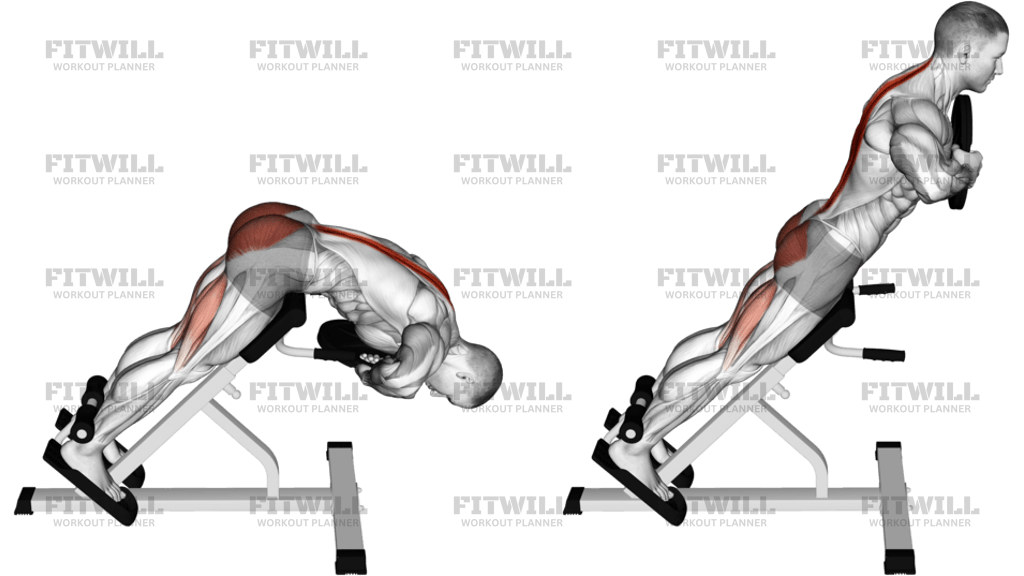
Weighted Hyperextension is a loaded back extension performed on a Roman chair or 45-degree hyperextension bench. The torso starts folded over the pad with the hips anchored and the feet secured, then the body extends until the trunk and legs form a long line. The added weight is usually held at the chest, which makes the rep more demanding without changing the movement pattern.
This exercise is mainly used to strengthen the glutes, hamstrings, and spinal erectors while teaching the hips to extend without losing position through the low back. Because the pad fixes the pelvis, the setup matters: if the hips are too high, too low, or too far off the pad, the movement turns into a compensation drill instead of a clean hip hinge. A stable setup lets you load the posterior chain with more control.
The best reps begin by bracing before you leave the bottom position. Keep the neck neutral, keep the weight tight to the chest, and drive the torso up by extending the hips until the body is straight rather than over-arching the lumbar spine. At the top, stop when the line from head to heel is aligned; lifting higher usually adds spinal extension, not better glute work.
On the way down, lower under control until the torso folds only as far as you can maintain tension and a neutral back. Smooth breathing helps keep the trunk organized, and a controlled tempo keeps the exercise productive for strength, hypertrophy, or accessory work. It is especially useful after squats, deadlifts, running, or any session where the posterior chain needs direct work without heavy axial loading.
Treat the load as a way to challenge posture and hip extension, not as a way to swing through the bench. Light to moderate weight with a clean range is usually more effective than chasing load and losing the hinge. If the bench contact, ankle lock, or chest position is off, fix that first; the exercise should feel like a controlled extension through the hips, not a backbend.
[ Workout Log & Planner ]
Put your next workout in Fitwill
Keep your plan and training log ready when you are.


Instructions
- Adjust the Roman chair or 45-degree bench so your hips rest just above the pad while your feet are locked in place.
- Hold the weight against your chest with both arms and fold your torso over the pad until your upper body hangs down with a neutral neck.
- Set your feet firmly on the footplate and brace your midsection before the first rep.
- Drive your torso upward by extending at the hips until your body forms a straight line from head to heels.
- Stop at the top when your trunk is aligned with your legs; do not lean back past neutral.
- Squeeze your glutes briefly, then lower your torso in a slow, controlled arc.
- Keep the weight tight to your chest and maintain steady breathing as you move through each repetition.
- Repeat for the desired reps, then step off carefully once the bench is fully stable.
Tips & Tricks
- Place the pad across the upper thighs, not the stomach, so the hips can hinge freely.
- Keep the chin slightly tucked; looking up at the top usually encourages lumbar overextension.
- Hold the plate or dumbbell close to the sternum so it does not pull you forward off the pad.
- Think about driving the hips into the pad on the way up instead of swinging the chest.
- Finish the rep at body alignment, not by hyperextending the low back.
- Use a slower lowering phase to keep tension on the posterior chain.
- Choose a load that still lets you pause briefly at the top without jerking.
- If your hamstrings cramp, shorten the bottom range and rebuild control before adding load.
Frequently Asked Questions
What muscles do weighted hyperextensions work?
They mainly target the glutes, hamstrings, and spinal erectors, with the core helping keep the torso rigid on the bench.
Is the weight held in front of the chest or behind the head?
Hold it at the chest. That keeps the load centered and makes it easier to maintain a controlled hinge on the 45-degree bench.
How high should I come up on each rep?
Lift until your torso is in line with your legs. Going higher usually turns the rep into a low-back arch rather than a hip extension.
What is the biggest setup mistake?
Setting the hips too far off the pad or letting the feet slide. Both make it hard to hinge cleanly and put more stress on the wrong area.
Can beginners use weighted hyperextensions?
Yes, if they start with body weight or a very light plate and learn to keep the movement smooth on the bench.
Should I round my upper back over the pad at the bottom?
A small fold at the hips is fine, but do not collapse or lose trunk control. Keep the movement organized around the hinge.
Where does this fit in a workout?
It works well after squats or deadlifts, or as posterior-chain accessory work when you want extra glute and hamstring volume.
What should I do if I feel the movement mostly in my lower back?
Reduce the load, shorten the range slightly, and focus on finishing with the hips rather than arching the spine.