Lying Chin Tucks
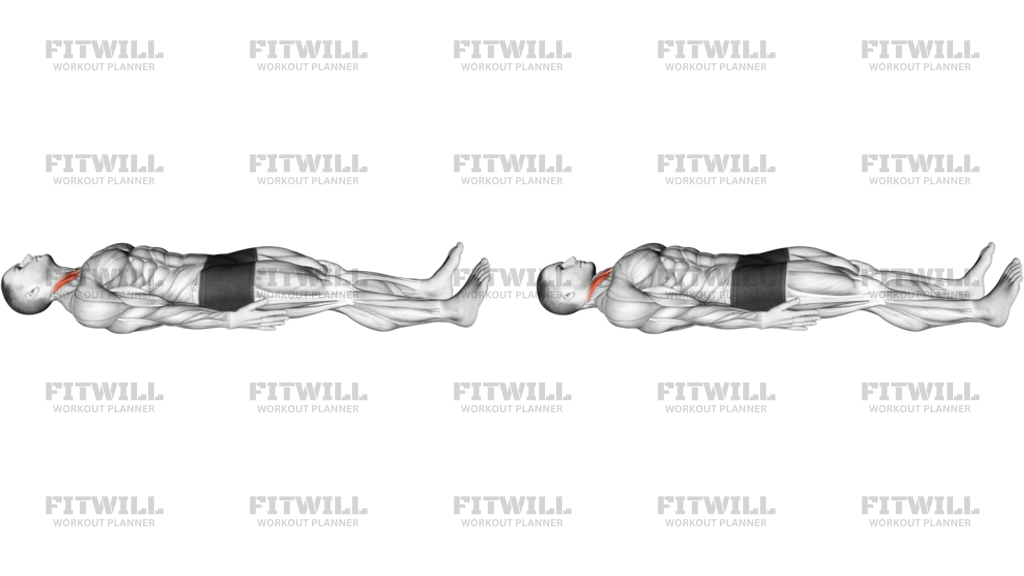
Lying Chin Tucks is a bodyweight neck-control exercise performed on a firm floor, mat, or flat bench while lying face up. It is designed to train the small muscles that hold the head and upper neck in a better stacked position, which makes it useful for posture work, warm-ups, rehab-style training, and any session where you want cleaner cervical control without loading the neck aggressively.
The movement is intentionally small. Instead of curling the head off the surface, you gently draw the chin straight back to create a subtle double-chin shape while keeping the back of the head supported. That action teaches the deep neck flexors to do the work while the jaw, shoulders, and upper chest stay relaxed. When it is done well, the rep feels precise rather than forceful.
The setup matters because the surface gives you feedback. Lie flat with the body long, ribs down, and the neck in a neutral starting position. A thin towel under the head can help if the floor feels too hard or if you need a little more space to find neutral. From there, the chin moves straight back, not down toward the chest and not up toward the ceiling. The goal is to lengthen the back of the neck while keeping the skull quiet.
This exercise is commonly used for people who spend a lot of time looking forward or down, or for athletes who need better head-and-neck position during pressing, pulling, running, or contact work. It is also a useful low-load option when the neck is irritated by faster or heavier work, as long as the movement stays pain-free and controlled.
The main mistake is trying to make the exercise bigger than it should be. If the head lifts, the jaw tightens, or the shoulders shrug, the work shifts away from the deep neck flexors and becomes a general neck strain. Keep the motion subtle, breathe smoothly, and stop the set if you feel pinching, dizziness, or symptoms that spread beyond the neck.
[ Workout Log & Planner ]
Put your next workout in Fitwill
Keep your plan and training log ready when you are.


Instructions
- Lie face up on a firm floor, mat, or flat bench with your legs long and your arms resting by your sides.
- Set the back of your head down lightly and make sure your neck starts in a neutral, comfortable position.
- Keep your jaw loose, your eyes looking straight up, and your ribs settled instead of flared.
- Draw your chin straight back toward your throat to create a small double-chin shape.
- Do not lift the head off the surface; the movement should stay tiny and controlled.
- Hold the tucked position briefly while you exhale and feel the front of the neck stay active.
- Slowly release the tuck until your neck returns to the starting position without jutting forward.
- Repeat for the planned number of reps with the same small range and smooth tempo.
Tips & Tricks
- Think about sliding the back of your skull across the surface instead of crunching your chin downward.
- Keep the motion small; a clean chin tuck is usually only a few centimeters of travel.
- If the front of your neck burns immediately, reduce the range and soften the effort.
- Keep your shoulders heavy on the floor or bench so the upper traps do not take over.
- A thin towel under the head can make it easier to find a neutral start without straining.
- Exhale as you tuck so the jaw and throat stay relaxed.
- Do not press the tongue hard into the roof of the mouth or clench the teeth.
- Stop if you feel dizziness, tingling, headache, or pain that is sharper than normal muscular effort.
Frequently Asked Questions
What does Lying Chin Tucks train?
It primarily trains the deep neck flexors that help keep the head stacked over the spine.
Can beginners perform this exercise?
Yes. It is usually beginner-friendly because the movement is very small and can be done without external load.
Should my head come off the floor or bench?
No. The back of the head should stay supported while the chin slides straight back.
Where should I feel the rep?
You should feel a light, controlled effort along the front of the neck and under the jaw, not a hard crunch in the throat.
How is this different from a neck curl?
A chin tuck is mostly a small retraction of the head, while a neck curl is a bigger flexion movement that lifts or curls the head.
How many reps or holds should I use?
Common options are 8 to 15 controlled reps or short holds of about 3 to 5 seconds.
Can I do this on a bed or soft couch?
A firmer surface is better because it makes the head position easier to feel and control.
What should I do if I feel neck pain or dizziness?
Stop the set. This exercise should feel controlled and mild, not sharp, dizzy, or irritating.