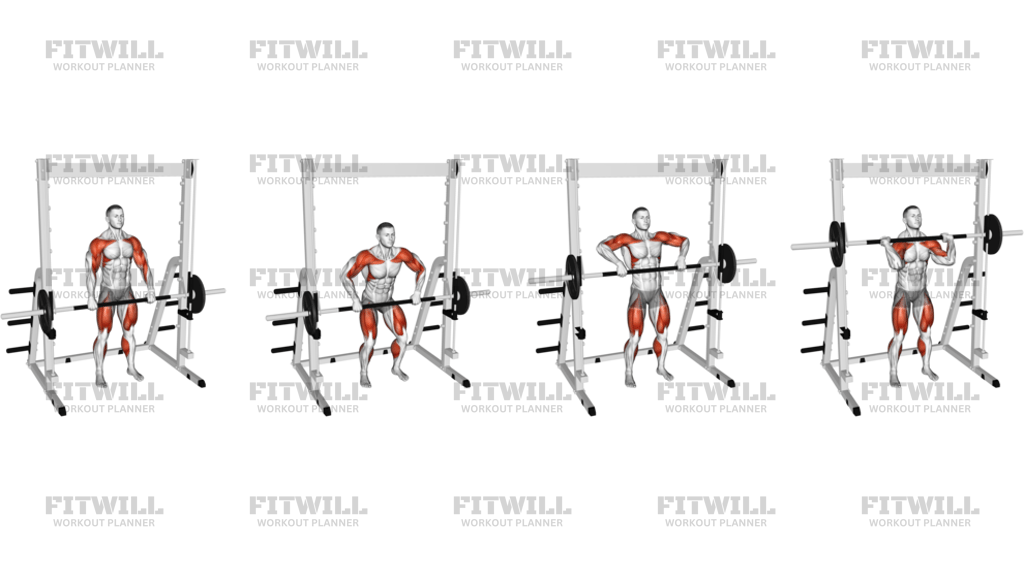
Smith Hang Clean
Smith Hang Clean is a power-focused pulling drill performed on a Smith machine, usually from a hang position around the upper thighs. The fixed bar path changes the feel of the lift compared with a free barbell clean, so the setup matters even more: your body has to line up with the bar instead of chasing it. Done well, the movement teaches a fast hip extension, an aggressive shrug, and a quick front-rack catch without turning the repetition into a loose upright row.
This exercise is useful when you want explosive lower-body drive, upper-back engagement, and better coordination between the pull and the catch. It is not a pure isolation exercise, and it should not be treated like one. The legs, glutes, upper back, shoulders, and core all contribute, but the main training value comes from producing force quickly and then receiving the bar in a stable athletic position.
The best setup is a controlled hang: feet about hip-width, knees softly bent, bar resting against the upper thighs, chest tall, and shoulders set so the lats keep the bar close to the body. Because the Smith bar travels straight up and down, the bar should stay close to the torso while your body dips and drives under it. If the bar drifts away from the thighs or the torso leans back to chase the track, the clean usually turns sloppy fast.
From there, each rep should feel like a sharp dip, an explosive extension, and a fast turnover into the front rack. The catch is usually high and athletic rather than deep, with the bar landing across the front delts and the elbows coming through quickly. That catch position is what keeps the load organized and lets you reset for the next rep instead of muscling the bar with the arms.
Smith Hang Clean works well in technique practice, power blocks, or accessory work for athletes who need a fast triple extension pattern without the balance demands of a free barbell clean. Keep the load light enough that every rep looks crisp, because the exercise stops being useful once the pull becomes a curl or the catch becomes a shrug. If the shoulders, wrists, or elbows cannot receive the bar comfortably, reduce the load and tighten the setup before adding speed.
Fitwill
Log Workouts, Track Progress & Build Strength.
Achieve more with Fitwill: explore over 9600 exercises with images and videos, access built-in and custom workouts, perfect for both gym and home sessions, and see real results.
Start your journey. Download today!




Instructions
- Set the Smith bar at upper-thigh height, stand hip-width under it, and take an overhand grip just outside your thighs.
- Hinge slightly at the hips, soften your knees, and let the bar rest close against your upper thighs with your chest tall.
- Set your shoulders down and back enough to keep the bar close, then brace your trunk before the pull.
- Dip a few inches by bending the knees and hips together, keeping your heels down and your weight over midfoot.
- Drive hard through your legs and hips to extend your ankles, knees, and hips as the bar rises on the fixed track.
- Shrug forcefully and pull your elbows high and outside while keeping the bar close to your shirt.
- Turn your elbows forward fast and catch the bar on your front delts and upper chest in a quarter-squat stance.
- Stand tall to finish the rep, then lower the bar back to the hang with control and reset before the next repetition.
Tips & Tricks
- Set the bar at the top of the thighs, not down near the knees, so you can start the pull from a strong hang instead of a deep hinge.
- On a Smith machine, move your body under the bar rather than trying to swing the bar around in an arc.
- Keep the bar brushing close to the thighs; if it drifts forward, the catch usually gets slow and unstable.
- Think of the pull as a leg-and-hip drive first and an arm pull second.
- Catch the bar across the front delts with the elbows through quickly; letting the elbows stay low turns the lift into a bad upright row.
- Use a light grip if your wrists feel cranky, because the bar should sit on the shoulders instead of hanging in the hands.
- If you are jumping forward or backward, narrow or reset your stance so the load stays over midfoot.
- Stop the set when the turnover slows down, because a late catch is usually the first sign the weight is too heavy.
Frequently Asked Questions
What muscle does Smith Hang Clean target most?
It is a full-body power drill, but the main work comes from the glutes, quads, hamstrings, traps, upper back, shoulders, and core.
Can beginners perform this exercise?
Yes, but only with a very light load and a clean hang setup. Beginners should learn the dip, drive, and front-rack catch before trying to move weight fast.
How is Smith Hang Clean different from a barbell hang clean?
The Smith bar follows a fixed vertical path, so balance demands are lower but your body has to line up more precisely under the track. That makes the catch feel more constrained than a free barbell clean.
Should the bar start from the floor?
No, this variation starts from a hang, usually around the upper thighs. Starting lower changes the exercise into a different clean variation.
Do I need to squat deep to catch the bar?
No. A small athletic dip or quarter squat is usually enough to receive the bar cleanly while keeping the movement explosive.
Why do my wrists hurt in Smith Hang Clean?
The bar is probably sitting too far in the hands or the elbows are not coming through fast enough. Lighten the load and let the bar rest more on the front delts during the catch.
Is Smith Hang Clean better for strength or power?
It is better for power, coordination, and explosive intent than for maximal strength. If the rep slows into a grind, the benefit of the lift drops quickly.
What should I avoid during the pull?
Avoid curling the bar, leaning back to chase the track, or letting the elbows stay low. Those habits usually turn the lift into a sloppy shrug instead of a clean catch.