Smith Standing Behind Head Military Press
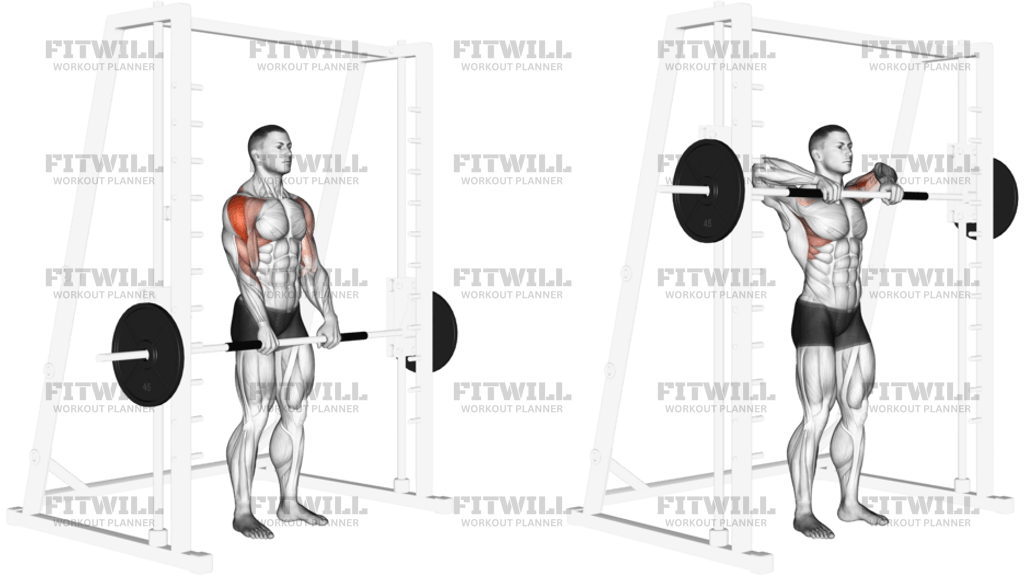
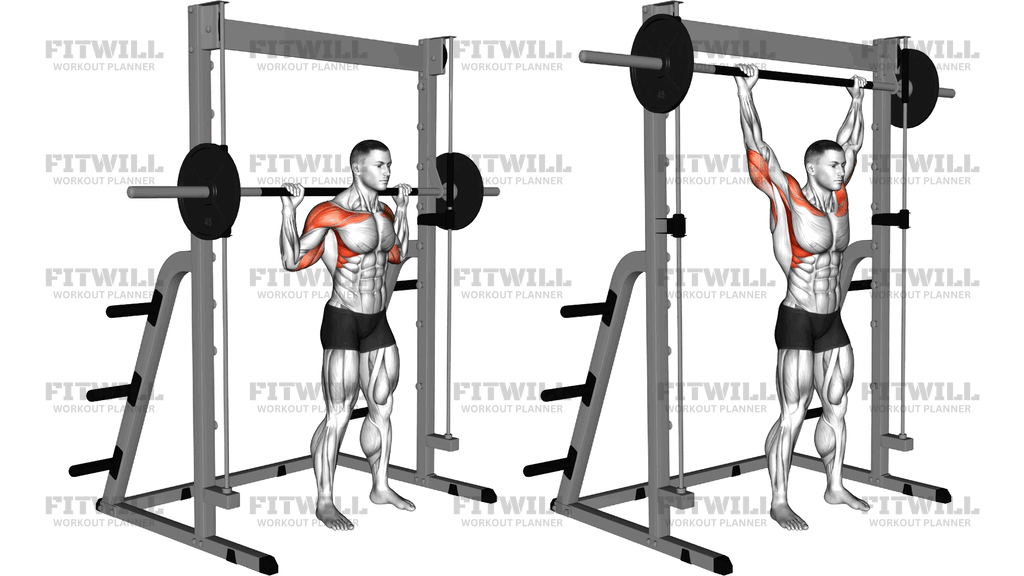
Smith Standing Behind Head Military Press is a standing overhead press performed on a Smith machine with the bar traveling behind the head. It mainly trains the deltoids, with the triceps, upper traps, and upper-back muscles helping stabilize the bar and keep the torso organized. Because the bar path is fixed, the exercise rewards clean setup and honest shoulder mobility more than it rewards heavy loading.
This variation places the bar lower and farther back than a standard front press, so the start position matters. Stand centered under the Smith bar with your feet about hip-width apart, the bar resting behind the head across the upper traps or rear shoulders, and your grip slightly wider than shoulder width. A stable ribcage, braced midsection, and neutral neck help keep the movement coming from the shoulders instead of from a lean or an aggressive shrug.
The lift should feel like a straight, controlled press with the bar moving on the rail until the arms are extended overhead. At the top, the biceps should finish close to the ears without forcing the lower back to arch. On the way down, lower the bar slowly to the same behind-the-head position and stop at the deepest range you can control without pinching or losing posture. Smooth breathing and a calm descent matter as much as the press itself.
Use this exercise when you want a strict shoulder-focused press with less balance demand than free weights. It can be useful for experienced lifters who tolerate the behind-the-neck position well, but it is less forgiving for anyone with limited shoulder external rotation, poor thoracic extension, or a tendency to flare the ribs. If the shoulders feel crowded, a front press or seated dumbbell press is usually the safer choice. The best reps are controlled, pain-free, and consistent from the first repetition to the last.
Fitwill
Log Workouts, Track Progress & Build Strength.
Achieve more with Fitwill: explore over 9600 exercises with images and videos, access built-in and custom workouts, perfect for both gym and home sessions, and see real results.
Start your journey. Download today!




Instructions
- Set the Smith bar just behind head height, step under it, and place it across the upper traps or rear shoulders with a grip slightly wider than shoulder width.
- Stand with your feet hip-width apart and centered between the rails so the bar can travel straight up and down without drifting forward or back.
- Brace your abs, squeeze your glutes lightly, and keep your ribs stacked over your pelvis before you unrack the bar.
- Unlock the bar and start with the elbows under the wrists, chest tall, and neck neutral instead of reaching the head forward.
- Press the bar straight up along the Smith path until your arms are nearly locked and the bar clears the crown of your head.
- Finish with the shoulders stacked under the bar without leaning back or turning the press into a standing incline.
- Lower the bar under control to the same behind-the-head starting position, stopping sooner if your shoulders start to pinch.
- Reset your breath at the bottom and repeat for the planned number of repetitions before racking the bar carefully.
Tips & Tricks
- Use a lighter load than you would on a front Smith press; the behind-the-neck position usually limits strength before the delts do.
- Choose a grip wide enough that your forearms stay close to vertical at the bottom and your wrists do not bend backward.
- Do not force the bar down onto the base of your neck; stop at the deepest comfortable range behind the head.
- Keep your ribs from flaring as the bar rises or the press turns into a lower-back arch instead of a shoulder press.
- Let your chin move just enough for the bar to clear, then bring your head back to neutral instead of jutting it forward.
- Press in the exact line of the Smith rails and avoid shifting your feet or hips to chase the bar.
- If one shoulder feels tighter, reduce the range on both sides rather than twisting to one side at the bottom.
- Exhale as the bar passes the head and inhale as you lower it, keeping the trunk steady through every rep.
Frequently Asked Questions
What muscle does Smith Standing Behind Head Military Press target most?
The deltoids are the main movers, especially the front and middle heads, with the triceps helping finish the press.
Why is the bar placed behind the head?
The behind-the-neck setup shifts the press slightly and can increase shoulder demand, but it also requires more mobility and control than a standard overhead press.
How wide should my grip be on the Smith bar?
Use a grip a little wider than shoulder width so your forearms stay close to vertical and the shoulders do not feel crowded at the bottom.
How low should the bar come down?
Lower it only to the point where the shoulders stay comfortable and the bar can sit behind the head without pinching or losing ribcage position.
Is this harder on the shoulders than a regular press?
Usually yes, because the behind-the-neck position asks for more shoulder external rotation and better upper-back positioning.
Can beginners do this exercise?
Only if they have good shoulder mobility and can keep the bar path pain-free; many beginners are better served by a front press or dumbbells first.
What should I do if I feel the press in my neck?
Reduce the load, stop forcing the bar lower, and keep the head neutral; if the pinch continues, switch to a front press variation.
Why use a Smith machine for this movement?
The fixed rail removes balance demands and makes it easier to keep the press strict, but it also locks you into one path, so setup has to be precise.