Bodyweight Kneeling Hold To Stand
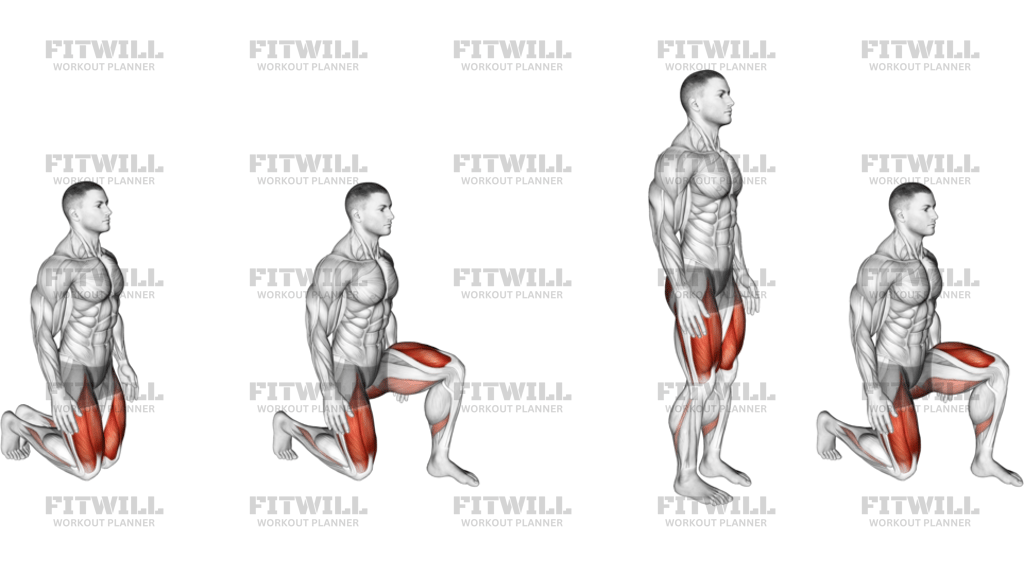
Bodyweight Kneeling Hold to Stand is a bodyweight transition drill that moves from a kneeling start, through half-kneeling, and up to a tall stand. It is most useful when you want to train the thighs and glutes together while also challenging balance, trunk control, and the ability to rise without rocking, hopping, or leaning too far forward. The image shows the sequence clearly: both knees on the floor, one foot stepping out in front, then a smooth stand.
The exercise places the heaviest demand on the front leg as you leave the floor. The quads help extend the knee, the glutes finish the hip extension, and the hamstrings and core keep the torso from folding or twisting. Because the movement starts from the floor, setup matters more than it does in a normal squat: the front foot needs enough space to stay flat, the front shin should stay roughly vertical, and the back knee should be padded so the start position is stable instead of painful.
Think of the rep as a controlled transition rather than a jump to standing. From the kneeling position, step one foot forward, stack the ribs over the pelvis, and drive through the front heel and back toes until you are fully upright. The top position should look tall and organized, with the hips extended and the torso stacked over the feet rather than arched backward. On the way down, reverse the path slowly so the body has to own the same positions under control.
This drill is a good fit for warm-ups, lower-body accessory work, rehab-style strength work, and beginner sessions where you want a simple pattern with a real control demand. It can also be used to teach clean knee tracking and single-leg loading before more advanced split squats or lunges. If the kneeling start irritates the knee, shorten the range, add padding, or reduce the time spent on the floor until the pattern feels smooth and repeatable.
Fitwill
Log Workouts, Track Progress & Build Strength.
Achieve more with Fitwill: explore over 9600 exercises with images and videos, access built-in and custom workouts, perfect for both gym and home sessions, and see real results.
Start your journey. Download today!




Instructions
- Start on both knees on a padded surface with your torso tall, hips extended, and knees under your hips.
- Step one foot forward into half-kneeling so the front foot is flat, the front shin stays close to vertical, and the back knee stays cushioned on the floor.
- Stack your ribs over your pelvis and lightly brace your trunk before you move.
- Shift your weight onto the front leg without letting the front knee cave inward or the torso collapse forward.
- Drive through the front heel and back toes to rise to standing in one smooth path.
- Finish tall with the hips fully extended, glutes squeezed, and the chest stacked over the pelvis.
- Pause for a moment at the top without leaning back or over-arching the lower back.
- Lower under control back through half-kneeling to the starting kneeling position, then repeat or switch sides as programmed.
Tips & Tricks
- Use a thick pad or folded mat under the back knee so the kneeling start stays comfortable and stable.
- Place the front foot far enough ahead that you can keep the heel down while shifting into the stand.
- Let the front leg do the work; avoid pushing off the floor hard enough to turn the rep into a hop.
- Keep the front knee tracking over the second or third toe instead of letting it collapse inward.
- Rise by extending the hip and knee together rather than finishing with a low-back arch.
- Move slowly on the return so you own the same half-kneeling position before the knee touches down.
- If balance is limiting the set, slow the tempo before you make the stance narrower or add load.
- Exhale as you stand and inhale as you lower back to the floor.
Frequently Asked Questions
What muscle does Bodyweight Kneeling Hold To Stand target most?
The front thigh and glute on the working side do most of the work, with the hamstrings and core helping stabilize the rise.
Do I start from both knees or half-kneeling?
Start from both knees, then step one foot forward into half-kneeling before you stand.
Should my front heel stay down?
Yes. Keep the front heel planted as long as you can so the front leg drives the stand instead of the back knee or momentum.
What is a common mistake with the half-kneeling setup?
The usual problem is placing the front foot too close, which forces the heel up and makes the stand unstable.
Can beginners perform this exercise?
Yes. It is beginner-friendly as long as the kneeling surface is padded and the stand is smooth rather than rushed.
Why does my lower back take over at the top?
That usually means you are finishing with a back arch instead of standing tall through the hips. Keep the ribs stacked over the pelvis.
How can I make the movement harder?
Slow the descent, pause in half-kneeling, or hold a brief balance at the top before lowering back down.
What should I do if the kneeling start bothers my knee?
Use a thicker pad, reduce the depth of the kneeling position, or stop the set until the knee pressure is comfortable.