Roman Chair 45 Degrees Side Bend
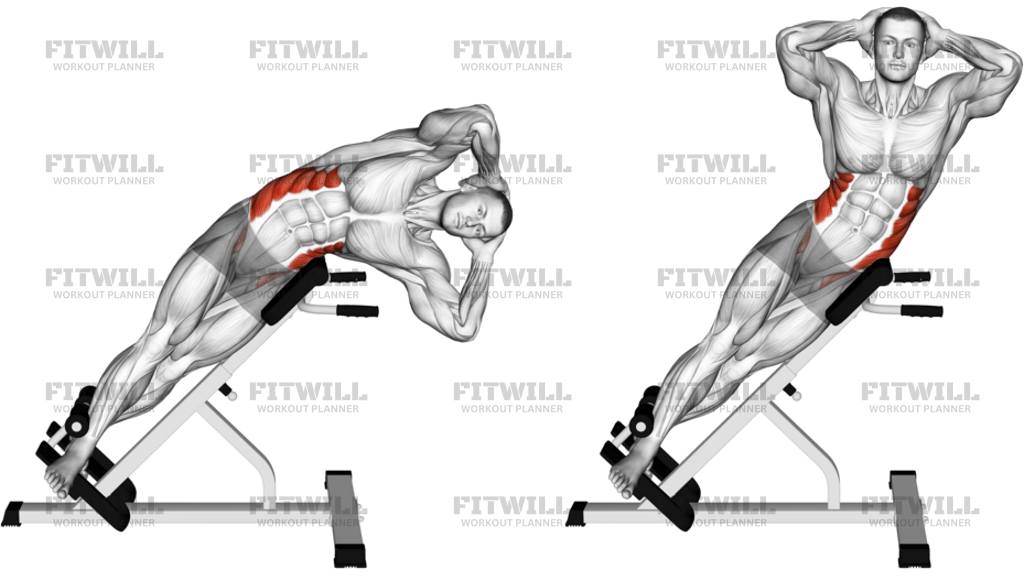
Roman Chair 45 Degrees Side Bend is a bodyweight side-flexion exercise performed on a 45-degree Roman chair or hyperextension bench. The pads lock the pelvis and legs in place so the torso can move cleanly through the waist instead of turning into a balance drill. That fixed setup is what makes the movement useful: it isolates lateral trunk work and lets you focus on the obliques, waistline control, and the smaller stabilizers that resist collapse on one side.
The image shows the body supported on the side of the bench with the feet anchored and the hands behind the head. From that position, the torso lowers into a side bend and then comes back up until the shoulders and hips stack again. The working range should feel like a controlled lateral contraction, not a twist through the spine or a swing driven by the legs. If the bench is set too high or the hips are not firmly braced against the pad, the exercise becomes harder to control and the target tension leaks into the low back.
This movement primarily trains the obliques, especially the external obliques, with the rectus abdominis, transversus abdominis, and spinal erectors helping stabilize the trunk. It is a good accessory choice for athletes, lifters, and anyone who wants stronger side-bending control for carrying, bracing, or resisting unwanted trunk motion. Because the load is just body weight in the base version, it is also approachable for beginners when the range of motion is kept conservative and the tempo stays slow.
Good execution depends on keeping the pelvis still and moving from the waist in a smooth arc. Start with the ribs down, neck relaxed, and elbows open so the head does not pull the torso forward. Lower under control until you feel a strong stretch and contraction through the side of the waist, then lift back up without snapping into lockout. The top position should look tall and stacked, not overextended. If you rush the lowering phase or swing through the bottom, the rep stops being a focused core repetition and turns into momentum.
Use Roman Chair 45 Degrees Side Bend as accessory core work, trunk stability training, or a warmup-to-moderate intensity movement before heavier lifts that rely on bracing. It fits well when you want targeted oblique work without equipment changes or loading complexity. Keep the range pain-free, match both sides evenly, and stop the set if the lower back starts taking over or the body can no longer stay anchored against the pad.
[ Workout Log & Planner ]
Put your next workout in Fitwill
Keep your plan and training log ready when you are.


Instructions
- Set the Roman chair to a 45-degree angle and position your hips and outer thigh against the side pad, with your feet locked into the foot supports.
- Place your lower hand against the side of your head or behind it, and keep the other arm folded with the elbow flared in line with the torso.
- Start with your torso lowered to the side so your waist is flexed and your body is anchored firmly to the bench.
- Brace your midsection and keep your ribs from drifting forward or rotating as you prepare to move.
- Lift your torso upward in a smooth side-bending arc until your shoulders and hips are stacked over the pad.
- Pause briefly at the top without leaning back or twisting through the chest.
- Lower back down slowly until you reach the same side-bent position without bouncing off the pad.
- Keep your head in line with your spine and exhale as you lift, then inhale as you lower.
- Complete all reps on one side before switching to the other side.
Tips & Tricks
- Keep your pelvis glued to the pad; if your hips slide, the movement turns into a twist instead of a side bend.
- Do not yank the head forward with your hands. The hands are only there to support the head lightly.
- Think about shortening the waist on the way up and lengthening the same side on the way down.
- Stop the ascent when your body is stacked; overextending the top position shifts tension into the low back.
- Use a shorter range if you feel the lower back taking over before the obliques do.
- Move slowly enough that the bench never loses contact with your torso.
- Match the number of reps on both sides so the waist stays balanced.
- If body weight is too easy, hold a small plate to the chest only after you can keep the torso from swinging.
Frequently Asked Questions
What muscle does Roman Chair 45 Degrees Side Bend target most?
The main target is the obliques, especially the external obliques on the working side.
What should I feel during the rep?
You should feel the side of the waist contracting as you lift and lengthening as you lower, not a twisting sensation in the lower back.
Do I work one side at a time?
Yes. Perform all reps on one side of the Roman chair, then switch sides and repeat the same number of repetitions.
Where should my feet and hips sit on the bench?
Your feet should be locked into the supports and your hips or outer thigh should stay pressed into the side pad so the torso can move without shifting the body.
Can I use weight with this exercise?
Yes, but only after you can keep the torso stacked and the movement smooth with body weight alone. A small plate held to the chest is the usual first progression.
Is this exercise hard on the lower back?
It should not be if you stay controlled and stop before you overarch at the top. If the low back dominates, shorten the range and slow the tempo.
What is the main setup mistake to avoid?
The biggest mistake is letting the torso rotate or slide off the pad instead of staying pinned to the bench.
Is this a beginner-friendly core exercise?
Yes, if you keep the range small and use slow reps. Beginners usually do best with body weight and strict control before adding any load.