Twisting Crunch
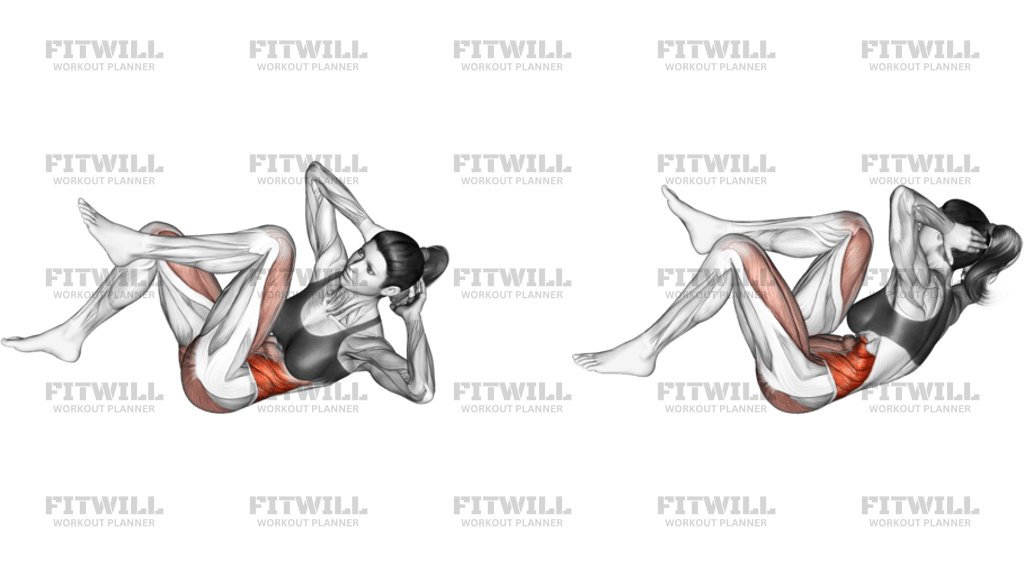
Twisting Crunch is a bodyweight floor exercise that trains the abdominal wall through a combination of trunk flexion and rotation. The movement is performed on your back with the knees bent, hands supporting the head, and the ribs curling toward the opposite hip as each side alternates. It is a practical way to challenge the obliques while still demanding enough work from the rectus abdominis to keep the torso organized.
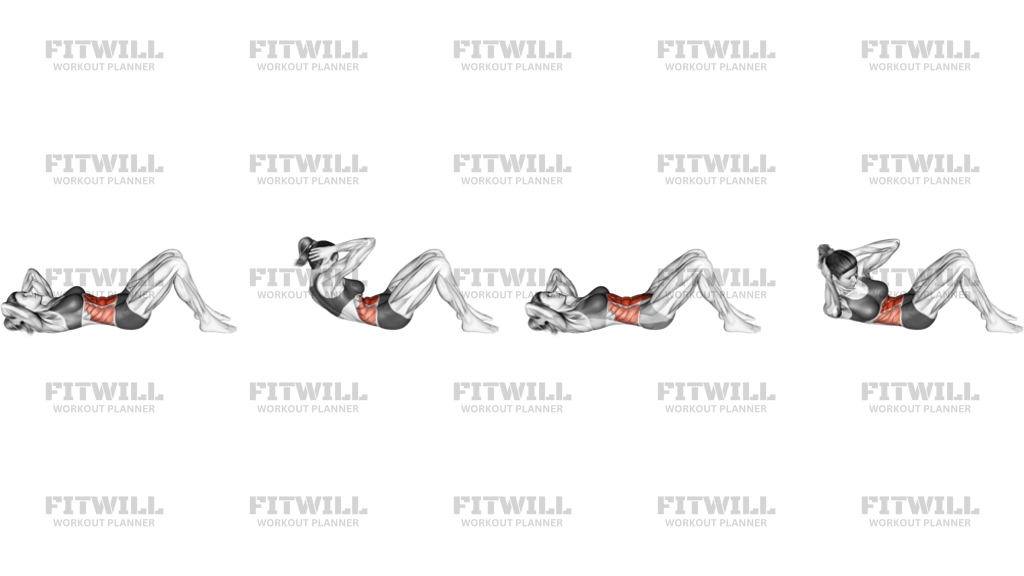
The image shows a classic alternating crunch pattern rather than a standing twist or a machine-based rotation. That matters because the floor position lets you keep the pelvis and ribcage easier to control, making the exercise more about clean rotation through the trunk and less about throwing the elbows or knees together. The useful range is usually short and deliberate: you curl up, rotate toward one side, and then lower with control before switching sides.
This exercise is most useful when you want direct abdominal work without external load, or when you need a core accessory that is easy to regress and easy to dose. It fits well in warm-ups, trunk-strength circuits, or conditioning sessions where crisp reps matter more than brute force. Because the movement is alternating and repetitive, it also exposes common compensation patterns quickly, especially neck tension, pulling on the head, and using hip flexors to fake the curl.
Good execution starts with the setup. Keep the lower back lightly connected to the floor, elbows open, and the chest lifted by the abs rather than by yanking the head forward. Rotate the ribcage toward the working side as the opposite shoulder comes off the floor, then lower under control until the ribs are back down. The best reps feel smooth, not jerky, and the neck should stay relaxed throughout.
Treat Twisting Crunch as a precision core drill. Stop the set if the elbows start collapsing inward, the hips start rocking, or the torso stops rotating and only the head is moving. If you can keep the movement clean, the exercise gives you a simple way to build stronger, more coordinated trunk control with very little equipment.
[ Workout Log & Planner ]
Put your next workout in Fitwill
Keep your plan and training log ready when you are.


Instructions
- Lie on your back on the floor or a mat with your knees bent, feet grounded, and your hands lightly behind your head with the elbows open.
- Set your lower back close to the floor and keep your chin slightly tucked so your neck stays long before the first rep.
- Exhale and curl your shoulder blades off the floor while twisting your ribcage toward one bent knee.
- Keep the rotation coming from your torso instead of pulling the elbow or cranking the head forward.
- Lower your shoulders back toward the floor with control until your ribs are down again.
- On the next rep, curl up and rotate to the other side in the same controlled arc.
- Keep the knees and hips quiet so the twist stays focused through the abs rather than the legs.
- Continue alternating sides for the planned reps, then lower your head and shoulders to the floor to finish.
Tips & Tricks
- Keep your elbows wide so you do not turn the rep into a neck pull.
- Think about lifting one shoulder blade and the opposite ribcage, not reaching the elbow across the body.
- If your lower back arches hard off the floor, shorten the range and reduce the leg drive.
- Use a smooth exhale as you curl up; that usually makes the twist easier to control.
- Move slowly enough that each side can pause briefly at the top without swinging.
- Do not let the chin jam toward the chest; keep space between the chin and sternum.
- A smaller twist with clean torso control is better than a bigger twist with hip rocking.
- Stop the set when the shoulders stop lifting cleanly or the movement turns into momentum.
Frequently Asked Questions
What muscles does Twisting Crunch train?
It mainly trains the obliques and the rectus abdominis, with the hip flexors and neck muscles assisting if the form gets sloppy.
Is this the same as a bicycle crunch?
It is very similar: both use a supine alternating crunch with rotation. The key difference is how much you emphasize the twist and how far you reach through the trunk.
Where should I feel the movement most?
You should feel the sides of your abdomen and the front of the core working, not the lower neck or the front of the hips taking over.
Do my knees need to touch my elbows?
No. A clean trunk curl with a controlled twist is more important than forcing contact between the elbow and knee.
Can beginners do this exercise?
Yes. Beginners should start with a short range, slow tempo, and no pulling on the head.
What is the biggest form mistake?
The most common error is yanking the head forward and letting the hips rock instead of rotating through the torso.
How should I breathe during the rep?
Exhale as you curl and twist up, then inhale as you lower back down under control.
How can I make Twisting Crunch harder without weights?
Slow the lowering phase, pause briefly at the top, or extend the working-side leg a little more while keeping the torso controlled.