Bottle Weighted Straight Legs Deadlift
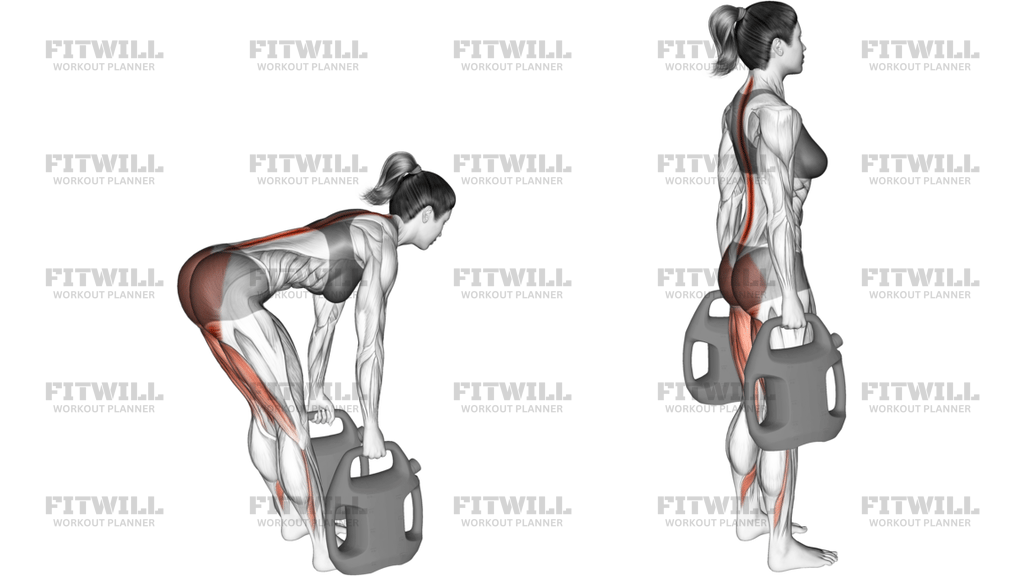
Bottle Weighted Straight Legs Deadlift is a bilateral hip-hinge exercise performed with a bottle or jug in each hand. It is designed to load the back side of the body through a long, controlled range of motion, with the hamstrings and glutes doing most of the work while the trunk stays braced and the spine stays neutral. The exercise is simple in appearance, but the quality of the hinge, the distance of the loads from the legs, and the amount of knee bend all decide whether it trains the right pattern.
The straight-leg version shifts more tension toward the hamstrings than a conventional deadlift, but the knees should still stay softly unlocked. Locking the knees hard usually pulls the pelvis out of position and makes the lower back take over too early. Start tall, stack the ribs over the pelvis, and let the bottles hang at the sides with the shoulders relaxed. The goal is not to reach the floor at any cost; it is to keep the torso long and hinged while the weights stay close to the body.
On the way down, the hips travel backward as if you are closing a car door with your glutes. The bottles should slide down the front of the thighs and shins without swinging forward. Lower only until the hamstrings are stretched enough that you can still hold a flat back and keep the neck in line with the torso. On the way up, drive the feet into the floor, push the hips forward, and finish tall without leaning back or shrugging the shoulders.
Because the movement is loaded in the hands, grip and balance matter more than they do in many other hinge drills. A matched pair of bottles or jugs helps you keep the torso square and avoid twisting. If the loads are uneven, the body will usually shift side to side and the hinge will turn into a compensation drill instead of a posterior-chain exercise. That is why the setup should be light enough to control before it is heavy enough to challenge.
This exercise fits well as lower-body accessory work, a hamstring-focused strength drill, or a controlled alternative when you want a hinge without barbell setup. It is especially useful for building awareness of hip movement, because the rep pattern is slow enough to feel where the tension shifts from hamstrings to glutes. Stop the set if the lower back rounds, the bottles drift away from the legs, or the descent becomes a reach instead of a hinge.
[ Workout Log & Planner ]
Put your next workout in Fitwill
Keep your plan and training log ready when you are.


Instructions
- Stand tall with your feet about hip-width apart and hold a bottle or jug in each hand at your sides with a neutral grip.
- Soften your knees slightly, keep your chest open, and stack your ribs over your pelvis before you start the first rep.
- Brace your trunk and keep your neck long so the spine stays neutral as you hinge.
- Push your hips straight back and let the bottles slide down the front of your thighs.
- Keep the loads close to your legs as your torso tips forward and your shins stay almost vertical.
- Lower only as far as you can without rounding your back or losing the stretch in your hamstrings.
- Pause briefly at the bottom, then drive through your feet and pull your hips forward to stand up.
- Finish tall with your glutes engaged, but do not lean back or shrug the weights at the top.
- Reset your posture, take another breath, and repeat for the planned number of reps.
Tips & Tricks
- Keep the bottles within an inch or two of your thighs and shins so the hinge stays centered over the midfoot.
- Do not lock the knees hard; a small bend keeps the hamstrings loaded without forcing the pelvis to tuck under.
- Let the descent stop where your back can still stay flat, even if that is well above the floor.
- Take a slower 2 to 3 second lowering phase so the hamstrings, not momentum, control the stretch.
- If the handles tug your wrists or forearms, choose lighter bottles or a more secure grip before adding range.
- Press through the heels and midfoot on the way up, but keep the toes planted so the balance does not shift forward.
- Exhale as you stand and finish the rep; holding the breath too long can make the top position feel stiff and rushed.
- If the bottles swing forward or you feel the lower back taking over, shorten the range and reduce the load.
Frequently Asked Questions
What muscles do Bottle Weighted Straight Legs Deadlift work most?
The main emphasis is on the hamstrings and glutes, with the spinal erectors, grip, and upper back helping to keep the hinge stable.
Should my knees stay completely straight during the rep?
No. Keep them softly unlocked. A tiny knee bend protects the hamstrings from being overstretched and helps you keep the pelvis in a strong hinge position.
How low should the bottles travel?
Lower only until you can still keep a neutral back and feel a strong hamstring stretch. For many people that is around mid-shin, but the exact depth depends on mobility.
Why do the bottles need to stay close to my legs?
Keeping the loads close reduces the lever on your lower back and makes the hinge feel like a true hip movement instead of a forward reach.
Can beginners do this exercise safely?
Yes, if they start with light bottles, a short range, and a slow descent. The hinge pattern is the hard part, not the load.
How is this different from a Romanian deadlift?
The pattern is similar, but the straight-leg version usually keeps the knees a little straighter and creates a stronger hamstring stretch.
What should I do if I feel this mostly in my lower back?
Shorten the range, soften the knees, and keep the bottles closer to your body. If the back still takes over, the load is too heavy or the hinge is too deep.
What is the best breathing pattern?
Inhale before you hinge, keep the torso braced as you lower, then exhale as you stand back up and finish the rep.