Bodyweight Reverse Lunge With Overhead Reach
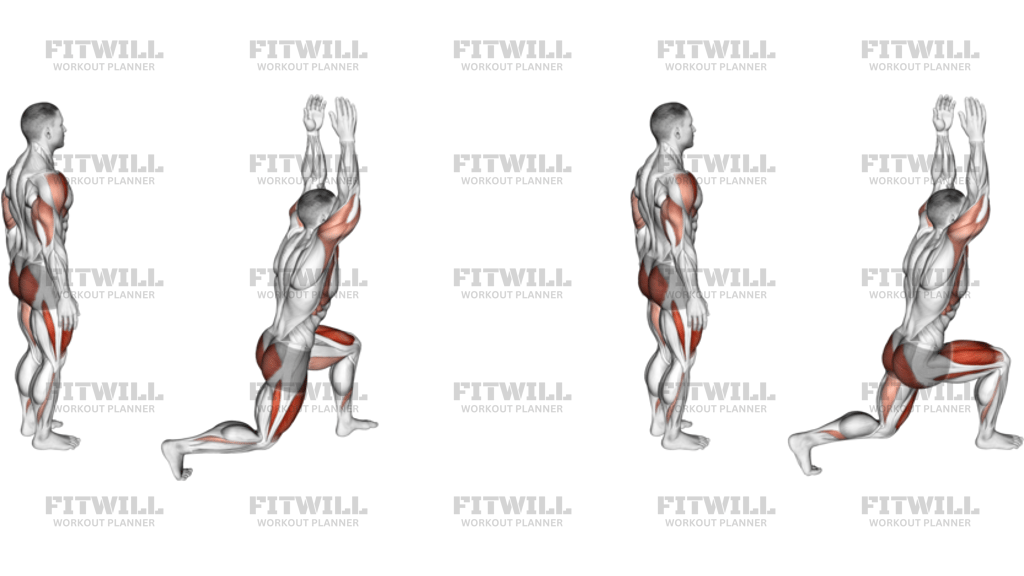
Bodyweight Reverse Lunge With Overhead Reach combines a step-back lunge with an overhead arm reach, so the lower body, hips, and trunk all have to work together. The rear knee lowers toward the floor while the front leg supports most of the load, and the overhead reach adds a balance and mobility challenge that makes this more demanding than a standard reverse lunge.
This exercise is useful when you want to train single-leg control without adding external load. It places meaningful work on the front thigh and glute of the working leg while the rear hip flexors, adductors, calves, and core help you stay stacked and steady. The overhead reach also asks the shoulders and upper back to keep the arms lifted without letting the ribcage flare.
The setup matters because the lunge only feels smooth if your feet are placed correctly before you move. Start tall, then step one leg back far enough that you can lower under control without collapsing the front knee inward or overextending the lower back. Keep the torso long, the front foot planted, and the arms reaching overhead only as far as you can hold the ribcage down and the shoulders organized.
At the bottom, the back knee should hover close to the floor or lightly touch down if that is the version you are using, while the front shin stays controlled and the front heel remains grounded. Drive through the front leg to return to standing, keeping the reach overhead until you are stable again. That sequence makes the exercise a useful blend of lower-body strength, balance, and postural control rather than just a stepping drill.
Bodyweight Reverse Lunge With Overhead Reach is a good accessory exercise for warmups, lower-body sessions, unilateral strength work, or mobility-focused conditioning. It is also a practical regression when a loaded split squat or lunge feels too heavy, because the overhead position exposes compensation quickly and lets you clean up alignment before progressing to load. When the reps stay crisp, the movement builds control you can carry over to squats, lunges, overhead work, and athletic change-of-direction tasks.
[ Workout Log & Planner ]
Put your next workout in Fitwill
Keep your plan and training log ready when you are.


Instructions
- Stand tall with your feet about hip-width apart and raise both arms overhead so your ribs stay stacked over your pelvis.
- Pick one foot and step it straight back into a split stance, keeping most of your weight over the front foot.
- Keep the front heel down, the front toes pointing forward, and the back toes light on the floor behind you.
- Lower straight down by bending both knees until the back knee is close to the floor and the front thigh is near parallel.
- Hold the arms overhead as you descend, but do not let your lower back arch or your chest collapse forward.
- Drive through the front heel and midfoot to stand back up, keeping the front knee tracking over the middle toes.
- Finish tall with the hips fully extended, then reach overhead again only after you are balanced at the top.
- Complete all reps on one side before switching legs, and reset your stance before starting the next side.
Tips & Tricks
- Take a longer step back if your front knee shoots far past your toes or your torso tips forward at the bottom.
- If the overhead reach makes you arch your lower back, lower the arms slightly until you can keep the ribs stacked.
- Keep pressure through the front heel and big toe so the front leg, not the back leg, drives the return.
- Let the back knee travel down and slightly behind you instead of reaching it forward under the hips.
- Use a smaller range and lightly tap the back knee to the floor if balance is the limiting factor.
- Keep the front knee pointed in the same direction as the front toes to avoid the knee caving inward.
- Move slowly enough that the overhead position stays steady; rushing the descent usually turns this into a balance scramble.
- If the shoulders feel pinched, reach with the biceps slightly in front of the ears instead of forcing a rigid vertical line.
Frequently Asked Questions
What muscles does Bodyweight Reverse Lunge With Overhead Reach work most?
It mainly trains the front thigh and glute on the working leg, with the core, calves, adductors, and shoulders helping you stay stable through the reach.
Why add the overhead reach to a reverse lunge?
The reach makes the exercise more demanding for trunk control and shoulder mobility, so it exposes loss of balance or rib flare that a plain lunge might hide.
How far back should I step in Bodyweight Reverse Lunge With Overhead Reach?
Step back far enough that you can lower straight down with the front heel planted and the front knee still tracking cleanly over the toes.
Should my back knee touch the floor?
It can hover close to the floor or lightly touch down, depending on your mobility and control, but do not crash into it or lose tension at the bottom.
Can beginners do this exercise?
Yes. It is beginner-friendly if you shorten the range, keep the reach slightly in front of the ears, and step only as far back as you can control.
What are the most common mistakes in this movement?
The big ones are arching the lower back on the reach, letting the front knee cave inward, and pushing off the back leg instead of standing up from the front leg.
What if my shoulders feel tight overhead?
Reach a little forward instead of straight up, or lower the arms to a comfortable angle until you can keep the ribs down and the neck relaxed.
How can I make Bodyweight Reverse Lunge With Overhead Reach harder?
Use a slower lowering phase, add a brief pause near the bottom, or hold a light load overhead once your bodyweight version is clean and stable.