Stepback Side Bend
The Stepback Side Bend is a standing bodyweight movement that combines a staggered stance with an overhead reach and a lateral bend to one side. One foot steps back behind the body while the opposite arm stretches tall overhead, and from there you bend sideways over the front leg before returning to an upright stance. It trains the side of the waist through a lengthened, active range instead of a static hold, which makes it feel quite different from typical floor-based oblique work.
This exercise is useful for anyone who wants mobile, responsive obliques and hips without equipment or floor work. It fits well into warm-ups, standing core circuits, cooldowns after running or cycling, and desk-break routines, since it reverses the compressed, forward-folded posture that sitting creates. Because the stepback shifts your base of support, it also asks the glutes and thighs to stabilize you while the waist bends, so you get leg involvement that a plain standing side bend doesn't provide.
The setup matters more than it looks. The back leg creates a diagonal line through the body, and the overhead arm lengthens the same side you are bending away from. If your stance is too narrow or your arm drifts forward, the bend turns into a slouch and the side of the waist stops doing the work. Keep the hips squared forward and let the bend come from the waist and upper body, not from twisting the torso or collapsing the chest.
To execute it well, plant the front foot flat, step the other foot back onto the ball of that foot, and reach the opposite arm straight up so the bicep sits near your ear. Brace the trunk lightly, then push the hips slightly toward the back-foot side as you arc the raised arm up and over, bending to the side of the front leg. Move slowly to the end range, pause for a breath, and ride the same arc back up before switching sides. The path should feel like a smooth curve, like your hand is tracing an arc over a fence rail.
A few practical points keep this safe and effective. Move within a range where you can stay tall and balanced, and keep the neck relaxed rather than craning toward the raised arm. If you feel pinching in the lower back or hip, shorten the stepback, reduce the bend, or skip the overhead reach and place the hand on the hip instead. Alternating sides each rep balances the work and keeps the movement rhythm steady.
Fitwill
Log Workouts, Track Progress & Build Strength.
Achieve more with Fitwill: explore over 9600 exercises with images and videos, access built-in and custom workouts, perfect for both gym and home sessions, and see real results.
Start your journey. Download today!




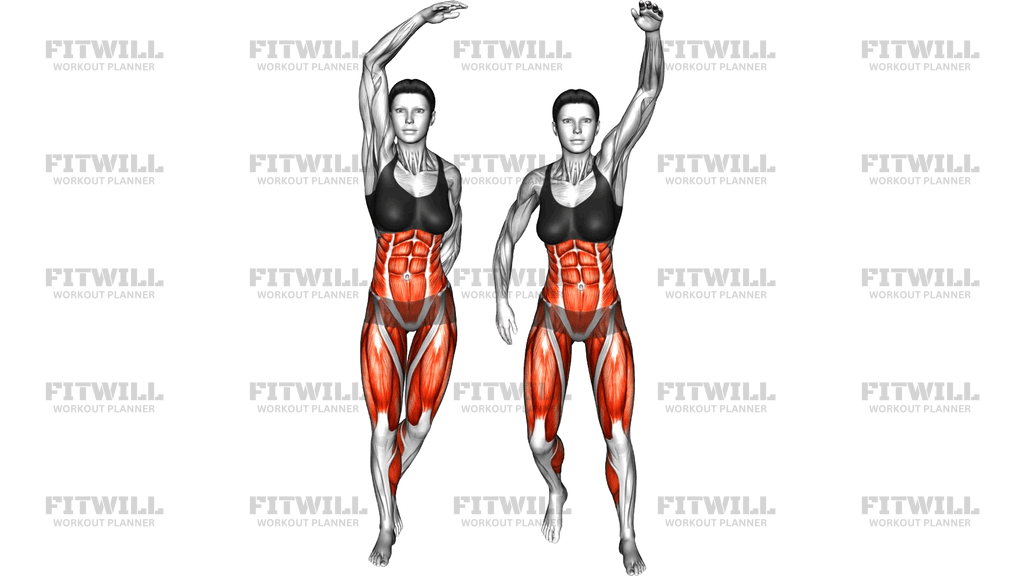
Instructions
- Stand tall with your feet hip-width apart, arms relaxed at your sides, and your weight centered over both feet.
- Step one foot back behind you about a_stride's length, placing the ball of that back foot on the floor and keeping your hips facing forward.
- Raise the arm opposite your front leg straight overhead so the upper arm is close to your ear, and let the other arm hang relaxed by your side.
- Brace your abdominal wall lightly and lengthen through the crown of your head before starting the bend.
- Bend sideways over the front leg, arcing the raised arm up and over while the hips shift slightly toward the back-foot side.
- Continue until you feel a firm stretch along the side of the waist and the outer hip of the back leg, holding the end position for one breath.
- Reverse the exact arc, stacking your shoulders over your hips as the raised arm returns to vertical.
- Exhale as you bend to the side and inhale as you come back up, keeping the breathing steady and unhurried.
- Step the back foot forward to return to the starting stance, then switch legs and repeat on the other side.
Tips & Tricks
- If the overhead arm drifts forward, the bend becomes a forward slump. Check your arm from the side of your vision and keep it in line with your ear throughout the bend.
- A common mistake is hinging at the hips so the chest drops toward the thigh. Think of bending along a curve, with the ribs moving sideways away from the hips rather than the torso folding.
- Keep the back foot's heel lifted. Driving that heel down locks the ankle and pulls the stretch out of the hip and waist.
- Do not let the front knee cave inward or roll outward as you bend; press the whole front foot into the floor and track the knee over the toes.
- Avoid twisting the torso to reach farther. If the shoulders start to rotate, shorten the range and keep the chest facing forward.
- Keep the neck neutral. Looking up at the raised hand strains the neck and usually shortens the side bend instead of improving it.
- If your balance wobbles, widen the stepback slightly less at first or hold onto a wall with the free hand until the stance feels steady.
- Control the return as much as the bend. Snapping back up to vertical wastes the second half of the rep and can jar the lower back.
- Move a little slower on the first rep of each side to feel which part of the waist is tight, then match that range on subsequent reps rather than forcing depth.
Frequently Asked Questions
Which muscles does the Stepback Side Bend work?
The primary muscles are the obliques along the side of the waist, with the quadratus lumborum assisting the lateral bend. The glutes and thighs of the staggered stance stabilize the body, and the shoulder of the raised arm helps drive the overhead reach.
Is the Stepback Side Bend suitable for beginners?
Yes. It requires no equipment and the range is easy to scale by shortening the stepback and reducing the bend. Beginners often benefit from holding a wall lightly with the free hand until balance feels secure.
Why does one foot step back instead of staying in a normal stance?
The staggered stance lengthens the outer hip and thigh of the back leg and shifts your center of gravity, so the side bend happens over a moving base. This adds a balance and hip-stability demand that a regular standing side bend lacks.
Should the raised arm match the front leg or the back leg?
Reach the arm opposite your front leg, which is the side you bend toward. This arrangement lengthens the side of the waist over the front leg and gives the obliques a full stretch and contraction on each rep.
How many reps of the Stepback Side Bend should I do?
For warm-up or mobility purposes, 6-10 slow reps per side work well. In a standing core circuit, pair it with another oblique drill and aim for 8-12 controlled bends per side.
My lower back aches when I bend sideways. What should I change?
Reduce the depth of the bend, shorten the stepback, and keep a light brace in your abdominals so the spine does not just collapse sideways. If discomfort persists, drop the overhead arm to a hand-on-hip version and rebuild the range gradually.
Can I use a weight for the Stepback Side Bend?
You can hold a light dumbbell in the raised hand once the bodyweight version feels easy, but the overhead position changes the load on the shoulder and spine. Most people get more from perfecting the arc and tempo with bodyweight first.
What is a good substitute if standing balance is difficult?
Perform a standing side bend with both feet flat and no stepback, or a kneeling side bend with the opposite arm overhead. Both keep the lateral bending pattern while giving you a wider or lower base of support.
Should I feel it more in the waist or the hip of the back leg?
You will usually feel a stretch through both the side of the waist and the outer hip of the back leg, which is normal for this staggered setup. If one area dominates completely, adjust the step length until the sensations feel more even.