Brettzel
The Brettzel is a side-lying mobility drill that stacks two powerful stretch positions into one: a knee hug that opens the hips and a reach-back that lengthens the quadriceps and hip flexors. You lie on one side, pull your top knee toward your chest with the bottom arm, then reach back with the top arm to hold your top ankle. The result is a simultaneous stretch through the front of the thigh, the front of the hip, and a rotational opening through the chest and upper back.
This movement earns its place in warm-ups and cooldowns because so many people spend their day seated. Sitting shortens the hip flexors and quads, and it stiffens the mid back into a forward slump. The Brettzel addresses all three at once, which is why it shows up frequently in strength and mobility programs, particularly before squatting, running, or any activity that demands hip extension and a tall spine.
Setup matters more here than in most stretches. Your hips need to stay stacked and your spine long; if you roll backward or forward as you reach for your ankle, you lose the quad stretch and turn the drill into a loose spinal twist. Keep the bottom leg straight as an anchor, and let the top knee rest against the floor or close to it as you draw it in. The stretch should feel strong but never sharp, especially around the knee you are reaching for.
To perform it well, move in stages rather than all at once. First settle into the side-lying position and breathe. Second, draw the top knee in and feel the glute and outer hip. Only then reach back for the ankle, letting the shoulder rotate open. Hold with slow, steady breaths, letting each exhale soften the stretch slightly. Then switch sides and repeat. Most people find one side noticeably tighter, which is useful information about how they move.
You will see the Brettzel used as a pre-training opener, a post-run reset, and a nightly desk-worker decompression. It pairs naturally with crawls, hip bridges, and thoracic rotations in a short mobility circuit. If reaching the ankle is out of reach, looping a towel around the ankle makes the position accessible without forcing the shoulder.
Treat this as a breathing exercise as much as a stretch. Forcing the reach with a held breath defeats the purpose. Two to three rounds of thirty seconds per side is a sensible dose, and staying relaxed in the neck and face is a good sign you are doing it right.
[ Workout Log & Planner ]
Put your next workout in Fitwill
Keep your plan and training log ready when you are.


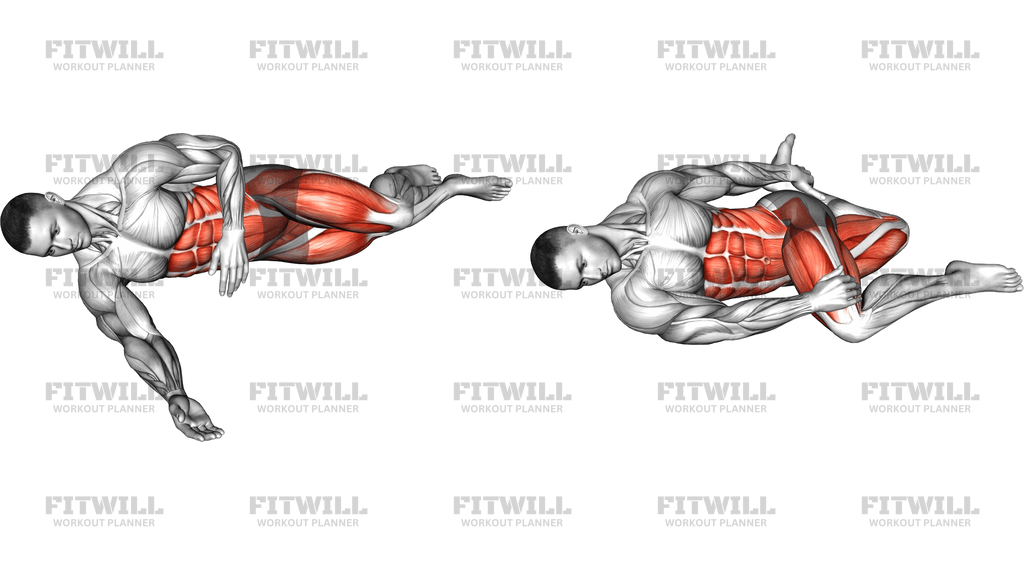
Instructions
- Lie on your side on an exercise mat with your bottom leg straight and your head supported in a neutral line with your spine.
- Bend your top knee and let your hips stay stacked, one on top of the other, without rolling forward or back.
- Reach your bottom arm across and place your hand on the top knee, then gently draw the knee toward your chest.
- Bend your top knee further and reach back with your top arm to grab the ankle or foot of that same top leg.
- Once you have the ankle, gently pull it back so you feel a stretch along the front of the thigh and hip of the top leg.
- Let your top shoulder rotate open toward the ceiling as you breathe out, expanding the stretch through the chest and upper back.
- Hold for 20 to 40 seconds, taking slow nasal breaths and sinking a little deeper with each exhale.
- Release the ankle first, then release the knee, and control both legs back to the stacked side-lying position.
- Roll over or switch sides and repeat the same sequence on the other hip.
Tips & Tricks
- If your top hand cannot reach the ankle, loop a towel around the ankle and hold the ends instead of collapsing your shoulder forward to chase the foot.
- Keep the knee you are hugging in line with your hips; yanking it diagonally across your body turns the quad stretch into an awkward lumbar twist.
- Do not let the reaching shoulder shrug up to your ear. Press it gently down and back so the rotation comes from the mid back, not the neck.
- A sharp pulling sensation behind the knee or in the kneecap means you are pulling the ankle too hard. Ease off until the stretch lives in the thigh and hip.
- Keep the bottom leg truly straight and heavy on the floor. A drifting bottom leg makes the whole position unstable and dilutes the stretch.
- If the front-of-hip stretch is intense but you feel nothing in the mid back, spend more time in the knee-hug phase before reaching back.
- Breathe out slowly during the reach instead of holding your breath; the ribs and thoracic spine open more on the exhale.
- Spend an extra round on your tighter side. Most people need it, and symmetric hips pay off in squats and running stride.
Frequently Asked Questions
What muscles does the Brettzel stretch?
The Brettzel primarily targets the hip flexors and quadriceps of the top leg, especially the rectus femoris which crosses both the hip and knee. The knee hug also works the glutes and outer hip, while the reach-back opens the chest and rotates the thoracic spine.
Is the Brettzel good for beginners?
Yes, it is beginner friendly because it uses no load and your own range decides the depth. Beginners may only manage the knee hug with a partial reach back, which is a perfectly good starting point.
Why do I grab the ankle in the Brettzel instead of just hugging the knee?
Holding the ankle puts the top hip into extension with the knee bent, which is what lengthens the quad and hip flexor. Without the reach-back you only get a glute stretch and lose the front-of-thigh component.
Should the Brettzel be done before or after a workout?
It works well before lower body training as a hip-opening prep, and after running or lifting to restore hip extension. Hold it shorter before training and longer, around 30 to 40 seconds, afterward.
How long should I hold the Brettzel?
Aim for 20 to 40 seconds per side, repeating two to three rounds on any tighter side. Longer relaxed holds tend to produce more lasting change in the hip flexors than quick, forceful pulls.
My knee hurts when I pull the ankle back in the Brettzel. What should I change?
Reduce how far you pull the ankle and keep the knee bend comfortable rather than forcing the heel toward your glutes. If discomfort persists, skip the reach-back and stay with the knee hug, or use a towel to soften the grip.
Can I do the Brettzel without a mat?
Yes, any firm but comfortable surface such as carpet works. A mat is recommended because you are lying on your side with a bony hip and knee in contact with the floor.
One side feels much tighter in the Brettzel. Is that normal?
Very normal, especially for people who habitually stand or sit with weight shifted to one side. Give the tighter side an extra round or two rather than trying to force it to match the loose side immediately.
What can I substitute for the Brettzel if I cannot get down to the floor?
A standing quad stretch combined with a knee pull approximates the two components, though with less spinal rotation. A couch stretch is a stronger alternative if floor-lying is fine but the reach-back is the limiting factor.
Is it normal to feel the Brettzel in my lower back instead of my hip?
If the sensation is mostly in your lower back, you are likely arching the lumbar spine or letting your hips roll as you reach. Re-stack the hips, brace the ribs down slightly, and take a smaller reach so the tension returns to the thigh and hip.