Twisting Woodchopper
The Twisting Woodchopper is a standing, rotational body weight exercise that mimics the diagonal swing of chopping wood, except you are swinging your own arms and torso instead of an axe. You start in a wide stance with both hands clasped and raised overhead to one side, then sweep them down and across your body toward the opposite hip, rotating through the waist as you go. Because no equipment is required, it can be done anywhere, which makes it a practical choice for warm-ups, home workouts, and circuit training.
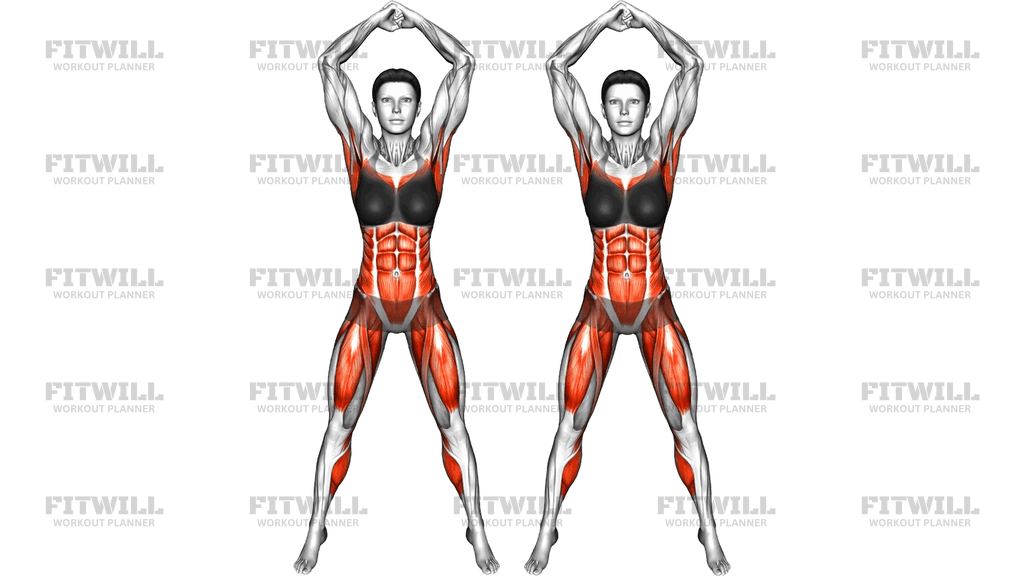
The main work comes from the obliques, the muscles along the sides of your waist that drive rotation. The rectus abdominis braces and flexes the trunk slightly as you chop, while the glutes and quadriceps stabilize the wide stance and absorb the shift of weight from one leg to the other. The shoulders and upper back stay active to keep the clasped hands moving as one unit, and the lower back works isometrically to control the rotation rather than collapse into it.
This movement is useful for anyone who wants to train rotation in a safe, controlled way. Rotation is often missing from basic ab routines that only include crunches and planks, yet twisting patterns show up constantly in daily life and in sports like tennis, golf, baseball, and throwing. The diagonal path also teaches your upper and lower body to coordinate through the core, which is what makes chopping patterns a staple in functional training.
Setup matters more than speed here. A wide, stable stance gives your hips room to rotate without forcing the knees to twist, and keeping the arms long with a firm grip of one hand over the other turns your upper body into a single lever. If the stance is too narrow or the arms bend and wander, the rotation gets absorbed by the shoulder joints and lower back instead of the waist, which is exactly what you want to avoid.
To execute it well, think of the movement as originating from the trunk, not the arms. Pivot the back heel naturally as you chop, let the eyes follow the hands, and finish with the hands across the opposite thigh while the torso has rotated to face that direction. Return along the same diagonal path with control rather than letting gravity yank you back overhead.
A few practical points keep this exercise safe and effective. Move at a moderate tempo, keep the knees soft and tracking over the toes, and keep the core braced throughout so the lower back is supported. Complete all repetitions on one side before switching, or alternate sides rep by rep if you prefer, and stop short of any range that causes pinching or strain.
[ Workout Log & Planner ]
Put your next workout in Fitwill
Keep your plan and training log ready when you are.


Instructions
- Stand with your feet roughly twice shoulder-width apart, toes turned slightly outward, and keep a soft bend in both knees.
- Clasp your hands together with one palm gripping the other, and raise both arms overhead so they extend diagonally above your right shoulder.
- Brace your core as if preparing for a light push, and look up toward your hands to set your starting posture.
- Exhale and sweep your clasped hands down and across your body in a diagonal arc, ending near the outside of your left thigh.
- As you chop, rotate your torso to the left, shift your weight toward the left leg, and let the right heel lift naturally off the floor.
- Keep both arms long and straight throughout the swing so the shoulders, torso, and hands move as one piece.
- Pause briefly at the bottom of the chop with your core tight, feeling the contraction along the left side of your waist.
- Inhale and return your hands along the same diagonal path back overhead to the right shoulder, rotating the torso back to the start.
- Complete all repetitions on one side, then switch so the hands start overhead to the left and chop down toward the right thigh.
- Reset your stance and brace between sets if your position drifts, and keep the knees tracking over the toes the entire time.
Tips & Tricks
- The most common mistake is pulling with the arms and elbows. Your hands should travel because the trunk rotates, not because the shoulders yank them down.
- If your lower back aches instead of your waist, you are likely rotating from the lumbar spine with a loose core. Tighten the abdominals before each rep and shorten the arc slightly.
- Do not lock the knees. A soft bend lets the hips contribute to the rotation and protects the knee joints as weight shifts side to side.
- The back heel should pivot up as you chop. Forcing the foot flat while twisting is a fast route to knee discomfort.
- Control the return as much as the chop itself. Letting the arms crash back overhead kills the tension and turns the second half of every rep into wasted motion.
- Start with no added speed and treat the movement like a pendulum with brakes. Once the path feels smooth, you can add tempo or hold a light object such as a small ball if you want more load.
- Keep the eyes on the hands. Following the arc helps the neck, shoulders, and spine rotate together instead of leaving the head twisted behind.
- If your stance is too narrow, your hips cannot rotate and the movement turns into a side bend. Widen the feet until the chop feels like it comes from the waist, not the spine folding sideways.
- Balance issues at the bottom of the chop usually mean the weight shift is too aggressive. Shift to about sixty percent onto the lead leg rather than dumping everything onto it.
Frequently Asked Questions
Which muscles does the Twisting Woodchopper work the most?
The obliques on the side of the waist do the primary rotational work, with support from the rectus abdominis, glutes, and quadriceps as they stabilize the wide stance and control the weight shift.
Is the Twisting Woodchopper a good exercise for beginners?
Yes, because it uses no equipment and the load is simply your own body. Beginners should start slowly, use a shorter arc, and focus on rotating from the waist rather than swinging hard from the shoulders.
How wide should my stance be during the Twisting Woodchopper?
Roughly twice shoulder-width works for most people, wide enough that the hips can rotate freely and the back heel can lift without the knees twisting inward. If the chop feels like a side bend, widen your feet.
Why do my shoulders fatigue before my abs in this exercise?
That usually means the arms are bending or initiating the swing. Straighten the elbows, clasp the hands firmly, and let the rotation of the trunk carry the arms so the waist, not the shoulders, drives the movement.
Should I complete all reps on one side or alternate sides of the Twisting Woodchopper?
Either works, but finishing all repetitions on one side before switching makes it easier to notice and correct side-to-side differences in strength or coordination.
Can I add weight to the Twisting Woodchopper?
Yes, once your form is consistent you can hold a light medicine ball or similar object in both hands along the same diagonal path. Add load gradually, because rotation under load stresses the spine more than straight-plane movements.
How does the Twisting Woodchopper differ from a regular crunch or plank?
Crunches and planks train the abs mostly in forward flexion or anti-rotation, while the Twisting Woodchopper trains actual rotation along a diagonal path, which better matches twisting actions in sports and everyday movement.
Is it safe for my lower back and knees?
When performed with a braced core, soft knees, and a pivoting back heel, it is generally a controlled and joint-friendly rotation drill. Avoid forcing extra range, keep the knees tracking over the toes, and skip the exercise if rotation currently causes you pain.
How many repetitions of the Twisting Woodchopper should I do?
Ten to fifteen controlled chops per side is a solid working range, or twenty to thirty at a steady rhythm if you are using it as a warm-up or conditioning move rather than a strength set.