Swing Torso Twist
The Swing Torso Twist is a dynamic, body-weight rotation drill performed from a wide, grounded stance with both arms reaching straight out in front of the chest. From there, you swing your upper body from one side to the other in a smooth, rhythmic arc, letting the arms travel with the torso as a single unit. Because nothing external is moving, the entire challenge comes from controlling your own rotation, which makes it an excellent warm-up, a standing core activation drill, and a low-impact way to loosen the midsection and hips.
The main work falls on the obliques along the sides of your waist, which drive and decelerate every swing. The rectus abdominis and deeper transverse abdominis brace to keep your ribcage and pelvis connected, while the adductors and outer hip muscles of the wide stance stabilize your legs so the twist comes from your waist rather than your feet sliding around. Holding the arms extended also lightly engages the shoulders and upper back as they travel with each rotation.
Setup matters more than it looks. A stance noticeably wider than shoulder width, with toes turned slightly out, gives you a stable base so the swinging motion does not drag your knees or ankles along. Extending the arms at chest height lengthens the lever, which amplifies the rotation through the torso — so keep the reach honest rather than letting the hands droop or drift as you fatigue.
To execute it well, plant your feet and think of sweeping your hands from one side of the room to the other, rotating through the waist while your hips and legs stay mostly facing forward. Let the swing build gradually in range rather than yanking to full rotation on the first rep. The arms stay long, the chest stays tall, and the head travels with the spine instead of snapping ahead of it.
This movement fits neatly at the start of a workout as a warm-up for any rotational sport or lifting session, and it also works as a standalone standing core exercise in circuits, since continuous swinging raises the heart rate while the waist works. It is friendly for beginners because it is load-free, but the wide stance and repeated rotation reward patience — a controlled, moderate range beats a fast, sloppy swing every time.
For safety, keep the movement in the trunk and avoid forcing the twist if you feel any pinching in the lower back or hips. If balance is an issue, narrow the stance slightly or hold onto a sturdy support with one hand until the rhythm feels natural.
[ Workout Log & Planner ]
Put your next workout in Fitwill
Keep your plan and training log ready when you are.


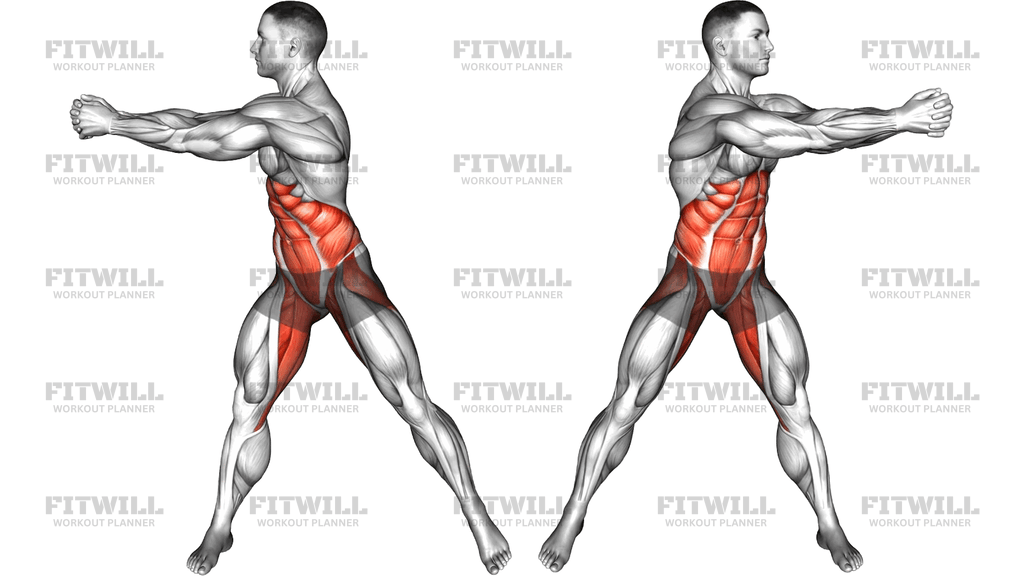
Instructions
- Stand with your feet roughly one and a half to two shoulder-widths apart, toes turned slightly outward, and shift your weight evenly across both feet.
- Extend both arms straight out in front of your chest at shoulder height and clasp your hands or press your fingertips together, keeping the elbows soft.
- Draw your belly button in slightly and stand tall, stacking your ribs over your hips before any movement begins.
- Swing both arms and your upper body to one side, rotating through the waist while your legs and feet stay planted and mostly facing forward.
- Follow the swing through the front of your body and continue to the opposite side in one continuous arc, letting the arms act as a long lever.
- Pause for a beat at each end of the range when you are learning the movement, feeling the side of your waist shorten on the side you rotate toward.
- Keep your hips square and resist the urge to let them swing out with the torso — the rotation should come from the waist, not the pelvis sliding sideways.
- Exhale as you swing through the middle and inhale briefly at each end of the arc, keeping the breath steady and rhythmic.
- Continue alternating side to side for your chosen number of reps or time, then stop the swing gently and bring your arms down before stepping out of the stance.
- Reset your stance and brace before starting the next set rather than twisting into position while off balance.
Tips & Tricks
- Start with a smaller arc for the first several swings and widen the range as the waist warms up; jumping straight to full rotation is the most common way people strain this drill.
- If your heels lift or your feet pivot as you swing, widen your base or press the outer edges of your feet down — a stable stance is what forces the obliques to do the work.
- Keep the arms at chest height throughout; as fatigue sets in the hands tend to drop, which shortens the lever and turns the move into a lazy shoulder swing.
- Do not let your lower back arch and hinge backward at the end of each swing — the twist is horizontal rotation, not a lean.
- Imagine a pole running through the top of your head down through your spine and rotate around it; this keeps the movement tall and prevents slumping forward.
- Breathe out through the center of each swing instead of holding your breath, which is a common mistake once the rhythm speeds up.
- Keep your head traveling with your shoulders rather than whipping ahead — your eyes can lead slightly, but the neck should never twist independently of the torso.
- If your inner thighs feel strained from the wide stance, turn the toes out a few more degrees, which gives the adductors and hips more room to work comfortably.
- For a warm-up, prioritize smooth continuous rhythm; for a core-strength set, slow down and add a deliberate squeeze of the waist at each end of the arc.
Frequently Asked Questions
What muscles does the Swing Torso Twist work?
The obliques on the sides of your waist do most of the driving and controlling, supported by the rectus abdominis and deeper core muscles that brace the trunk. The wide stance also challenges the inner thigh and hip muscles to keep your legs steady as you rotate.
Is the Swing Torso Twist good for beginners?
Yes, because it uses no load and you control the speed and range. Beginners should start with a smaller arc and a moderate pace, then widen the swing as the waist and hips loosen up.
Why is the stance so wide in the Swing Torso Twist?
The wide base keeps your legs and hips planted so the rotation happens through the waist instead of your whole body pivoting. It also gives the inner thighs and hips a mild stability demand, which is part of the exercise's value.
Should my hips twist along with my shoulders?
The hips can rotate a few degrees naturally, but they should not swing freely with the arms. If your pelvis and feet are turning dramatically with each swing, you are losing the rotational work in your waist.
How do I know if I am swinging too fast?
If your heels lift, your lower back arches sharply at the end of each arc, or you cannot stop the swing smoothly at either side, the pace has outgrown your control. Slow down and shrink the range until the ends of the arc feel deliberate.
Can I use the Swing Torso Twist as a warm-up?
Absolutely — it is one of its best uses. A set of continuous, moderate swings raises your heart rate and prepares the waist, hips, and shoulders for rotational sports like tennis, golf, or baseball, or for core-focused lifting sessions.
What can I substitute if standing rotation bothers my lower back?
Try a seated or lying rotational core exercise where the spine is supported, or reduce the stance width and range so the twist stays comfortable. Stop the standing version entirely if you feel sharp or pinching sensations rather than muscular effort.
How many reps or how long should I perform the Swing Torso Twist?
For warming up, 20 to 40 continuous swings or roughly 30 seconds works well. For a standing core set, slow the tempo and aim for 10 to 15 controlled twists per side with a brief pause at each end.
Do I need my hands clasped, or can the arms move separately?
Clasping or pressing the hands together is preferred because it makes both arms act as one long lever, which loads the rotation evenly through your waist. Letting the hands separate usually means one arm drifts and the twist becomes lopsided.