Pike Push Up From Deficit
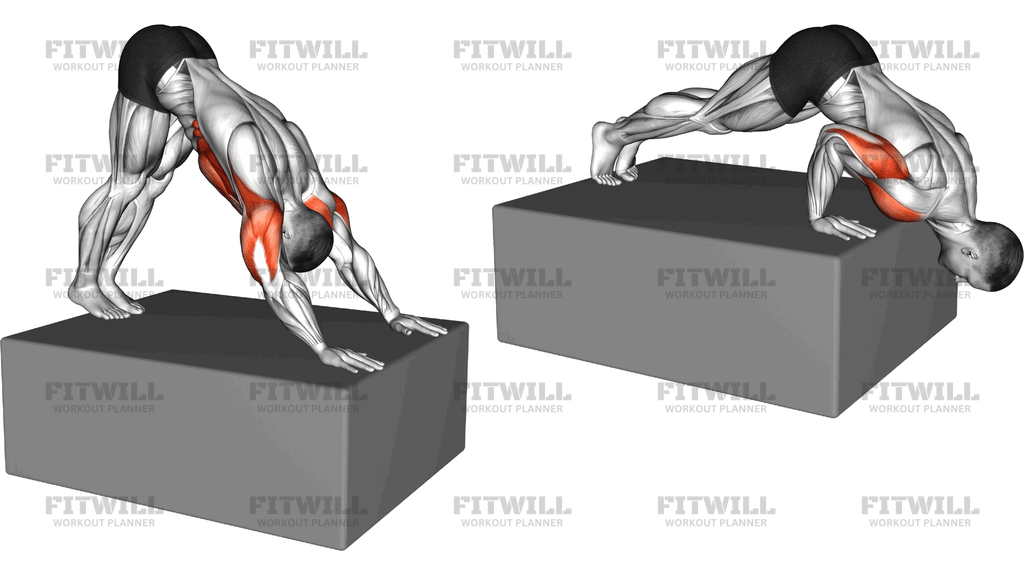
The Pike Push Up From Deficit is a vertical pressing variation where your feet are elevated on a sturdy box or platform while your hands stay on the floor, creating a deficit that lets your head and shoulders travel lower than your hands at the bottom. Because your hips sit high and your torso angles steeply toward the floor, the movement closely mimics an overhead press with your own body weight. The added depth from the deficit makes it noticeably harder than a standard pike push up and pushes your shoulders through a longer range of motion.
This exercise is a favorite progression for anyone working toward handstand push ups, since it replicates the overhead pressing pattern without requiring balance upside down. It is equally useful for general upper body strength, especially if you train at home with minimal equipment and have outgrown regular push ups. Lifters who want bigger, stronger front delts and triceps without pressing a barbell overhead will get a lot out of it.
The primary work falls on the front and side shoulders, with the triceps locking out each rep and the upper chest assisting near the bottom. Your upper traps, serratus, and core work hard to hold the inverted V position and keep your ribs from sagging as you press back up. The deficit version demands more from the shoulder stabilizers because you control the weight through a deeper stretch at the bottom.
Setup matters here more than in most push up variations. Your box needs to be tall enough to create a real deficit but stable enough that it will not slide when your toes dig into it. Walk your hands far enough from the box that your hips stack high over your shoulders, forming a sharp pike rather than a flat plank. Hands should be slightly wider than shoulder width, fingers spread, with your head aimed at the space between them.
To execute well, bend your elbows and let your head travel down and slightly forward toward the floor between your hands, keeping your hips high the entire time. Descend until your head nears the floor or your shoulders reach a depth you can control, then press back up by driving the floor away until your arms are straight. The path should feel like a vertical press, not a horizontal push up, so keep your weight over your shoulders rather than drifting toward your chest.
Because the deficit increases the stretch on the shoulder at the bottom, build up gradually. If you cannot control the full depth, reduce the box height or place a folded towel or mat on the floor as a target and depth limiter. Keep your neck neutral rather than forcing your head to touch the floor, and stop the set as soon as your hips drop or your elbows flare wildly, since those are signs the set is no longer productive.
[ Workout Log & Planner ]
Put your next workout in Fitwill
Keep your plan and training log ready when you are.


Instructions
- Place a sturdy box or step platform on a non-slip surface and set your toes on top of it so your feet are elevated behind you.
- Walk your hands out on the floor until your hips are stacked high over your shoulders in a sharp pike, with straight arms and hands about shoulder width apart, fingers spread.
- Squeeze your legs, tuck your pelvis slightly, and brace your core so your lower back does not sag toward the floor.
- Turn your elbows out at roughly 45 degrees rather than flaring them straight to the sides.
- Inhale, then bend your elbows and lower your head down and slightly forward, aiming for the floor between your hands while keeping your hips high.
- Descend until your head is close to the floor or your shoulders reach the deepest point you can control, letting the deficit take your head below hand level.
- Exhale and press the floor away, straightening your elbows until your arms are locked out and your shoulders are pushed up between your arms.
- Keep your hips elevated throughout the rep; if they drop toward a plank position, reset before continuing.
- Complete all reps on one side of the box edge or re-set your feet between reps if you drift, then step down carefully rather than hopping off the box.
Tips & Tricks
- The most common mistake is letting the hips sink into a plank, which turns this into a decline push up and removes the overhead pressing angle; if this happens, walk your hands closer to the box and think about pushing your hips to the ceiling.
- Use a mat, folded towel, or book stack on the floor as a depth target so every rep touches the same point instead of guessing when to stop.
- If your elbows flare out to a T position, your shoulders are likely fatigued; drop to a lower box or standard pike push ups for the rest of the set.
- Start with a box only slightly higher than your feet would be in a normal pike push up, then raise it over weeks as your bottom-position control improves.
- Keep your neck long and relaxed instead of craning to reach the floor with the top of your head; the target is controlled depth, not head contact.
- Grip the floor actively with spread fingers and turn your fingertips slightly outward if your wrists complain at the deep end range.
- Because the stretch at the bottom loads the shoulder in a vulnerable position, warm up your shoulders with arm circles and a few easier pike push ups before hitting the deficit version.
- Film yourself from the side for a set; most people discover their pike angle is far shallower than it feels.
- Slow the lowering phase to two or three seconds if you find yourself bouncing out of the bottom, since the stretch reflex is what usually fails first.
Frequently Asked Questions
What muscles does the Pike Push Up From Deficit work?
The front and side shoulders do most of the pressing, supported heavily by the triceps during the lockout. Your upper traps, serratus, and core also work to hold the elevated pike position throughout the set.
How is the deficit version different from a regular pike push up?
In the deficit version your feet are elevated on a box while your hands stay on the floor, so your head can travel below hand level for a longer range of motion. This makes it substantially harder and a better stepping stone toward handstand push ups.
Is the Pike Push Up From Deficit suitable for beginners?
It is best treated as an intermediate progression. Start with standard pike push ups on the floor, and only add the elevated deficit once you can complete controlled reps with your hips staying high and no bouncing out of the bottom.
How tall should the box be?
Start with a box around knee height or slightly lower so the pike angle is steep but the bottom position is still manageable. As your strength and control improve, you can progress toward a taller box that more closely matches a handstand push up range.
Why do my wrists hurt at the bottom of the movement?
The deficit places your wrists into deep extension under load, which bothers many people. Try turning your fingers slightly outward, gripping the floor hard, warming up your wrists, or using parallettes if the discomfort continues.
Can this replace overhead pressing with a barbell or dumbbells?
For many home trainees it covers the vertical pressing pattern well, especially with progressive overload through box height, reps, and tempo. That said, loaded pressing offers easier small jumps in weight, so many people use both.
What is the most common mistake in this exercise?
Letting the hips drop into a plank position as fatigue sets in, which shifts the work from the shoulders to the chest and turns it into a decline push up. Stop the set or reset your pike as soon as you feel your hips sinking.
How does this exercise help with handstand push ups?
It trains the same overhead pressing angle and deep range of motion while removing the balance demand. Once you can handle a tall box deficit for solid reps, the strength base for wall-supported handstand push ups is largely in place.
How many reps and sets should I do?
Because the movement is demanding at the bottom range, 3 to 5 sets of 5 to 10 clean reps works well for strength. Prioritize keeping your hips high over chasing higher rep numbers.
Is it safe for the shoulders given the deep stretch at the bottom?
For healthy shoulders with a gradual build-up in box height, it is generally well tolerated and even builds stability through the end range. If you have a history of shoulder impingement or pain during overhead positions, work with a shallower range first and stop any set that produces sharp pain.