Butterfly Twist
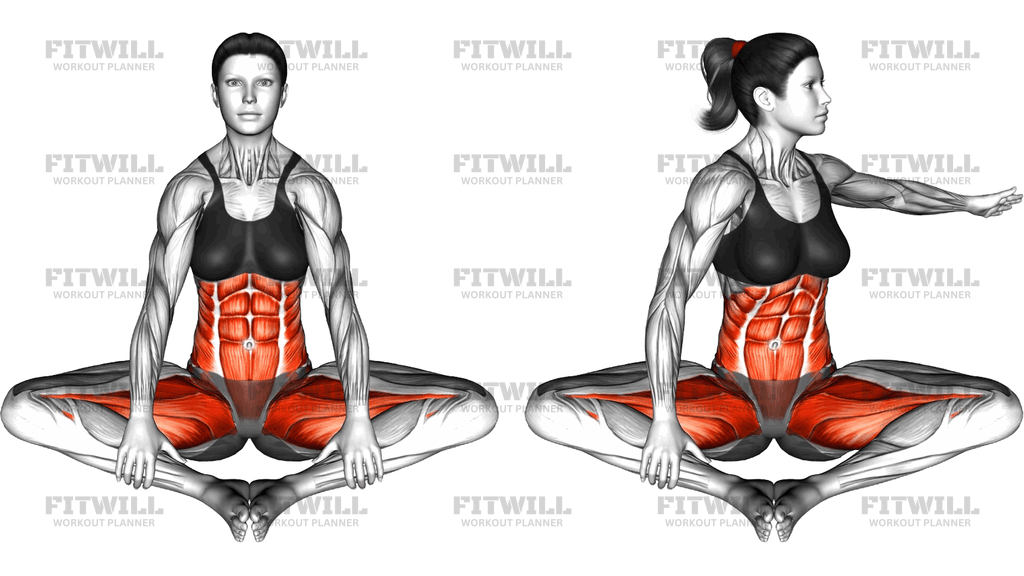
The Butterfly Twist is a seated stretch that combines the classic butterfly position with a slow rotation of the upper body. You sit tall with the soles of your feet pressed together and your knees dropped out to the sides, then twist your ribcage and shoulders to one side while your seat stays grounded. The stretch reaches two stubborn areas at once: the adductors along the inner thighs and the obliques wrapping around your waist.
This movement is useful for almost anyone who sits a lot, since prolonged sitting keeps the hips constantly folded and the trunk muscles dormant. It is also a common warm-up and cooldown choice for lifters who squat and hinge, for runners who need freer hip rotation, and for martial artists and dancers who work in straddle and open-hip positions.
The setup matters more than people expect. When your heels are pulled close to your body and your spine is genuinely upright before you twist, the rotation comes from your ribs and waist instead of from a rounded lower back. Slouch first and the twist loses most of its effect on the obliques while adding unnecessary pressure to the lumbar discs.
To perform it well, anchor both sit bones evenly, lengthen through the crown of your head, and rotate on an exhale. One hand rests on your feet or ankles while the opposite arm opens behind you or presses gently against your knee to deepen the turn. The stretch should feel like a pulling sensation through the inner thighs and a wrapping tension along the side of the waist, never sharp pain in the groin or spine.
Because no equipment is required beyond a comfortable floor surface, the Butterfly Twist is easy to slot into almost any routine. Hold each side for 20 to 45 seconds, breathe steadily, and avoid bouncing. If your knees ride high off the floor, that is normal; flexibility improves with consistency rather than force.
[ Workout Log & Planner ]
Put your next workout in Fitwill
Keep your plan and training log ready when you are.


Instructions
- Sit on an exercise mat or the floor and bring the soles of your feet together, letting your knees fall open toward the sides.
- Draw your heels in toward your groin to a comfortable distance and hold your feet or ankles with both hands.
- Sit up tall on both sit bones, stacking your spine so your ears, shoulders, and hips are roughly aligned.
- Brace lightly by drawing your lower belly in and take a slow breath in to lengthen your spine.
- Exhale and rotate your ribcage and shoulders to one side, keeping your hips and knees exactly where they started.
- Place one hand on your feet for support and let your other arm swing behind you or press gently on your outer knee to turn a little further.
- Hold the twisted position for 20 to 45 seconds, breathing slowly and relaxing deeper into the stretch on each exhale.
- Inhale and slowly rotate back to center, squaring your chest over your feet before switching sides.
- Repeat the twist to the opposite side for the same hold time, and complete 2 to 3 rounds per side if you want a deeper release.
Tips & Tricks
- If your lower back rounds the moment you twist, place a folded towel or firm cushion under your sit bones to raise your hips and restore a tall spine.
- Do not yank your knees down with your hands; the goal of the Butterfly Twist is rotation, and pressing the knees only strains the groin.
- If one side twists noticeably further than the other, start with the stiffer side and spend a few extra seconds there to even out over time.
- Keep your head moving with your shoulders rather than craning your neck to look behind you, which overloads the upper trapezius.
- When your feet feel too far away to hold, loop a towel around them or rest your hands on your ankles instead of bending forward to reach.
- Move your heels closer to your body to bias the inner thighs, or leave them a hand-span away to make the twist easier on tight hips.
- Twisting before you feel prepared often leads to forcing from the shoulders; take one full breath of sitting tall before each rotation.
- Avoid holding your breath during the hold, since exhaling fully is what lets most people rotate a few more degrees comfortably.
Frequently Asked Questions
Which muscles does the Butterfly Twist stretch?
It primarily stretches the obliques along the sides of your waist while the butterfly leg position targets the adductors of the inner thighs. The lower back and hip area also get a gentle release from the seated rotation.
Is the Butterfly Twist suitable for beginners?
Yes, as long as you twist only as far as feels comfortable and keep your spine tall. Beginners can sit on a cushion and skip the arm press on the knee until flexibility improves.
Why do my knees float high off the floor in this stretch?
Tight adductors and hip rotators hold the knees up, which is very common for people who sit frequently. Let the knees hang where they naturally fall and let time, not force, bring them closer to the floor.
How long should I hold the Butterfly Twist?
A hold of 20 to 45 seconds per side works well, repeated two to three times. Longer holds of up to a minute are fine once the position feels relaxed rather than strained.
Should I do the Butterfly Twist before or after a workout?
It fits best after training or as part of a dedicated mobility session, when warm muscles tolerate stretching well. If you use it beforehand, keep the holds short and gentle so you do not temporarily reduce power output in the hips.
Can I practice the Butterfly Twist every day?
Yes, daily practice is generally fine for a gentle stretch like this, especially if you sit for long hours. Stop or reduce the range if you notice lingering soreness in the groin or lower back.
What is the most common mistake in the Butterfly Twist?
Rounding the lower back to chase extra rotation, which shifts the stretch away from the waist and loads the lumbar spine. Keep the chest lifted and let the twist come from the ribs instead.
What can I use as a substitute if I cannot sit on the floor comfortably?
A seated spinal twist on a chair with the feet flat and knees apart offers a similar rotation for the waist, though it trains the inner thighs less. Sitting on a firm cushion with hips elevated is another easy fix.
Does the Butterfly Twist help with squat depth?
It can support better squat mobility by improving adductor flexibility and hip rotation, but it works best alongside loaded movements like deep goblet squats. Stretching alone rarely solves depth issues completely.