Single Arm Scapular Push Up To Rotation
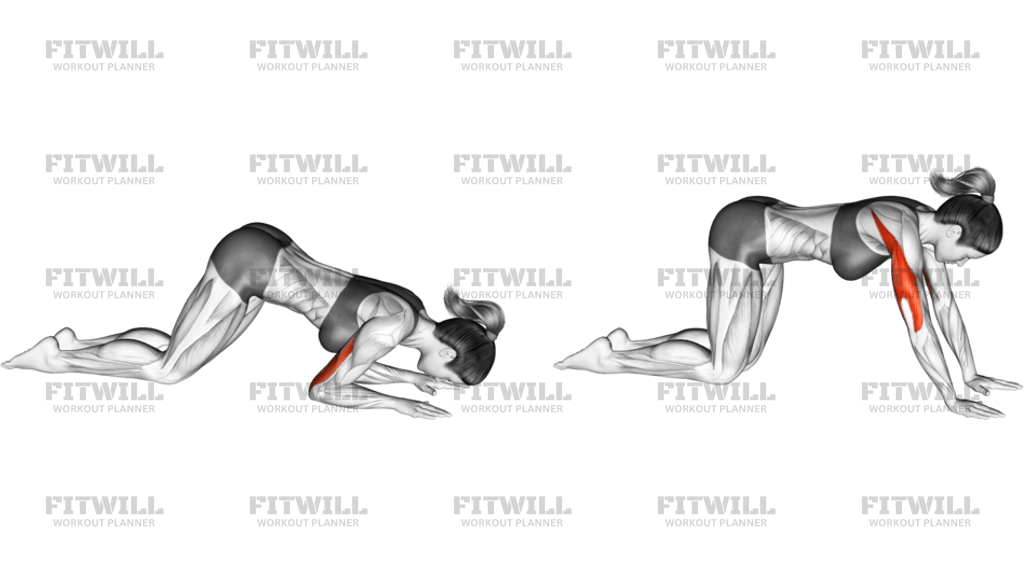
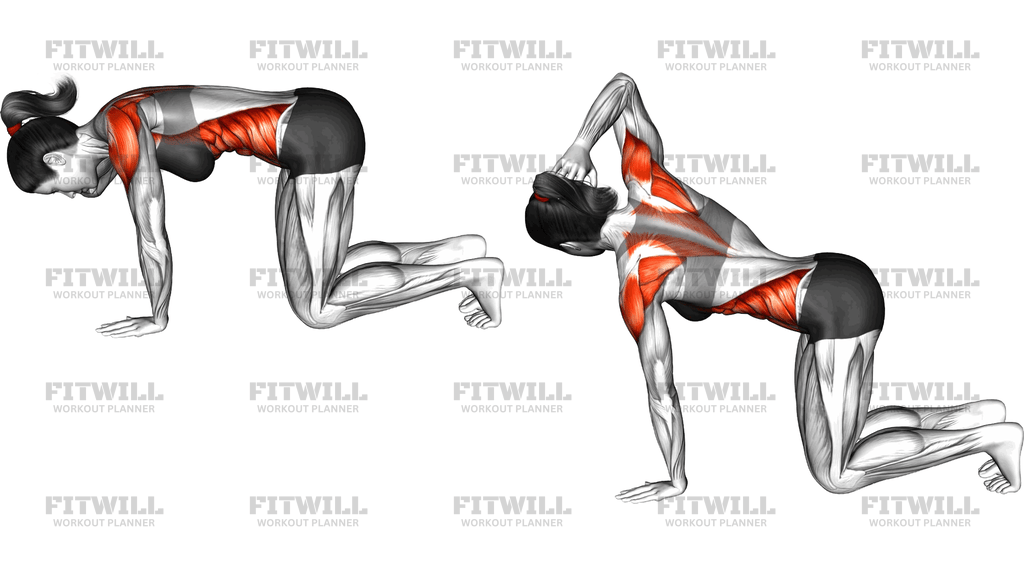
The Single Arm Scapular Push Up To Rotation is a ground-based mobility and stability drill that combines two jobs in one repetition. You support yourself on one straight arm in a kneeling position, drive the shoulder blade forward and let it glide back in a controlled scapular push up, then finish with a thoracic rotation as the free hand reaches across your body. Because you are kneeling instead of holding a full plank, the position removes much of the demand on the legs and lower back, letting you focus entirely on the shoulder blade, the shoulder joint, and the mid-back.
The main target is the serratus anterior, the fan-shaped muscle that wraps around the ribcage just under the armpit and controls how the shoulder blade moves against the ribs. The supporting muscles around the shoulder, along with the middle and upper trapezius, rhomboids, and rotator cuff, all work to keep the arm stable while the blade glides. When you add the rotation, the obliques and the small muscles between the thoracic vertebrae take over, which is why this movement shows up in warm-ups for pressing, throwing, and overhead work.
This is a particularly useful exercise for people whose shoulder blades do not move well when they press. If your shoulder blades flare out, your shoulders roll forward at the top of push ups, or your pressing feels pinchy in front of the shoulder, working one side at a time from a kneeling position gives you a low-load way to relearn the protraction and retraction pattern. The single-arm setup also exposes left-right differences quickly, since each side has to do the work independently.
Setup matters more here than in most drills. Your supporting hand should sit directly under the shoulder with the elbow soft but not locked, and your hips should stay stacked over the knees throughout. If the hand drifts out to the side or the hips rotate as you move, the shoulder blade loses its track and the rotation becomes a compensation instead of a training stimulus.
To execute it well, think of two distinct phases. In the scapular push up, keep the elbow almost still and let the shoulder blade do the moving: push the floor away so the upper back rounds slightly, then lower the chest between the shoulder blades without bending the arm much. For the rotation, keep the supporting arm tall and turn through the ribcage, reaching the free hand across or toward the head, then return with the same control. Two clean phases beat one rushed, blended movement every time.
Common use cases include pre-workout shoulder preparation, rehab-style serratus activation after pressing injuries or long periods of desk work, and as a teaching progression before full push ups, one-arm push ups, or overhead pressing. Keep the range moderate at first, stop the rotation where you can keep the supporting shoulder quiet, and progress repetitions before you chase a bigger turn.
[ Workout Log & Planner ]
Put your next workout in Fitwill
Keep your plan and training log ready when you are.


Instructions
- Kneel down on an exercise mat and place one hand flat on the floor directly under your shoulder, fingers spread forward, with a slight bend in the elbow.
- Stack your hips over your knees and place your free hand behind your head or across your chest, keeping your torso square to the floor.
- Brace your core lightly and press the floor away with the supporting arm so your shoulder blade spreads forward and your upper back rounds a little.
- Reverse the motion by letting your chest sink between the shoulder blades while keeping the elbow nearly straight, so the shoulder blade glides back toward your spine.
- From that retracted position, rotate your ribcage toward the ceiling, turning your free shoulder and head with it as the hand behind your head travels across your body.
- Pause briefly at the end of the rotation, then unwind the torso and press the floor away again to begin the next scapular push up.
- Exhale as you push the floor away and rotate, inhale as you let the shoulder blade settle back.
- Complete all repetitions on one side, then switch the supporting hand and repeat on the other side.
- Reset your kneeling position between sets so the supporting hand stays under the shoulder and the hips stay level rather than drifting side to side.
Tips & Tricks
- The most common mistake is bending the elbow to fake the range. If your arm is doing the work, the shoulder blade is not. Keep the elbow angle nearly constant and let the chest move up and down instead.
- Watch for the supporting shoulder collapsing toward the floor during the rotation. Keep pressing that arm long into the ground so the shoulder stays packed while the ribcage turns.
- If your hips sway as you rotate, narrow your thinking to the ribcage only. Imagine your belt buckle staying pointed straight down at the mat while the upper body turns.
- Rushing blends the two phases together and turns this into a wiggle. Count a full second on the scapular push up and another on the rotation so each part stays distinct.
- Range should be limited by control, not by how far you can twist. A rotation of twenty to forty degrees performed cleanly beats a big turn that drops your supporting shoulder.
- Spreading the fingers and gripping the mat lightly gives you a more stable base and makes the pushing motion of the scapular push up easier to feel.
- If wrist discomfort shows up on the supporting hand, angle the fingers slightly outward or hold onto the edge of a folded mat instead of flat cotton to reduce the extension angle.
- Do not hold your breath through the rotation. Exhaling as you turn tends to let the ribcage rotate further without forcing it.
Frequently Asked Questions
What muscles does the Single Arm Scapular Push Up To Rotation work?
The primary muscle is the serratus anterior, which drives the shoulder blade forward during the scapular push up. The trapezius, rhomboids, rotator cuff, and front of the shoulder stabilize the supporting arm, and the obliques and thoracic rotators handle the turning phase.
Why is this exercise done kneeling instead of in a full plank?
Kneeling removes the load that the legs and core would otherwise contribute, so you can concentrate on clean shoulder blade movement and thoracic rotation. Once the pattern is solid, you can progress the same drill to a plank position.
Is the Single Arm Scapular Push Up To Rotation suitable for beginners?
Yes, it is one of the friendlier shoulder drills because the kneeling position keeps the load low. Beginners should keep the range small and prioritize feeling the shoulder blade glide rather than chasing a large rotation.
Why does my elbow bend during the scapular push up portion?
That usually means the shoulder blade is not moving enough on its own, so the arm compensates. Reduce the range, press the floor away with less force, and focus on the chest rising and lowering between the shoulder blades.
Should my hips rotate when I turn into the rotation phase?
No, the hips should stay stacked over the knees and roughly square to the floor. The rotation should come from the ribcage and mid-back, so if your hips are turning, limit the range and re-brace your core.
Can I use the Single Arm Scapular Push Up To Rotation as a warm-up?
It works very well as a warm-up before push ups, bench pressing, or overhead work, since it wakes up the serratus anterior and adds rotation to the mid-back. One to two sets of five to eight reps per side is usually enough before a pressing session.
What can I do if the rotation feels restricted on one side?
Work within a comfortable range on the restricted side and do not force the turn, since pushing into a stiff rotation often makes the supporting shoulder drop. Consistent, controlled reps on the limited side usually improve the range over time.
How does this exercise differ from a regular scapular push up?
A regular scapular push up is usually done in a plank with both arms and only moves the shoulder blades. This version is single-arm and kneeling, and adds a thoracic rotation, so it trains each side independently and includes mid-back mobility in the same rep.
Is this movement safe if my wrist hurts in a push up position?
Kneeling support puts much less load on the wrist than a full plank, but discomfort can still occur. Try angling the fingers slightly out or supporting the hand on a folded mat or low incline, and skip the exercise if pain persists.