Low Lunge Twist
Low Lunge Twist is a body-weight rotational stretch performed from a deep lunge position. You step one foot forward into a lunge, plant the hand on the same side on the floor inside the front foot, and rotate your chest upward, reaching the opposite arm toward the ceiling so your torso turns toward your front leg. It blends a hip flexor and groin stretch with a thoracic spine rotation, which is why it shows up constantly in yoga flows, warm-ups, and cooldowns alike.
This movement is especially useful for people who spend long hours sitting. Sitting shortens the hip flexors of the trailing leg and stiffens the mid back, and Low Lunge Twist addresses both at once: the back leg's hip flexor gets a long stretch while the rotation mobilizes the thoracic spine and stretches the obliques on the side you're twisting away from. Runners, lifters, and anyone whose lower back feels locked up after training or desk work tend to feel the benefits quickly.
The setup matters more than most people expect. A wide enough stance lets your chest drop between your hands, and placing your front foot flat with the knee tracking over the ankle protects the joint while giving you a stable base. The planted hand should be directly under or slightly ahead of the shoulder, because that contact point is what you press into as you rotate. Without a solid base, the twist comes from collapsing through the shoulder instead of rotating through the spine.
To execute it well, keep the back leg active with the heel lifted and the thigh reaching away from you, press the floor away with your planted hand, and think about turning your ribs and chest rather than just swinging the arm. Your gaze follows the raised hand. The stretch should feel broad across the front of the trailing hip and through the side of your waist, not pinchy in the lower back or front knee.
In practice, Low Lunge Twist works well as part of a dynamic warm-up before squats, running, or any sport that demands rotation, and equally as a standalone mobility drill. Hold it for several slow breaths per side if you're stretching, or move in and out of it for reps if you're warming up. Because it requires no equipment beyond floor space, it's easy to slot in almost anywhere, though a mat makes the planted hand and back foot more comfortable.
[ Workout Log & Planner ]
Put your next workout in Fitwill
Keep your plan and training log ready when you are.


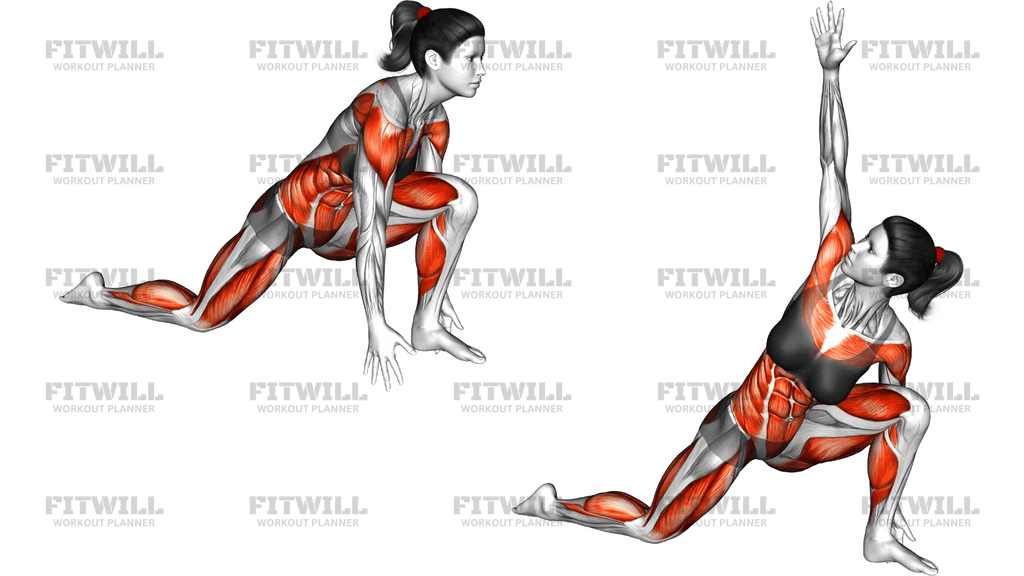
Instructions
- Start on all fours at the top of a mat, then step your right foot forward between your hands so your right knee stacks over your ankle and your left leg extends behind you with the ball of the left foot on the floor.
- Lower your hips forward and down until you feel a stretch along the front of your left hip, and keep both hands on the floor inside your right foot to establish a wide, stable base.
- Press your left hand down firmly into the mat directly under your left shoulder and spread your fingers for grip.
- Brace your core lightly and inhale as you begin to rotate your chest and ribcage up and open toward your right thigh.
- Reach your left arm straight up toward the ceiling so it stacks over your shoulder, turning your gaze up toward your left hand if your neck is comfortable.
- Hold the end position for two to five slow breaths, actively pressing the floor away with the right hand and keeping the back heel lifted and the left thigh engaged.
- Exhale as you lower the left arm back down and place the hand on the floor inside your front foot, reversing the rotation with control.
- Step back to all fours or a standing position, reset, and repeat on the other side with the left foot forward and the right arm reaching up.
Tips & Tricks
- If your hand can't reach the floor comfortably, place it on a yoga block or a stack of books inside the front foot instead of letting the shoulder slump down to compensate.
- The most common mistake is letting the knee of the front leg cave inward during the twist; actively press the knee gently toward the pinky toe side to keep it tracking over the ankle.
- Keep the back leg doing work. A lazy trailing leg lets the lower back hyperextend, so drive the back heel up and back and squeeze the glute to protect the lumbar spine.
- Rotate from the ribcage, not the arm. If your raised arm goes up but your chest stays facing the floor, you've missed the spinal rotation that makes this stretch effective.
- Don't force the neck. If looking up at your raised hand causes discomfort, keep your gaze down or forward and let the rotation happen in the mid back.
- If the top of the back foot hurts on the floor, tuck a folded mat or towel under the toes and ball of the foot for padding.
- Tight hamstrings often pull the hips back and shorten the lunge; widen the stance slightly and let the hips sit lower and forward to keep the hip flexor stretch intact.
- For a warm-up version, move with your breath by reaching up on the inhale and lowering the hand on the exhale for five to eight reps per side rather than holding statically.
Frequently Asked Questions
Which muscles does Low Lunge Twist stretch the most?
The main targets are the hip flexors of the back leg, especially the iliopsoas, along with the obliques on the side you twist away from. The glutes, quads, and thoracic rotators are also involved, and the shoulders work to support the raised arm.
Is Low Lunge Twist good for beginners?
Yes, as long as you scale the position. Beginners can drop the back knee to the mat, place the planted hand on a block, and limit the rotation depth until mobility improves.
Should my back knee be up or down in Low Lunge Twist?
Both versions are valid. Keeping the knee lifted with the heel raised builds more leg engagement and a stronger hip flexor stretch, while knee down is gentler and better for balance or sensitive joints.
Why can't I get my hand flat on the floor inside my front foot?
This usually comes from tight hips or hamstrings pulling your torso up. Widen your stance slightly and place your hand on a yoga block or low step so you can rotate without straining.
How long should I hold Low Lunge Twist?
For a stretch, hold 20 to 30 seconds or two to five slow breaths per side. For a warm-up, move in and out of the rotation for five to eight controlled reps per side instead of holding.
Can Low Lunge Twist replace a separate hip flexor and spinal mobility routine?
It covers a lot of ground in one position, but it isn't a complete substitute. It pairs well with hamstring stretches and dedicated thoracic rotation drills for a fuller mobility session.
Is it normal to feel Low Lunge Twist in my lower back?
A mild lengthening sensation is fine, but pinching or sharp discomfort means you're rotating from the lumbar spine or letting it arch. Engage the back-leg glute, keep the ribs knitted toward the hip, and reduce the rotation depth.
When should I avoid Low Lunge Twist?
Skip it or modify if you have an acute knee, hip, or spinal injury, or any condition where spinal rotation is restricted. If a movement causes pain rather than stretch, stop and consult a qualified professional.
Should I do Low Lunge Twist before or after a workout?
Both work, but the intent changes. Before training, use shorter moving repetitions to open the hips and mid back; after training, use longer static holds to restore length in the hip flexors and obliques.