Standing Lateral Stretch
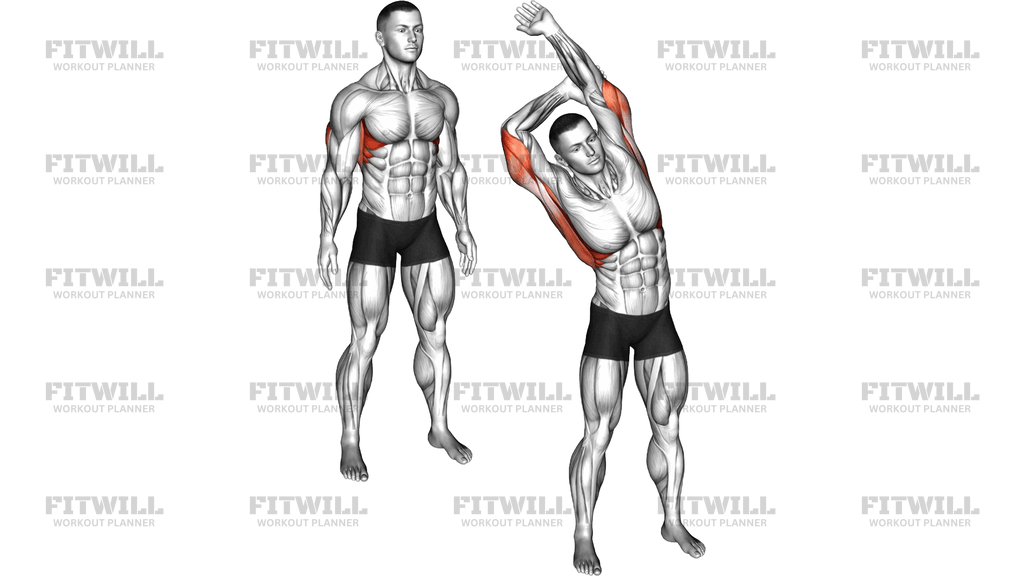
The Standing Lateral Stretch is a bodyweight side-bend stretch performed from an upright, feet-about-hip-width stance. You raise one arm overhead, then lean directly sideways over the opposite leg, lengthening the entire side of the body from hip to fingertips. The opposite hand can rest lightly on your thigh or reach behind you for balance. It is one of the simplest ways to open up the lateral line of the torso, which everyday life rarely asks you to lengthen.
The main targets are the obliques on the stretched side, along with the quadratus lumborum deep in the lower flank. Because the arm reaches overhead, the stretch also travels into the lats and the spaces between the ribs, which is why many people feel it up toward the armpit rather than just at the waist. The side that is not stretching works quietly to keep you from toppling sideways, so you get a mild stability demand on the supporting obliques and hip muscles as well.
This movement suits almost everyone: desk workers with compressed, stiff sides; lifters who want to restore range after heavy squatting, deadlifting, or pressing; and anyone warming up before training or cooling down afterward. Because it requires no equipment and very little space, it fits easily into a morning routine, an office break, or the first five minutes of a workout.
Setup matters more than it looks. Your feet need to stay planted and your hips square to the front, because the moment your pelvis rotates or one foot drifts, the bend stops coming from the waist and starts coming from somewhere else. Keep both legs active and your spine long before you lean, so the stretch happens along the side of your body instead of collapsing into your lower back.
To execute it well, think of growing taller first and then bending sideways as if sliding along a wall behind you, rather than folding forward or twisting. The stretch should feel like a long, even pull from your hip to your raised hand. Hold the end position with steady breathing, return upright with control, and then match the hold on the other side. Avoid bouncing, shrugging the raised shoulder toward your ear, or leaning so far that you lose your balance and have to catch yourself.
If you feel any sharp pinching in the lower back or a painful squeeze in the shoulder joint, reduce the range, soften the knees slightly, or lower the raised arm so the hand sits closer to head height. The stretch should be comfortably intense, never forced.
[ Workout Log & Planner ]
Put your next workout in Fitwill
Keep your plan and training log ready when you are.


Instructions
- Stand tall with your feet about hip-width apart, weight spread evenly across both feet, and your hips facing straight ahead.
- Let your spine lengthen, engage your core lightly, and pull your shoulders down and back so you are not starting in a slouch.
- Raise one arm straight overhead, palm facing inward, and keep that shoulder relaxed away from your ear.
- Place your other hand lightly on the side of your thigh or let it hang for balance, whichever helps you stay steady.
- Inhale, then exhale as you bend directly sideways over the leg opposite your raised arm, reaching up and over rather than folding forward.
- Keep both feet flat and your hips square; the bend should come from your waist and ribcage, not from twisting at the pelvis.
- At the end position, you should feel a long stretch from your hip up the side of your torso and into your armpit. Hold for 15 to 30 seconds while breathing evenly.
- Exhale and slowly pull yourself back up to standing by engaging the obliques on the underside, keeping the return as controlled as the lean.
- Reset your posture briefly, then repeat the same hold on the other side so both sides get equal work.
- Perform 2 to 3 stretches per side, especially after lower-body or core training.
Tips & Tricks
- The most common mistake is turning this into a forward lean. Stand side-on to a mirror and check that your chest stays facing forward the whole time.
- Do not let the raised shoulder creep toward your ear. Press the armpit open and reach through the fingertips to keep the lat involved in the stretch.
- If you cannot feel the stretch in your waist, lengthen before you lean. Most people skip the tall spine and just flop sideways, which shortens the stretch.
- Keep the opposite foot fully planted. Lifting the heel or rolling to the outer edge of that foot means you are going past a range your hips can support.
- Bend along a slight arc behind your ears rather than straight out to the side if your lower back pinches; it shifts the stretch away from spinal compression.
- Never bounce at the end range. This stretch responds better to a long, still hold with slow exhales than to rhythmic pulsing.
- If your balance is shaky, stand with your heels closer to a wall and let your lower hand hover near your thigh for support.
- Match the time and effort on each side. Most people have one tighter side, and rushing the looser side creates an imbalance over time.
- Slightly soft knees are fine, but keep them from collapsing inward as you lean, so the stretch stays in the torso.
Frequently Asked Questions
Which muscles does the Standing Lateral Stretch target?
It primarily lengthens the obliques and the quadratus lumborum on the side you are bending away from. With the arm overhead, it also stretches the lats and the muscles between the ribs.
Is the Standing Lateral Stretch good for beginners?
Yes, it is one of the most beginner-friendly stretches because it needs no equipment and the range is easy to self-limit. Beginners should start with a small lean and focus on keeping the hips square rather than bending deep.
Why do I feel the Standing Lateral Stretch in my armpit instead of my waist?
When the arm is fully overhead, the lats and serratus muscles along the ribs are often tighter than the obliques, so they take the stretch first. This is normal, and you may feel more waist involvement as those tissues loosen up.
How long should I hold the Standing Lateral Stretch?
Hold each side for 15 to 30 seconds and repeat 2 to 3 times per side. If you are using it to unwind after training or a long day of sitting, longer holds of 30 to 45 seconds feel productive.
Should I do the Standing Lateral Stretch before or after a workout?
It works in both slots. Use it as part of a dynamic warm-up with shorter, moving leans, or hold it statically after training when the muscles are warm and respond better to lengthening.
Can I do the Standing Lateral Stretch every day?
Yes, a gentle version is safe to perform daily, especially if you sit a lot or train your core frequently. Just keep the intensity comfortable rather than pushing to a deep pull every session.
Why does my lower back pinch when I bend sideways?
A pinch usually means you are collapsing into the lumbar spine instead of lengthening through the whole side, or your hips are twisting. Re-extend your spine, bend slightly along an arc behind your head, and reduce the range until the pinch disappears.
What can I use instead of the Standing Lateral Stretch if standing is uncomfortable?
A seated version on a bench or chair works the same side-bending path, and a kneeling side bend is another option. Both keep the same goal of lengthening the obliques and lats without loading the legs.
Is it a problem if one side is much tighter than the other?
Most people have a side difference, and it is usually nothing to worry about. Spend an extra hold or a few more seconds on the tighter side, but do not force it to match the flexible side in a single session.
Can I add load to the Standing Lateral Stretch?
You can hold a light dumbbell in the lower hand to gently pull the stretch deeper, but skip any added weight overhead until your side-bend mobility is solid. The unweighted version is already effective for most people.