Seated Upright Circle Shift
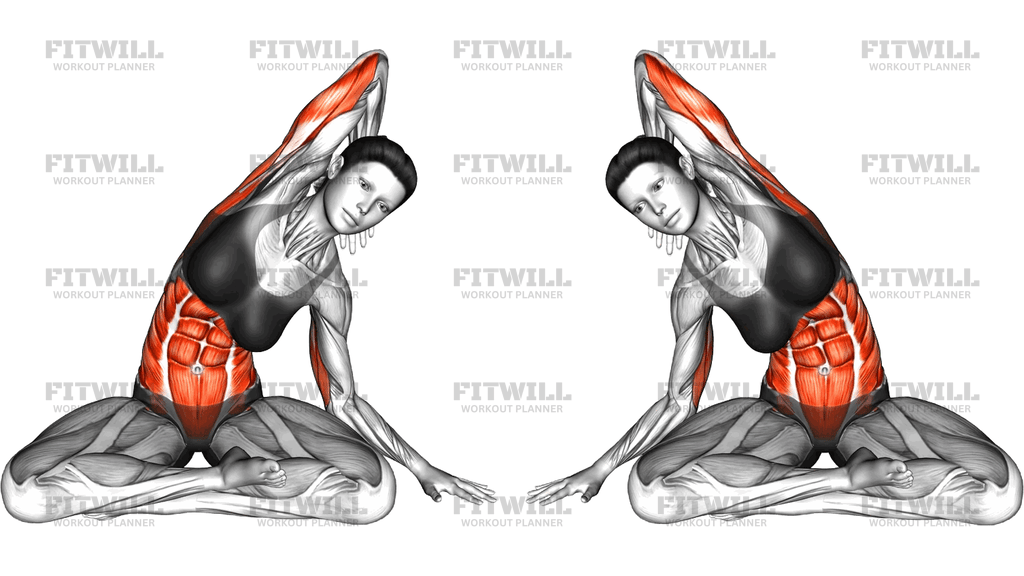
The Seated Upright Circle Shift is a bodyweight mobility drill performed sitting cross-legged on the floor. From this stable base, you reach one arm up and over your head, lean your torso sideways into a long lateral arc, then return upright and shift smoothly to the opposite side. The two positions flow together, so instead of holding a static side bend, you move through a continuous side-to-side pattern that wakes up the entire waist and ribcage.
The main focus is the obliques on the side of the waist, which lengthen as you lean away and shorten as you come back to center. You will also feel a strong stretch through the latissimus dorsi and the side of the ribcage on the reaching arm, along with the quadratus lumborum deep in the lower back. The cross-legged seat adds a gentle opening for the outer hips and inner thighs, so the drill covers several tight areas in one economical movement.
This is a great early-day or pre-workout movement for anyone who sits for long hours. Desk work tends to lock the midsection into a neutral, slightly slumped position, and deliberate lateral flexion is something most people simply never do. It works well as part of a morning routine, a warm-up before strength training or yoga, or a cooldown that restores side-to-side range after heavy lifting.
Setup matters more than it looks. Sitting directly on a hard floor often tips the pelvis backward and rounds the spine, which steals range from the waist. Sitting on the edge of a folded mat, cushion, or towel lifts the hips high enough for the pelvis to stay neutral and tall. Keep both sitting bones grounded and the legs relaxed in a comfortable cross so the shift comes from the trunk rather than from wobbling at the hips.
To execute it well, think of growing long before you bend. Reach the overhead arm toward the ceiling first, then arc up and over in a smooth C-shape rather than collapsing forward or twisting. The non-reaching arm can rest on the floor or thigh for light support. Move slowly enough that you can feel exactly where the stretch begins and stops, pause briefly at the end of each side, and let the return to center be just as controlled as the lean.
Keep the effort moderate. This is a mobility and flexibility drill, not a strength test, so no weight is needed and forcing depth works against you. If a knee or hip complains about the cross-legged position, sit on a chair or extend the legs instead. Stop short of any pinching at the shoulder or compression at the side of the waist, and build range gradually over repeated sessions.
[ Workout Log & Planner ]
Put your next workout in Fitwill
Keep your plan and training log ready when you are.


Instructions
- Sit on the floor or an exercise mat in a comfortable cross-legged position, resting on a small cushion or folded edge of the mat if your hips are tight.
- Place your hands lightly on your knees or thighs, stack your ribs over your pelvis, and lengthen the spine so you are sitting tall rather than slumped.
- Inhale and sweep one arm out to the side and up overhead, letting the shoulder relax down away from the ear as the arm rises.
- Brace the trunk lightly, keep both sitting bones planted, and begin leaning sideways away from the raised arm.
- Follow the hand with your eyes and let the body form a long, even C-curve from hip to fingertip; rest the other hand on the floor or thigh for light balance support.
- Pause for one or two breaths at the deepest comfortable point, feeling the stretch along the opposite side of the waist, ribs, and shoulder.
- Exhale and draw yourself back up to a tall, upright seat by engaging the obliques on the stretching side rather than dropping back down loosely.
- Lower the arm, sweep the opposite arm overhead, and shift straight into the side bend on the other side.
- Continue alternating sides in a smooth, circular flow, moving for roughly 20 to 40 seconds or 6 to 10 shifts per side.
- Finish by returning to center, lowering both arms, and taking a few tall breaths before standing or moving to the next exercise.
Tips & Tricks
- If you find yourself collapsing forward instead of leaning sideways, imagine trying to touch the wall to your left or right rather than the floor in front of you.
- A rounded lower back usually means the pelvis has tipped backward; add height under the hips so the sitting bones stay level and the spine can stay neutral.
- Keep the overhead shoulder pressed gently down away from the ear. Shrugging into the ear is the most common way people turn a waist stretch into a neck strain.
- Do not twist as you lean. Both sides of the waist should stretch evenly, and your chest should keep facing forward throughout the shift.
- Move at breathing pace, not rep pace. Rushing the transition between sides is where most people lose the stretch on the return.
- The bend should feel strongest just below the ribcage. If you only feel it in the shoulder, reach further overhead and lengthen before bending.
- If a knee sits high off the floor and pulls your torso off balance, let that leg extend straight instead of forcing the full cross-legged seat.
- Keep the neck long as you lean; let the head follow the line of the spine rather than dropping it toward the shoulder.
- Soreness the next day along the side of the waist is normal for newcomers to lateral work, but sharp or pinching sensations at the hip or shoulder mean you should reduce the depth.
Frequently Asked Questions
What muscles does the Seated Upright Circle Shift stretch and work?
It primarily stretches and loads the obliques along the side of the waist, with the latissimus dorsi and quadratus lumborum on the reaching side also lengthening. The deep core stabilizes the return to upright, and the cross-legged seat adds a mild stretch for the outer hips.
Why is the Seated Upright Circle Shift done cross-legged instead of standing?
Sitting removes the legs from the equation, so the pelvis stays grounded and the lean has to come from the waist and ribcage. It also makes the drill easy to perform in a small space, on the floor of a living room, or at the start of a yoga or stretching session.
Is the Seated Upright Circle Shift suitable for beginners?
Yes. It uses no load and a small range, so beginners can simply lean less far and still get the benefit. The main adjustment most beginners need is sitting on a cushion to keep the spine tall.
How deep should I lean during the Seated Upright Circle Shift?
Lean only until you feel a clear, comfortable stretch along the opposite side of the waist and ribs. The deepest point should feel like a stretch you could breathe through for several seconds, never a strain or a pinch.
My shoulder hurts when my arm goes overhead during this movement. What should I do?
Stop short of the full overhead position and place the hand behind the head or on the opposite shoulder instead, then perform the same side lean. Keep the shoulder blade relaxed and, if discomfort continues, choose a different side-flexion drill that does not require overhead reaching.
Can I do the Seated Upright Circle Shift before weight training?
Yes, it works well as part of a warm-up because it restores lateral range in the trunk before squats, presses, or carries. Keep the movements gentle and rhythmic rather than long and static so you prime mobility without reducing muscle tension.
How many reps or how long should I perform the Seated Upright Circle Shift?
A practical dose is 6 to 10 smooth shifts to each side, or about 30 to 45 seconds of continuous alternating movement. In a stretching-only session, you can slow the pace and add a few seconds of pause on each side.
What can I use instead of sitting on the floor for the Seated Upright Circle Shift?
A firm chair works well: sit tall on the front edge with feet flat, keep the hips square, and perform the same arm-overhead side lean. The key is a stable pelvis, so avoid soft couches that let the spine round.
Why do I feel the Seated Upright Circle Shift more on one side of my waist?
Side-to-side differences are common, especially if you habitually sit, carry a bag, or sleep on one side. Spend a little extra time and a few more slow shifts on the tighter side, but avoid forcing the shorter side to match the looser one in a single session.
Should my other hand touch the floor during the Seated Upright Circle Shift?
It can rest on the floor or on your thigh purely for balance, but it should not push or prop you deeper into the lean. If you need to press hard to reach further, the range is coming from leaning on the arm rather than from the waist.