Plank Scapular Push Up
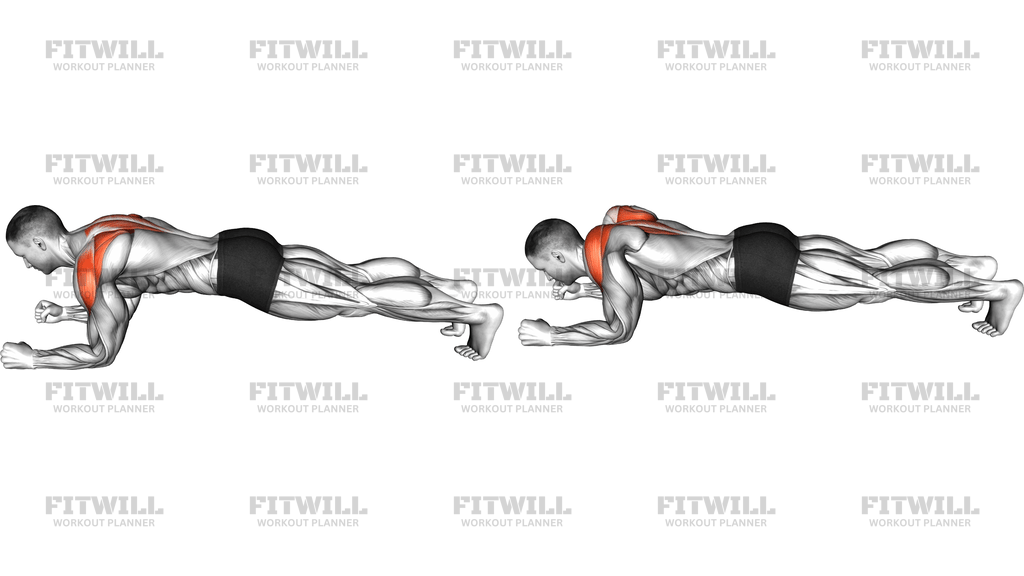
The Plank Scapular Push Up is a small, precise movement performed from a forearm plank. Instead of bending the elbows like a regular push up, you keep your arms completely still and move only at the shoulder blades, pressing your forearms into the floor to push your upper back toward the ceiling, then letting the chest sink slightly as the blades draw back together. The range of motion is only a few inches, but when it is done deliberately it is one of the cleanest ways to train control of the shoulder blades in a weight-bearing position.
The main muscle at work here is the serratus anterior, the fan-shaped muscle along the side of your ribs that pulls the shoulder blades forward and flat against the torso. The trapezius and rhomboids handle the retracting half of the motion, while the pecs assist as the chest lowers slightly. Because you are holding a plank the entire time, the deep core, glutes, and legs work isometrically to keep your body in one straight line, so the exercise quietly trains trunk stability at the same time as scapular control.
This is a particularly useful drill for people whose shoulder blades wing out or ride up when they press. If your shoulders shrug toward your ears during push ups, overhead presses, or planks, the small stabilizers around the scapula are usually being skipped in favor of larger muscles. The Plank Scapular Push Up isolates exactly that job, which makes it a common warm-up before pressing days, a rehab-friendly stepping stone toward full push ups, and a corrective exercise for anyone who sits at a desk with rounded shoulders.
Setup matters more than it looks. On a mat, place your forearms on the floor with the elbows directly under the shoulders, forearms parallel, and hands lightly fisted. Step the feet back to hip width and build one straight line from head to heels before you move anything. If your hips sag or pike before you even start, the shoulder blades will not move cleanly, because the trunk is borrowing motion that should stay out of the exercise.
To execute it, brace the core and squeeze the glutes, then exhale and drive the forearms down into the floor as if trying to push the mat away from you. Your upper back should round gently toward the ceiling and the space between the shoulder blades should widen. Pause for a second at the top, then inhale and lower with control, letting the chest drop a touch below the shoulder line as the blades pinch together. The elbows never bend and the hips never move.
Because the movement is small, tempo and honesty are what make it work. Ten slow, deliberate reps with a still trunk beat thirty quick shrugs every time. If you feel it mostly in your lower back or neck, shorten the range, reduce the reps, and reset your plank position between sets. Stop and rest whenever you cannot keep the hips level or the forearms planted.
[ Workout Log & Planner ]
Put your next workout in Fitwill
Keep your plan and training log ready when you are.


Instructions
- Place an exercise mat on the floor and set up on your forearms with the elbows directly under the shoulders and the forearms parallel to each other, hands in loose fists.
- Step your feet back to about hip width so your body forms one straight line from head to heels, with your weight on the forearms and the balls of your feet.
- Brace your abdominals, squeeze your glutes, and pull your shoulder blades into a neutral position so your upper back is flat, not rounded and not pinched.
- Check your alignment: neck in line with the spine, eyes on the floor just ahead of your hands, hips level with the shoulders.
- Exhale and press both forearms firmly into the floor, pushing your upper back toward the ceiling so the shoulder blades spread apart and the upper back rounds slightly.
- Hold the protracted position for one to two seconds, keeping the elbows planted and the hips completely still.
- Inhale and slowly release, letting the chest sink a few inches toward the floor as the shoulder blades draw together behind you.
- Stop at the point where the blades are gently squeezed and begin the next rep from there, moving only at the shoulder blades while the elbows stay fixed.
- Keep breathing steadily throughout the set — exhale as you press up, inhale as you lower — and keep the core tight so the lower back does not arch.
- If your hips sag, your shoulders creep toward your ears, or your forearms slide, pause and reset your plank position before continuing.
Tips & Tricks
- The cue that fixes most reps is simple: push the floor away from you. If you think about lifting the upper back rather than moving the shoulder blades, the serratus anterior does the work automatically.
- The most common mistake is turning this into a shrug, with the shoulders climbing toward the ears. Before each rep, consciously pull the tops of the shoulders away from the ears so the blades glide forward instead of hiking up.
- Keep the elbows at a fixed angle under the shoulders. If your torso rises and falls a lot or the arms start bending, the range has grown beyond the shoulder blades and the drill loses its point.
- Hips sagging or piking means the core gave out before the shoulders did. Drop to your knees for the set rather than letting the lower back take over.
- Do not chase a big range of motion. A few inches of controlled travel at the upper back is the entire exercise; forcing more usually means the trunk or neck is compensating.
- Slow the lowering half down. Most people snap back to the retracted position, but the return is where the traps and rhomboids get their work — aim for two to three seconds down.
- If your forearms slide forward on a slick mat, widen your stance slightly and press the fists down, or use a mat with more grip so the elbows stay stacked under the shoulders.
- Start on your knees if a full plank shakes apart within a few reps. The scapular movement is identical from a knee plank, and you can progress to the full version once the trunk stays quiet.
- Keep your gaze a foot or so in front of your hands. Craning the neck up or dropping the head tends to pull the whole shoulder girdle out of position.
Frequently Asked Questions
What muscles does the Plank Scapular Push Up work?
The primary mover is the serratus anterior, which protracts the shoulder blades, with the trapezius and rhomboids controlling the retracting phase. The core, glutes, and legs also work isometrically to hold the plank position.
Why is this done on the forearms instead of straight arms like a normal scapular push up?
The forearm position removes the wrist and elbow from the equation and makes it easier to isolate the shoulder blades. It also loads the core more heavily than a straight-arm plank, so you train scapular control and trunk stability together.
My arms bend when I press up — is that wrong?
Yes. In this exercise the elbows stay locked in place under the shoulders and only the shoulder blades move. If your arms are bending, you are drifting into a regular push up, so reduce the range and slow the tempo.
How is the Plank Scapular Push Up different from a regular plank hold?
A regular plank holds the shoulder blades still while the core works, whereas this exercise adds deliberate protraction and retraction of the blades on top of the plank. You get the same anti-extension demand plus active shoulder blade control.
How many reps should I do?
Eight to twelve slow, controlled reps is a good working set, focusing on a one-to-two-second pause at the top. It works well as a warm-up before pressing exercises, so two to three quality sets are usually enough.
Is the Plank Scapular Push Up suitable for beginners?
Yes, and it is one of the best first pressing drills because there is very little load on the joints. Beginners should start from a knee plank until they can keep the hips level and the shoulders relaxed for a full set.
Where should I feel this exercise?
You should feel it along the sides of your upper ribs and between the shoulder blades, with a steady burn in the abdominals from holding the plank. Any sharp sensation in the lower back, neck, or shoulder joint means the setup needs fixing.
Why does my lower back hurt when I do this movement?
That almost always means the hips are sagging and the lumbar spine is absorbing the press instead of the shoulder blades. Reset into a strict plank with the glutes squeezed, or drop to your knees until trunk endurance improves.
What can I substitute if a forearm plank is too hard right now?
Perform the same protraction and retraction from a knee plank or from a wall push up position with straight arms. The shoulder blade action is identical, and you can progress the leverage as control improves.
Can the Plank Scapular Push Up help my regular push ups?
It can, because many push up faults — winging shoulder blades, shrugging shoulders, sagging hips — come from poor scapular control and trunk stability. Practicing this drill before push up training gives you the stable base the pressing motion depends on.