Seated Overhead Side And 45 Degrees Bend Forward
The Seated Overhead Side And 45 Degrees Bend Forward is a bodyweight stretch performed from a cross-legged seat on the floor. You interlace your fingers, press your palms toward the ceiling until your arms are fully extended overhead, then lean diagonally to one side and slightly forward, roughly 45 degrees off vertical, so the stretch travels down the side of your torso from hip to armpit. It is a slow, deliberate mobility drill rather than a strength or rep-based movement, and it works best when you treat it like one.
This stretch is especially useful for anyone whose days involve a lot of sitting. Long hours in a chair shorten the hip flexors, round the upper back, and stiffen the obliques and the muscles along the side of the spine, which makes overhead reaching and rotation feel restricted. Office workers, lifters who train heavy pressing and pulling, and people who feel tight after running or cycling all tend to feel the benefit quickly, because the position opens the exact areas that those habits and activities compress.
The primary targets are the obliques on the lengthening side of the waist, along with the quadratus lumborum deep in the lower back and the latissimus dorsi running from the armpit toward the pelvis. Because the arms are locked overhead with fingers interlaced, the shoulders, upper traps, and the muscles between the shoulder blades are also placed under a mild stretch, which is why many people feel it as a full side-of-body release rather than just a waist stretch.
Setup matters more than most people expect. Sitting cross-legged gives you a stable, symmetrical base, but only if your sit bones are grounded and your spine is tall before you lean. If you start the lean from a slouched torso, the stretch leaks into the lower back and neck instead of opening the side body. Keep both hips connected to the floor as you bend; if one side lifts, you lose the isolated lateral stretch and turn it into an uncontrolled twist.
To execute it well, extend tall first, then think of pushing your hands up and away rather than simply flopping sideways. The diagonal, 45-degree path is what makes this different from a plain side bend: the slight forward angle reaches the lats and the back of the waist more directly. Move into the position over two or three slow breaths, hold where the stretch is strong but never sharp, and return to vertical with the same control you used going out.
Use this drill in a morning mobility routine, as a movement break between desk sessions, or in the cooldown after lower body and core training. Hold each side for 20 to 45 seconds and repeat two to three times. Stop if you feel pinching in the shoulder, sharp pain in the lower back, or numbness down the arm, and scale back the lean angle until the sensation is a comfortable, steady pull.
[ Workout Log & Planner ]
Put your next workout in Fitwill
Keep your plan and training log ready when you are.


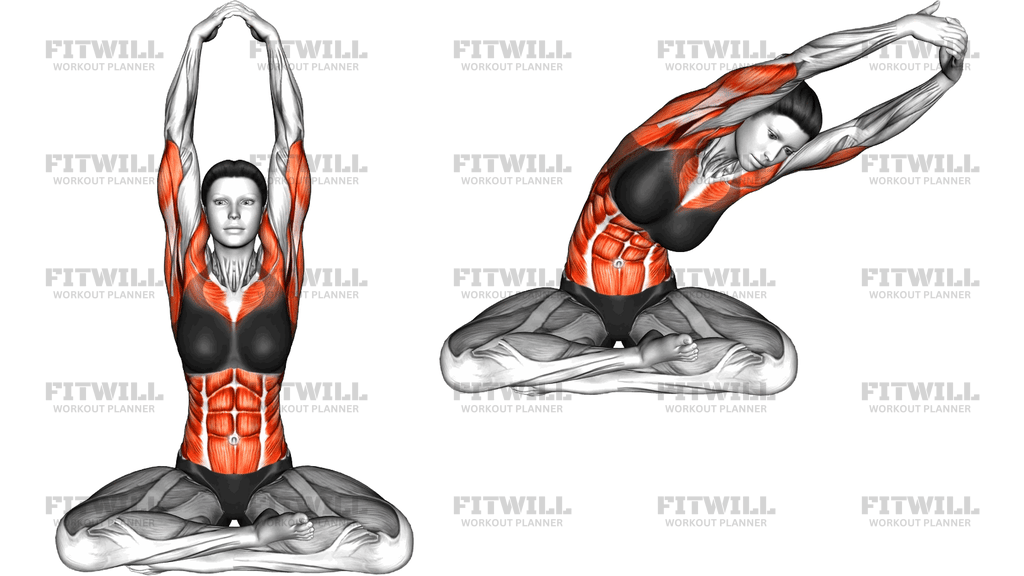
Instructions
- Sit on an exercise mat or the floor in a cross-legged position, stacking each foot over the opposite thigh if your hips allow, or resting them lower if that is more comfortable.
- Ground both sit bones evenly and lengthen your spine so your ears sit over your shoulders before you move anything else.
- Interlace your fingers and rotate your palms so they face away from you, then press your arms straight overhead until your elbows are fully extended and alongside your ears.
- Brace your core lightly and keep your ribs from flaring as you hold the overhead reach.
- Exhale and lean diagonally to one side, aiming your clasped hands about 45 degrees off vertical and slightly forward, letting the stretch spread from your hip up through the side of your ribs and armpit.
- Keep both hips glued to the floor and both shoulders pulling away from the ears throughout the hold.
- Breathe slowly through the position, inhaling into the ribs of the stretched side and letting the exhale settle you a little deeper.
- After 20 to 45 seconds, contract your side waist gently to draw yourself back up to a tall seated position rather than collapsing back.
- Re-establish your overhead reach for a breath, then repeat the diagonal lean to the opposite side.
- Finish both sides, release your fingers, and shake out your arms and shoulders before moving on.
Tips & Tricks
- If your hips sit above your knees when cross-legged, prop yourself on a folded blanket or low cushion; a level pelvis changes how much side bend you can actually access.
- The most common mistake is bending straight sideways instead of on the 45-degree diagonal, which shifts the work into the front of the waist; think of reaching your hands toward a point up and slightly in front of you.
- Watch for the opposite hip lifting off the floor as you lean, which silently cancels the oblique stretch; press it down deliberately and accept a smaller angle.
- Do not let the leaning-side shoulder collapse toward the ear; keep active length between the shoulder and the ear so the lat and upper trap stay under tension.
- If your shoulders cannot lock out overhead, hold a light stick or towel between your hands with a slightly wider grip instead of interlacing your fingers.
- Rushing the return is a frequent fault; pulling yourself back up with the side waist muscles is part of the value of the drill, so take a full breath to come back.
- If your knees float high in the cross-legged seat, switch to sitting with legs simply crossed at the shins, which is easier on the hips and does not reduce the torso stretch.
- Avoid cranking deeper with each breath by yanking with the arms; the hands press up and out, the torso follows, and the neck stays relaxed and in line with the spine.
Frequently Asked Questions
What muscles does the Seated Overhead Side And 45 Degrees Bend Forward stretch?
It primarily targets the obliques and the quadratus lumborum on the lengthening side of the waist, with added stretch in the lats and the tissues along the side of the lower back. The overhead arm position also places mild stretch on the shoulders and upper traps.
Why does the Seated Overhead Side And 45 Degrees Bend Forward use a 45-degree angle instead of a straight side bend?
The diagonal path combines lateral flexion with a slight forward lean, which reaches the lats and the back portion of the waist more directly than a pure side bend. This makes it a better choice for people who feel tight from sitting or from heavy back training.
Can beginners do this stretch?
Yes, and it is actually well suited to beginners because it uses only body weight and a floor seat. Start with a smaller lean angle and shorter holds, and prioritize keeping both hips on the floor over reaching far.
What should I do if I cannot sit cross-legged comfortably?
Sit on a folded blanket or low cushion to raise your hips, or simply cross your shins loosely in front of you. As long as your sit bones are grounded and your spine is tall, the torso stretch is unaffected.
How long should I hold each side?
Twenty to forty-five seconds per side works well, repeated two to three times. If you feel the sensation fade, ease a little deeper on an exhale rather than forcing a bigger lean immediately.
Is it normal to feel this stretch in the shoulder or armpit instead of the waist?
Yes, especially if you have tight lats or shoulders. Make sure your ribs are not flaring and your opposite hip stays down, and the sensation should gradually spread down the side of the torso as those tissues release.
What is the most common mistake in this exercise?
Losing the base: one hip lifts or the torso twists as the person chases a deeper lean. That redirects the stretch into the lower back and neck. Keep the hips planted and let a smaller, cleaner angle do the work.
Can I substitute the Seated Overhead Side And 45 Degrees Bend Forward with a standing side bend?
You can, but the seated version anchors the pelvis to the floor, which prevents you from shifting your hips to fake the range. If you stand, keep your feet planted and hips level to preserve the same intent.
When is the best time to use this stretch?
It fits well in a morning mobility routine, during breaks from prolonged sitting, or in the cooldown after lower body, back, or core training. Avoid aggressive stretching right before heavy lifting that depends on lateral stability.
Are there safety concerns I should watch for?
Keep the movement pain-free; stop if you feel sharp lower back pain, shoulder pinching, or tingling down the arm. If you have a recent hip, spine, or shoulder injury, reduce the range and check the position with a qualified professional first.