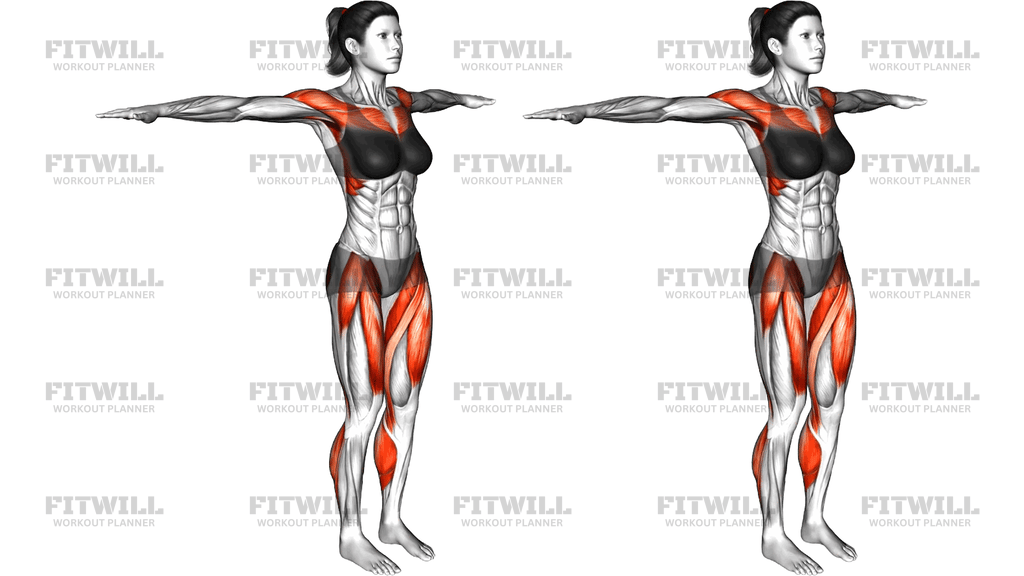
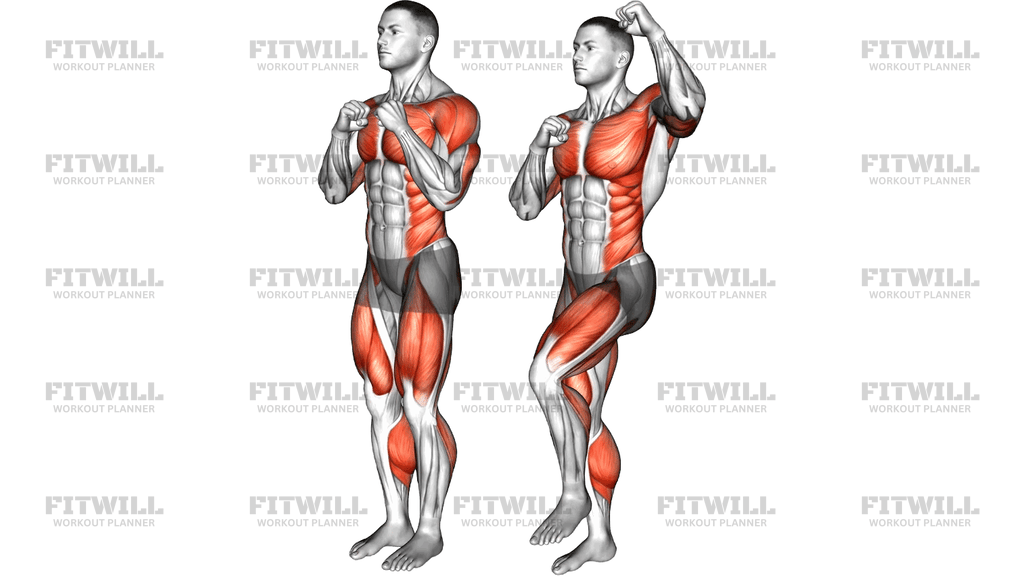
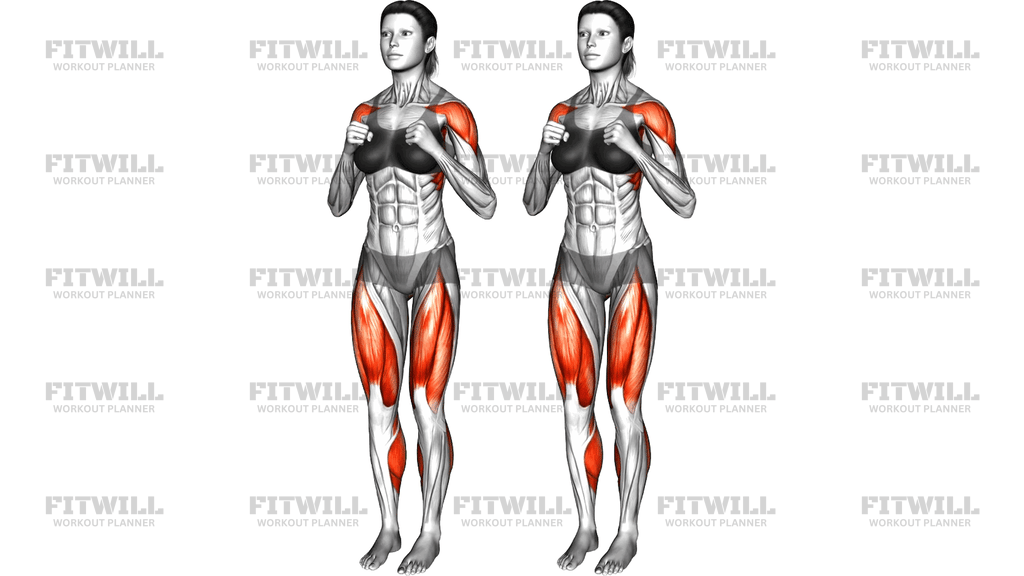
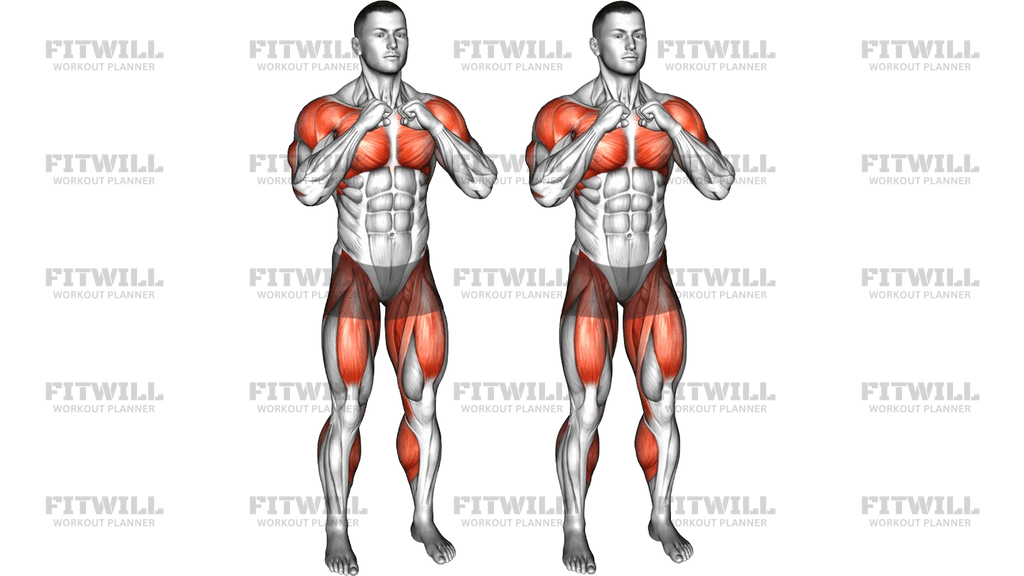
Palm Push March
The Palm Push March is a standing, low-impact cardio move that pairs an alternating marching step with a forward palm press at shoulder height. You stay in one spot the whole time, which makes it easy to fit into a warm-up, a circuit, or a quick movement break when you have no equipment and very little space. Because the arms and legs work on opposite rhythms, it doubles as a coordination drill rather than just a heart-rate raiser.
This movement suits a wide range of people. Beginners can use it to build a cardio base without any jumping or joint pounding, and more experienced trainees often use it as an active recovery station or as the lead-in drill before intervals. It is also a practical choice for older adults or anyone returning from a layoff, since the pace is entirely self-controlled and the support base stays wide and stable.
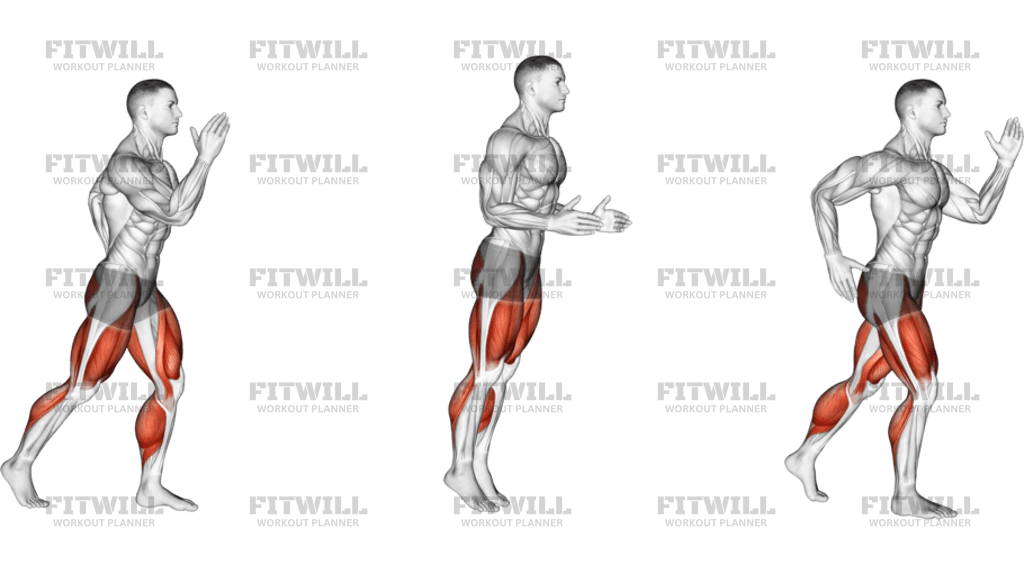
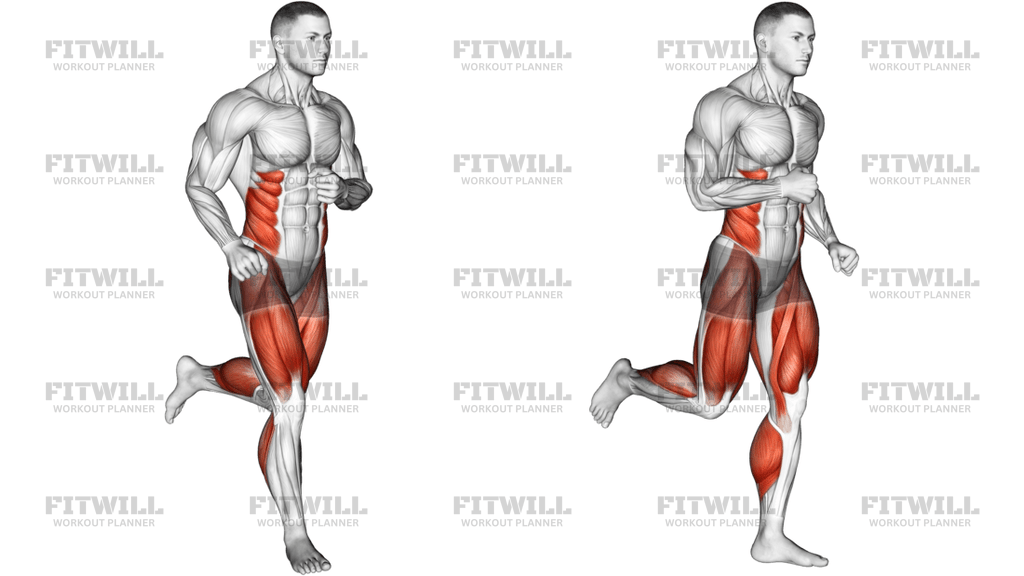
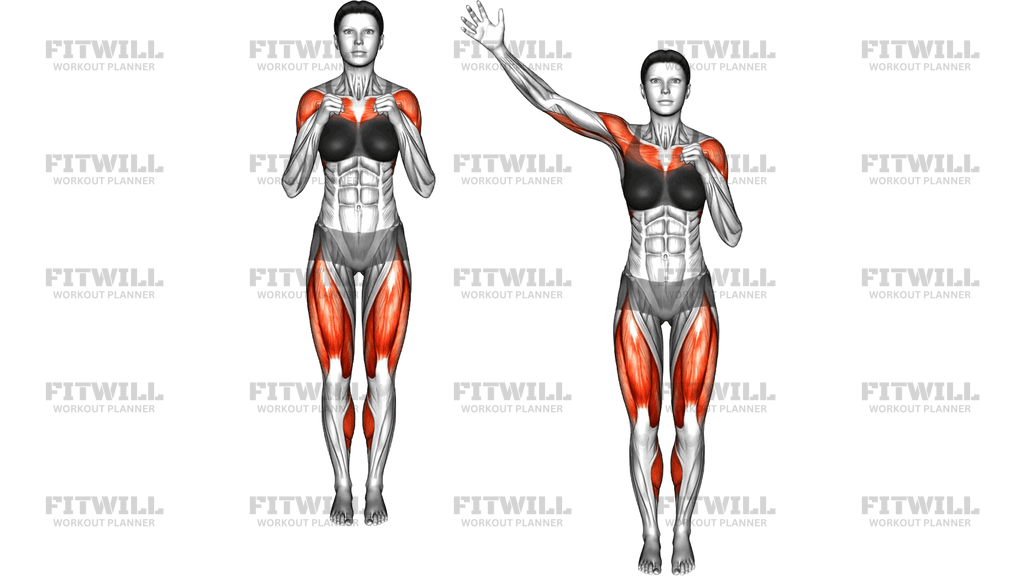
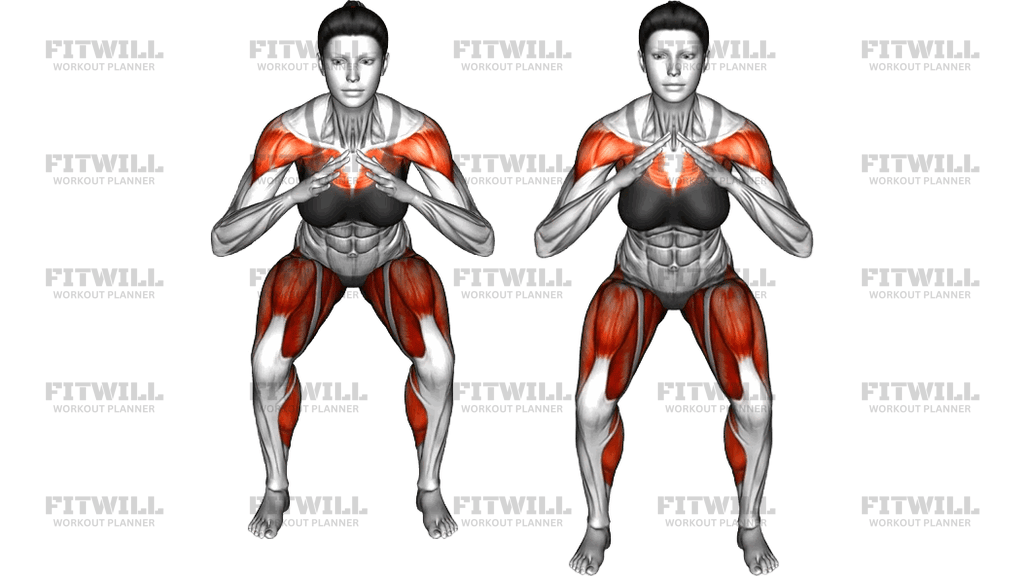
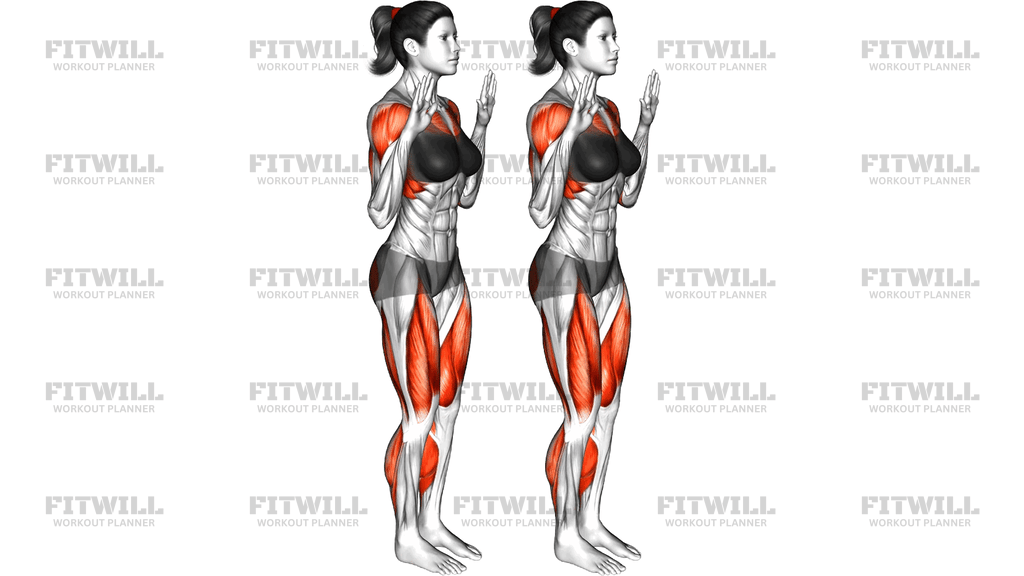
The main work comes from the front of the shoulders as each palm presses forward, while the legs drive the march through the thighs and calves. Holding your torso tall against the rhythm of the arms and legs keeps the core engaged, especially the deep abdominal muscles that stabilize your spine as you shift weight from foot to foot. Your heart rate climbs mainly from the continuous, rhythmic use of large muscle groups rather than from resistance.
Setup matters more than it looks. Stand with feet roughly hip-width apart, elbows bent so your hands sit near shoulder height with palms facing forward, and keep your ribcage stacked over your pelvis. If you let the lower back arch or the shoulders creep toward the ears, the pressing motion loses its target and the marching rhythm falls apart. A tall posture with relaxed neck and shoulders is the foundation of every good repetition.
To execute well, press one palm straight forward at chest-to-shoulder height as the opposite knee lifts to about hip height, then switch sides in a smooth, continuous march. Think of the press coming from the whole arm and the lift coming from the front of the hip, not from leaning the torso backward. Keep the movement brisk but controlled, and breathe steadily throughout rather than holding your air.
Common use cases include dynamic warm-ups, home cardio sessions, group fitness classes, and low-impact conditioning blocks. Watch for two frequent errors: pushing the hands so far forward that the shoulders round, and stomping the feet instead of landing softly through the ball of each foot. Keep the presses crisp, the steps light, and the pace one you could hold while holding a conversation.
Fitwill
Log Workouts, Track Progress & Build Strength.
Achieve more with Fitwill: explore over 9600 exercises with images and videos, access built-in and custom workouts, perfect for both gym and home sessions, and see real results.
Start your journey. Download today!




Instructions
- Stand tall with your feet hip-width apart and your weight balanced evenly across both feet.
- Bend your elbows and raise your hands to about shoulder height with your palms facing forward and fingers pointing up.
- Draw your belly button in slightly, relax your shoulders down away from your ears, and look straight ahead.
- Press your right palm straight forward until your arm is nearly extended at chest-to-shoulder height.
- At the same moment, lift your left knee up toward hip height while keeping your torso upright.
- Bring the right hand back to the starting position and lower the left foot with a soft, controlled step.
- Immediately repeat on the other side, pressing the left palm forward as the right knee lifts, and keep alternating in a steady marching rhythm.
- Exhale on each press and knee lift, and inhale as the arm and leg return.
- Continue for your desired time or repetition count, then stop marching and stand still for a few breaths before your next exercise.
Tips & Tricks
- If your shoulders shrug up during the presses, consciously drop your shoulder blades before each rep and reduce how far you push the palms forward.
- Avoid leaning your torso backward as the knee lifts; imagine a string pulling the crown of your head toward the ceiling instead.
- Land each marching step through the ball of the foot rather than the heel to keep the rhythm light and protect your knees.
- Keep the pressed arm at shoulder height; letting it drop toward your chest turns the move into a random arm swing and reduces shoulder involvement.
- Match the arm press to the opposite knee lift precisely, since the cross-body timing is what challenges coordination.
- If your calves tire quickly, shorten the knee lift to a lower march and build up gradually.
- Pick a tempo you can sustain with steady breathing; speeding up before your rhythm is solid usually causes the posture to collapse.
- Add light wrist or ankle resistance only after you can keep clean form for at least a full minute of continuous marching.
- Do this move on a firm, non-slip surface and wear supportive shoes if you plan to march for more than a minute or two.
Frequently Asked Questions
What muscles does the Palm Push March work?
The front of the shoulders drives each palm press, while the thighs and calves power the marching step. Your core works continuously to keep the torso stable as the arms and legs alternate.
Is the Palm Push March good cardio for beginners?
Yes. It raises the heart rate without any jumping or impact, and you control the tempo completely, so beginners can start slow and speed up as fitness improves.
How high should I lift my knee during the Palm Push March?
Aim for roughly hip height, which is where the hip flexors and thighs do most of the work. If your lower back arches or your rhythm breaks, lower the knee and rebuild the pace first.
Should my palm face forward or up when I press?
Keep the palm facing forward with fingers pointing up, as this positions the shoulder to press cleanly without rounding. Turning the palm sideways or letting the arm drift inward changes the shoulder path.
Why do my shoulders shrug when I do the Palm Push March?
Shrugging usually means the neck and upper traps are taking over because the press is too forceful or too far forward. Soften the press, relax the shoulders down, and reset your posture before continuing.
Can I do the Palm Push March without any equipment?
Yes, the exercise is performed entirely with body weight and only needs a small area of flat, non-slip floor to march in place.
What can I substitute if marching is uncomfortable for my knees?
Try a lower-impact version where you tap one toe forward instead of lifting the knee, keeping the same alternating palm press. This keeps the arm and core work while reducing knee flexion.
How long should I perform the Palm Push March?
Start with 20 to 40 seconds per set in a warm-up, or march continuously for one to three minutes as a standalone cardio interval. Stop when your rhythm or posture deteriorates rather than pushing through sloppy reps.
Is the Palm Push March safe during pregnancy?
It is low impact and self-paced, but every pregnancy is different, so confirm with your healthcare provider before adding it to your routine and reduce the knee height if balance feels off.