Air Punches March
Air Punches March is a standing, body-weight cardio drill that combines alternating straight punches with a high-knee march. You stay in one spot, drive each knee up toward hip height in a marching rhythm, and punch the opposite arm forward in time with the lift. Because the arms and legs work on opposite sides of the body at once, the drill doubles as light coordination training, not just conditioning.
This movement fits a wide range of trainees. Beginners use it as a low-impact entry into cardio intervals since one foot always returns to the floor and there is no jumping. More advanced lifters and athletes use it as a warm-up primer, an active recovery between sets, or a finisher that raises the heart rate without loading the joints. It is also a common fixture in boxing-inspired classes and home workouts where no equipment is available.
The main work comes from the shoulders and arms, which accelerate each punch, while the hip flexors and quads lift the knees and the calves absorb each landing. The real challenge, however, is keeping your torso tall and braced while the limbs move. Your core works continuously to stop your trunk from twisting or collapsing every time an arm and leg cross the midline, which is why the drill feels harder through the midsection than most people expect.
Setup matters more than it looks. Stand with your feet about hip-width apart, soft knees, and your fists raised to chin level in a loose guard position. If your stance is too narrow you will wobble on each knee lift; too wide and the march turns into a shuffle. Keep your weight centered over the whole foot rather than rocking back onto the heels as the knees come up.
Execute the drill by lifting one knee to roughly hip height while punching the opposite arm straight out at about chest to chin height, then switch sides in a steady rhythm. The punch should be crisp but not locked out at the elbow, and the knee should be lifted under control rather than yanked up. Think of driving the knee with the lower abs and thigh rather than leaning back to help it up.
A few practical points keep this safe and effective. Stay on the balls of your feet with quick, light contacts so each landing stays quiet. Keep the punches at or below chin height so the shoulders do not shrug into your ears. Start with 20 to 30 second bouts to learn the opposite arm-leg timing, then build to longer intervals or faster tempos once the pattern feels automatic. If you feel your lower back arching as you march, lower the knee height and tighten your brace before continuing.
[ Workout Log & Planner ]
Put your next workout in Fitwill
Keep your plan and training log ready when you are.


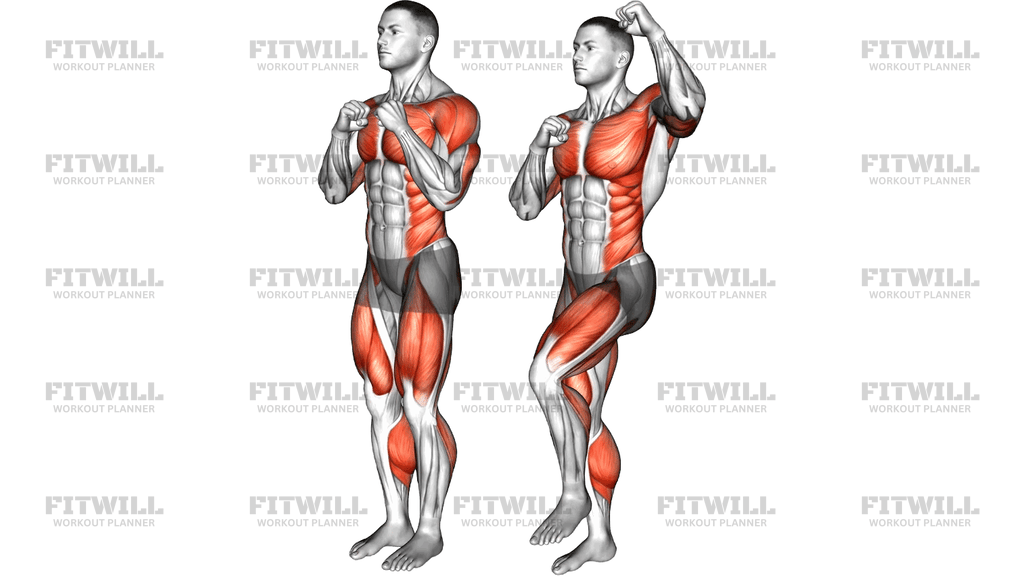
Instructions
- Stand tall with your feet hip-width apart, knees slightly bent, and your weight spread evenly across both feet.
- Raise both fists to chin level in a loose guard position, elbows tucked close to your ribs.
- Brace your abdominals lightly and pull your ribs down so your lower back stays neutral before you start moving.
- Lift your right knee up toward hip height while simultaneously punching your left arm straight forward at chest to chin height.
- Exhale sharply as the knee and punch reach their high point, keeping the punching elbow soft rather than snapped straight.
- Lower the right foot under control back to the floor and return the left fist to guard as your right fist drives forward.
- Lift your left knee with the same controlled drive, matching the march rhythm so each side takes the same amount of time.
- Keep your eyes forward and your head level; do not lean back or round forward as the knees come up.
- Continue alternating for your planned interval, keeping foot contacts light and quiet on the floor.
- To finish, slow the tempo for a few reps, place both feet flat, drop the fists, and breathe fully before your next exercise or rest.
Tips & Tricks
- The most common breakdown is leaning back as the knee lifts. If your torso tilts behind your hips, lower the knee height to just below hip level until you can stay upright.
- Avoid punching across your body. Each arm should travel straight forward on its own side so the shoulders stay square to the front.
- If your shoulders creep upward during fast intervals, reset your guard with the elbows heavy at your sides before continuing.
- Stay on the balls of your feet with quick contacts. Heavy heel-first landings turn this into a stomp and waste the light, springy feel the drill is built around.
- Match the punch to the knee on the opposite side every rep. If the timing falls apart, slow the tempo down rather than letting the arms flail independently.
- Keep a small bend in the punching elbow at full extension. Locking the elbow out hard on every rep jars the joint, especially at faster speeds.
- Your breathing should be rhythmic, one exhale per knee-and-punch combination. Holding your breath is a sign the pace is too fast for your current conditioning.
- If you need an easier version, hold onto a wall or chair with one hand and march with punches on the working side only.
- To make it harder, add slight speed to the punches rather than jumping, keeping the march low-impact throughout.
Frequently Asked Questions
Which muscles does Air Punches March work the most?
The shoulders and triceps drive each punch, while the hip flexors and quads lift the knees. Your core stays busy the entire time keeping the torso upright and resisting the rotation created by the opposite arm-leg pattern.
Is Air Punches March suitable for complete beginners?
Yes. One foot always returns to the floor, there is no jumping, and the intensity is fully controlled by your pace and knee height. Beginners should start with short 20 to 30 second bouts at a comfortable marching tempo.
How high should I lift my knees during Air Punches March?
Aim for roughly hip height, but only as high as you can go without leaning back or arching your lower back. A slightly lower knee with a tall, braced torso beats a high knee with poor posture.
Should the arm punch on the same side as the lifting knee or the opposite side?
Use the opposite arm, just like natural walking or running mechanics. When the right knee lifts, the left arm punches forward, which keeps the movement coordinated and balanced across the midline.
Why do I keep losing my balance during Air Punches March?
Balance usually breaks down when the stance is too narrow or the weight shifts back onto the heels. Widen your feet to hip-width, keep your weight over the whole foot, and slow the tempo until each knee lift feels stable.
Can I use Air Punches March as a warm-up?
Yes, it works well as a general warm-up because it raises the heart rate while mobilizing the shoulders, hips, and ankles. Start at a moderate tempo for 30 to 60 seconds before increasing the speed.
What can I substitute if marching is too hard on my knees?
Reduce the knee height to a low march, or perform the punches while standing still with both feet planted. Both options keep the upper-body and coordination work while removing most of the knee flexion.
How long should I perform Air Punches March for conditioning?
Start with 30 second work bouts and 30 seconds of rest, then build toward 60 to 90 second intervals as your conditioning improves. The drill responds well to tempo changes, so speeding up the punches is an easy progression.
Do I need any equipment or space for Air Punches March?
No equipment is needed, just enough floor space to stand and lift your knees freely. Supportive footwear helps with the repeated foot contacts, though the drill can also be done barefoot on a forgiving surface.