Front Step Criss Cross Arms
Front Step Criss Cross Arms is a standing, body weight coordination drill that pairs a forward step with a sweeping arm cross in front of your chest. You start with your arms extended straight out to your sides at shoulder height, then as one foot steps forward, both arms swing in and cross over each other at chest level. As you step back or switch legs, the arms open wide again. Repeated in a steady rhythm, it becomes a low-impact, full-body movement that raises your heart rate while challenging timing and control.
This drill is useful for anyone who wants to warm up the whole body before strength training, add low-impact cardio to a routine, or rebuild coordination after time away from training. Because the arms stay lifted and move through a wide arc, the front shoulders and chest do continuous work, while the abs stabilize your torso every time the arms cross your midline. The stepping leg drives the action, engaging the quads and hip flexors, and the calves handle the repeated weight shifts.
The setup matters more than it looks. Standing tall with your arms genuinely at shoulder height — not drooping toward your hips — keeps the shoulders and upper back under tension through the entire set. A stable base with feet about hip-width apart before the first step keeps the crossing motion smooth instead of rushed. If you skip the brace or let your ribs flare, the arm cross turns into a sloppy swing and your lower back takes the strain.
To execute it well, think of the arms and legs as one unit: the step forward and the cross happen together, and the return happens together too. Cross one arm over the other at chest height, then alternate which arm is on top with each rep so both sides get even work. Keep the elbows soft but mostly straight, palms facing down or forward, and reach long through the fingertips rather than bunching the shoulders up toward your ears.
The rhythm should feel like marching with a purpose — controlled, not frantic. One rep, one breath cycle for most people: inhale as the arms open, exhale as they cross. Because there is no impact from jumping, this is a friendly option for beginners, active recovery days, and older trainees, but the shoulder endurance demand adds up quickly, so expect a burn in the front delts by rep twenty or thirty.
Use Front Step Criss Cross Arms as a dynamic warm-up, a station in a circuit, or a standalone movement snack during the day. Keep the stepping distance moderate — a comfortable forward step, not an overreach — and keep your gaze forward rather than down at your feet to protect your balance and posture throughout the set.
[ Workout Log & Planner ]
Put your next workout in Fitwill
Keep your plan and training log ready when you are.


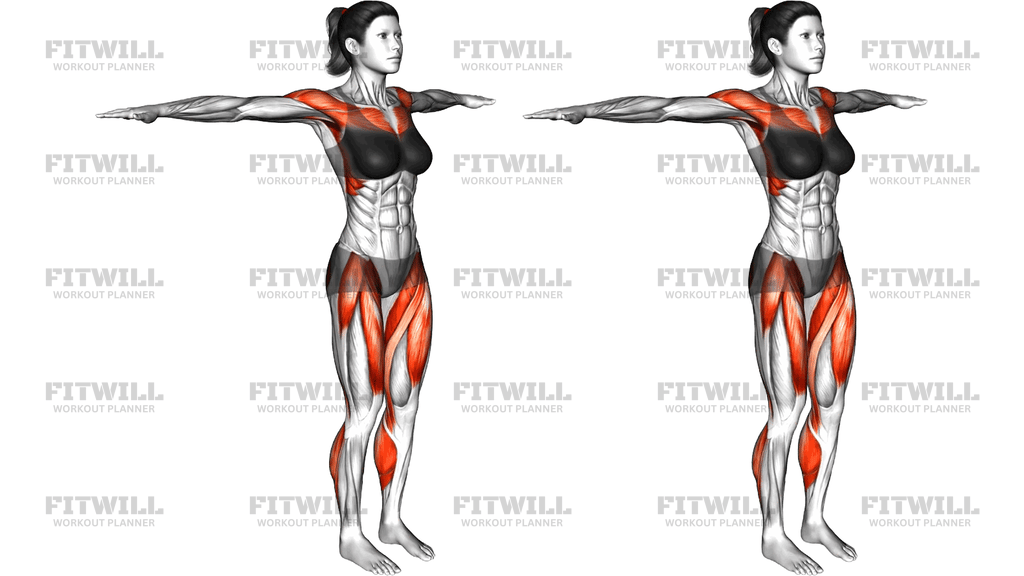
Instructions
- Stand tall with your feet hip-width apart, weight spread evenly across both feet, and your gaze fixed on a point straight ahead.
- Raise both arms straight out to your sides until they are level with your shoulders, palms facing down, elbows soft but nearly straight.
- Brace your abs lightly and pull your shoulders down away from your ears so your neck stays long.
- Step your right foot forward a comfortable distance while sweeping both arms in toward each other at chest height, crossing one over the other.
- Pause for a beat in the crossed position with the step planted, keeping your torso upright and your shoulders level.
- Step the right foot back to the starting stance while opening the arms back out to shoulder height, uncrossing them smoothly.
- Repeat the forward step with the left foot, this time crossing the opposite arm on top so both sides work evenly.
- Continue alternating steps and crosses at a steady, controlled rhythm, keeping the arms at shoulder height the whole time.
- Breathe in as the arms open wide and breathe out as they cross in front of your chest.
- When you finish the set, lower your arms slowly to your sides and stand still for a few breaths before moving on.
Tips & Tricks
- If your arms drift downward as you tire, that is the first sign the set is ending — either lift them back to shoulder height deliberately or stop and rest rather than grinding through a droopy cross.
- Alternate which arm crosses on top each rep. Using the same arm on top every time creates a lopsided pattern and one shoulder ends up doing more of the reaching.
- Keep the forward step short enough that you never feel a stretch at the front of the stepping hip; overreaching pulls your torso forward and ruins the arm path.
- Do not let the cross become a clap or a slap — the arms should meet and overlap with control, roughly over your sternum, not collide with momentum.
- If you feel this in your neck instead of your shoulders, you are shrugging. Consciously press your shoulder blades down and reach out through the fingertips before starting.
- Keep your hips square to the front. Twisting the torso to help the arms cross reduces the work on the abs and shoulders and turns it into a partial movement.
- Slow the tempo down before speeding it up. This drill exposes coordination gaps quickly, and rushing the step-cross timing is the most common way people lose balance.
- If standing balance is a challenge, hold onto a wall or sturdy chair with one hand and work one arm at a time until the stepping pattern feels automatic.
Frequently Asked Questions
What muscles does Front Step Criss Cross Arms work?
The main work is done by the front shoulders, which hold the arms up and sweep them across, along with the chest during the cross. The quads and hip flexors power each forward step, and the abs steady your torso every time the arms cross your midline.
Is Front Step Criss Cross Arms good for beginners?
Yes, it is low impact and requires no equipment, so most beginners can start right away. Begin with a slower tempo and a shorter range on the cross, and build speed only once the step and arm timing feel automatic.
How high should my arms be during the Front Step Criss Cross Arms?
Your arms should stay level with your shoulders throughout the set, both when open wide and when crossing. Letting them sag toward your hips shifts the work away from the shoulders and shortens the crossing arc.
Why do my shoulders fatigue so quickly in this drill?
Holding your arms at shoulder height against gravity is continuous work for the front shoulders and upper back, so a burn within twenty to thirty reps is normal. Lower your arms and rest, then continue rather than letting your form collapse.
How many reps of Front Step Criss Cross Arms should I do?
For a warm-up, aim for twenty to forty total steps, alternating legs, at a controlled pace. For a cardio circuit, work in thirty to forty-five second bouts and focus on keeping the rhythm consistent rather than fast.
Which arm should cross on top?
Alternate which arm is on top with each rep so both shoulders get equal work. If the pattern feels awkward on one side, that is normal at first and improves with practice.
What is the most common mistake in the Front Step Criss Cross Arms?
The most common mistake is swinging the arms with momentum while shrugging the shoulders up toward the ears. Fix it by slowing the tempo, pressing the shoulder blades down, and making the cross a controlled overlap at chest height.
Can I do Front Step Criss Cross Arms if I have knee issues?
Because the forward step is low impact and the knee only bends slightly, many people with cranky knees tolerate it well. Keep the step short, stay in a pain-free range, and stop if the knee complains.
What can I substitute if I need an easier version?
Do the same arm cross pattern while marching in place instead of stepping forward, or hold onto a wall with one hand and cross one arm at a time. Both versions cut the balance demand while keeping the shoulder and core work.
Does the Front Step Criss Cross Arms count as cardio or strength work?
It sits in between: sustained sets elevate your heart rate like light cardio, while the shoulders and legs work against your body weight. Treat it primarily as a coordination and conditioning drill rather than a muscle-building exercise.