Side To Side Punches
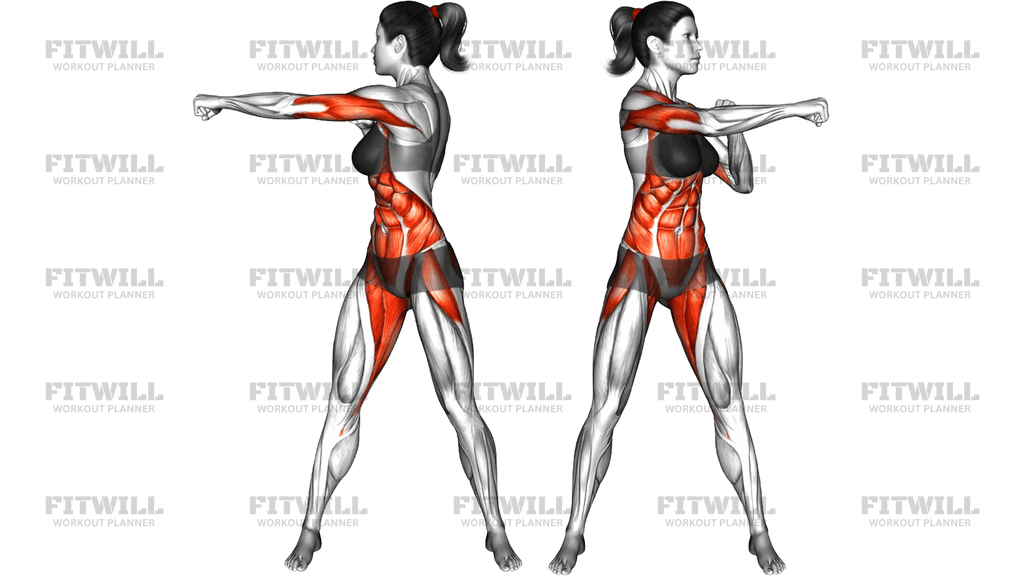
Side To Side Punches are a standing bodyweight movement where you throw alternating straight punches across your body from a wide, stable stance. One arm extends fully at chest height while the other stays cocked near the ribs, then the roles switch in a steady rhythm. It looks simple, but the rotation through the torso on every punch is what makes it more than just an arm exercise.
This movement works the shoulders and triceps as the prime movers of the punch, while the obliques and deep core control the twisting that happens with each cross-body reach. The wide stance keeps the legs and glutes engaged isometrically, and when you pick up the pace, your breathing and heart rate climb quickly, which is why it shows up so often in warm-ups, boxing-inspired conditioning circuits, and low-impact cardio intervals.
Setup matters more than most people expect. A stance roughly shoulder-width or slightly wider, soft knees, and a braced torso give you a stable base so the rotation comes from your hips and waist rather than your lower back slopping around. Feet planted and ribs stacked over hips let you punch hard and retract cleanly without wobbling sideways.
To execute well, drive one fist straight out across the midline of your body at roughly chest height, letting the opposite hip and shoulder rotate slightly into the punch, then snap it back to guard as the other hand fires. The hands should alternate smoothly, with the retraction as crisp as the extension. Keep the shoulders down away from your ears and the wrists neutral so the fist travels in a straight line.
Side To Side Punches suit almost anyone because they require no equipment and very little space. Beginners can use them to groove punching mechanics and build shoulder endurance, while more advanced trainees use them as active recovery, a cardio finisher, or a warm-up primer before pressing or striking work. Because the intensity scales entirely with your speed and effort, you control exactly how demanding each set becomes.
The main practical points are to keep the movement controlled enough that your torso rotation stays deliberate, avoid locking the elbows at full extension, and stop the set once your form gets sloppy rather than grinding through fatigue. Done consistently, this is one of the most efficient ways to combine upper-body muscular endurance with a genuine cardio response in a couple square meters of floor space.
Fitwill
Log Workouts, Track Progress & Build Strength.
Achieve more with Fitwill: explore over 9600 exercises with images and videos, access built-in and custom workouts, perfect for both gym and home sessions, and see real results.
Start your journey. Download today!




Instructions
- Stand with your feet about shoulder-width apart or slightly wider, toes pointing forward, and distribute your weight evenly across both feet.
- Soften your knees slightly, hinge your hips back a touch, and bring both fists up to guard position just below your chin with elbows tucked close to your ribs.
- Brace your core as if preparing for a light push, and keep your ribs stacked over your pelvis so the rotation comes from your waist, not your lower back arching.
- Punch one fist straight forward and across the midline of your body at chest height, allowing your opposite hip and shoulder to rotate naturally into the strike.
- Fully extend the punching arm without snapping or locking the elbow, keeping the wrist straight and the knuckles leading the path.
- Retract that hand quickly back to guard as the opposite arm fires its punch across the body, creating a smooth alternating rhythm.
- Exhale sharply on each punch and inhale briefly during the retract-switch transition, keeping the breath steady rather than holding it.
- Continue alternating sides at a consistent pace, keeping your feet planted and your head steady with your eyes forward.
- When finishing, slow the pace over the last few reps, bring both fists back to guard, then lower your hands and shake out the shoulders before your next set.
Tips & Tricks
- If your punches drift upward or downward, pick a fixed target point straight ahead at chest height and aim every cross-body punch at it.
- A common mistake is twisting from the lower back while the hips stay frozen; let the rear hip and heel rotate slightly into each punch so the obliques do the work instead of your spine.
- Avoid overreaching by leaning the torso forward as you punch across the body; the extension should come from the shoulder and trunk rotation, not from falling toward the target.
- If your shoulders creep up toward your ears as you fatigue, consciously drop the shoulder blades down and back before continuing.
- Keep the retraction as fast as the extension; letting the hand hang out at full extension kills the rhythm and reduces the cardio effect.
- Start at a moderate pace for the first set to groove the alternating pattern, then increase speed only once the cross-body path feels automatic.
- If your wrists flop at the end of each punch, keep the fist closed firmly with the wrist locked in line with the forearm from guard through full extension.
- For a conditioning set, time rounds of 30 to 60 seconds rather than counting reps, since pacing by the clock keeps the effort honest.
- If you feel any pinching in the front of the shoulder, reduce the punch height slightly and shorten your extension range until the joint moves freely.
Frequently Asked Questions
What muscles do Side To Side Punches work?
The shoulders and triceps drive each punch, while the obliques and core control the cross-body rotation. The legs work isometrically to hold the wide stance steady.
Are Side To Side Punches good cardio for beginners?
Yes. Because you control the speed and effort, beginners can start with slow, deliberate punches and progress to faster rounds as their conditioning improves. There is no jumping or impact on the joints.
Should my feet stay planted during Side To Side Punches?
Keep your feet in the same wide stance throughout, but allow the rear heel to pivot slightly as your hips rotate into each punch. Forcing the hips to stay completely square shifts stress into the lower back.
Why do my shoulders burn faster than my arms during this exercise?
The front and side of the shoulder perform most of the lifting and extending on every punch, while the triceps assist with lockout. This is normal and improves quickly with practice.
How fast should I punch in Side To Side Punches?
Match your pace to your goal: moderate speed for warm-ups and form practice, faster continuous punching for conditioning rounds. Slow down as soon as your punches start drifting off their straight path.
What can I use instead of Side To Side Punches?
Straight alternating punches in place, shadowboxing combos, or light bag work train similar patterns. A resistance band anchored behind you can add load to the same cross-body punching motion.
Can I do Side To Side Punches every day?
Yes, as long as the overall volume stays reasonable and your shoulders do not feel nagging soreness. Many people use short daily rounds as a low-impact cardio and mobility habit.
Should I hold weights while doing Side To Side Punches?
It is not recommended. Adding load to fast, snapping punching motions stresses the elbow and shoulder at full extension, and the cardio benefit comes from speed, not resistance.
How do I know if my punching height is correct?
Your fist should finish at roughly chest or upper-chest height in a straight line across your body. Punches that finish near the chin or waist usually mean the shoulder is compensating for lost trunk rotation.