Wide Stance Side Bend
The Wide Stance Side Bend is a bodyweight core exercise that targets the obliques through lateral flexion of the spine. You take a stance much wider than shoulder width, place both hands lightly behind your head, and bend directly sideways from the waist, first to one side and then to the other. Because there is no external load, the movement relies entirely on clean technique and muscle control, which makes it easy to learn but surprisingly demanding when done with intention.
The wide stance is not a cosmetic detail. Spreading the feet well beyond hip width lowers your base and creates a stable, tripod-like foundation so you can lean sideways without tipping or compensating. It also engages the inner thigh muscles isometrically as they work to hold your legs open and your pelvis steady while your trunk travels side to side. That combination of moving trunk and braced lower body is what separates this exercise from a casual standing side stretch.
This movement suits a wide range of trainees. Beginners can use it to learn what true lateral flexion feels like before adding resistance with a dumbbell or cable. More experienced lifters use it as a warm-up activation, a high-rep finisher for the waist, or a low-impact option during deload weeks. It is also useful for anyone whose daily life involves rotation and bending, since strong, controlled obliques support the trunk in every direction, not just forward.
To execute it well, keep the bend happening at your waist, not at your hips. Your torso should travel in the frontal plane, sliding your ribcage toward the same-side hip, while your shoulders stay square to the front and your chest points forward the entire time. Avoid letting your body twist, hinge forward, or drop your head. The hands behind the head are for light support and balance only, so never pull on your neck to deepen the range.
Because the obliques work one side at a time in this pattern, the exercise highlights and can even expose side-to-side differences in strength or control. Moving slowly and pausing briefly at the bottom of each bend helps you feel whether one direction bends further or smoother than the other. If you notice a clear imbalance, do an extra set or a few extra repetitions on the stiffer side rather than rushing both sides equally.
For most people, ten to twenty controlled repetitions per side works well, either for one or two rounds. Stay within a comfortable range at first; the goal is a deliberate side bend with a strong squeeze back to tall standing, not reaching toward your toes. Keep your knees soft but still, and let your legs quietly do their job of anchoring you while the waist does the moving.
[ Workout Log & Planner ]
Put your next workout in Fitwill
Keep your plan and training log ready when you are.


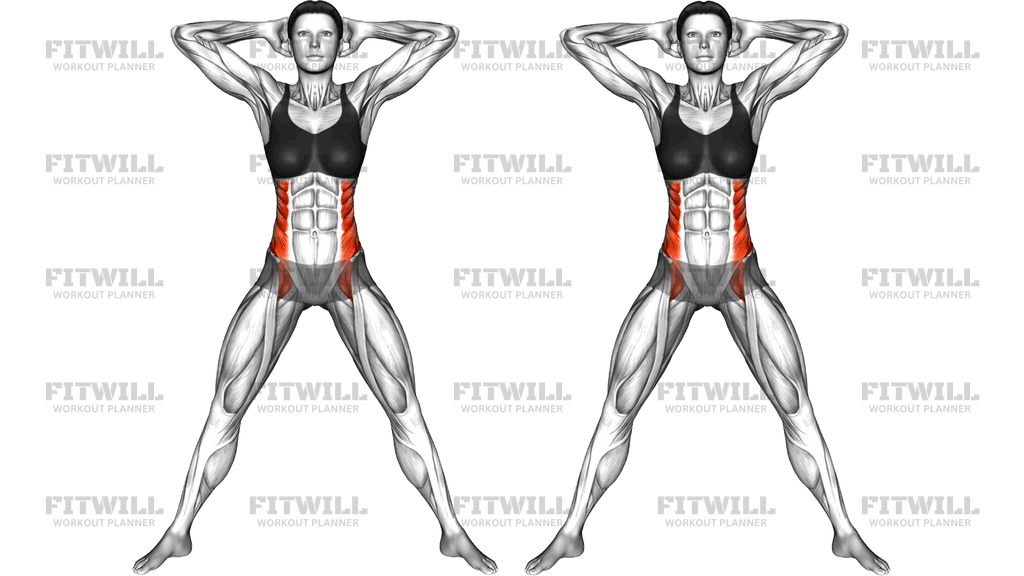
Instructions
- Stand with your feet roughly two to three shoulder widths apart, toes turned out slightly, and shift your weight evenly across both feet.
- Place both hands gently behind your head with your elbows flared wide, and stand tall with your chest open and your gaze straight ahead.
- Brace your abdominal wall lightly and squeeze your inner thighs toward each other to lock your lower body into the wide stance.
- Keeping your hips level and your shoulders square to the front, bend directly sideways at the waist, sliding your ribcage down toward your right hip.
- Lower only as far as you can move without your torso tipping forward, twisting, or your hips shifting sideways, and pause for a beat in the shortened position.
- Pull yourself back up to a tall standing position by contracting the obliques on the opposite side, feeling the stretch along your left waist at the top of the return.
- Exhale as you bend to the side, and inhale as you rise back to vertical, keeping the breath steady throughout the set.
- Complete all repetitions on one side, then switch and bend to the left for the same number of reps.
- Between reps, reset your stance and posture rather than letting your body slump into the next bend.
- Keep your knees soft but stationary the whole time; the movement should come from your waist, not from your legs bowing in or out.
Tips & Tricks
- A common mistake is turning the side bend into a hip push, where the pelvis shoots left as the torso drops right. Fix it by imagining your hip bones fixed between two walls and letting only your ribcage travel.
- Do not tug on the back of your neck to pull yourself deeper. Your fingertips should rest behind your head with the elbows wide, and the work comes from your waist, not your arms.
- If your inner thighs cramp in the wide stance, narrow your feet slightly. That usually means the adductors are working hard to hold the position, which is fine, but the stance should not steal focus from the waist.
- Move slower than feels natural. A two-second descent, a one-second pause, and a two-second return turns this from a casual stretch into a genuine oblique exercise.
- Keep both feet flat. Lifting the heel on the side you bend away from is a sign you are leaning rather than bending, and it weakens the lateral work.
- Bend within a range where you can still squeeze back up under control. If you have to swing or momentum your way back to standing, you went too deep.
- Face a mirror from the front for your first few sessions. The most common error, a slight forward fold, is invisible to you but obvious from the front.
- If one side bends noticeably further than the other, start your set on the stiffer side and match the range to it rather than chasing the looser side's depth.
Frequently Asked Questions
Which muscles does the Wide Stance Side Bend work?
The obliques on the sides of your waist are the prime movers, with the deep core and rectus abdominis assisting. The inner thigh muscles also work isometrically to hold the wide stance and keep your pelvis stable.
Why does the Wide Stance Side Bend use such a wide stance instead of a normal one?
A wide base lowers your center of gravity and gives you side-to-side stability, so you can bend laterally without losing balance or pushing off with your hips. It also keeps the adductors engaged as stabilizers throughout the set.
Can beginners do the Wide Stance Side Bend?
Yes, it is one of the safest ways to learn lateral flexion because there is no external load. Beginners should use a slightly narrower stance, a shorter range, and slower tempo before trying to increase depth.
Should I feel the Wide Stance Side Bend on both sides at once?
During a single bend, the obliques on the side you are bending toward contract while the opposite side stretches. Over a full set of both sides, the work evens out, but a one-sided pulling sensation during the stretch itself is normal.
How do I stop my hips from shifting when I bend sideways?
Lightly squeeze your inner thighs toward each other and imagine your pelvis bolted in place while only your ribcage moves. Filming yourself from the front for a few reps will quickly show whether your hips are drifting.
Can I add weight to the Wide Stance Side Bend?
Yes, once your technique is solid, holding a single dumbbell or kettlebell in one hand creates a loaded version. Build up with the bodyweight version first so the added load does not pull you into twisting or hinging forward.
How many repetitions of the Wide Stance Side Bend should I do?
Ten to twenty controlled repetitions per side for one to two rounds works well, whether as a core finisher or a warm-up. Because the range is short and the load is low, higher reps with strict form beat low reps with sloppy swinging.
Is it normal for the Wide Stance Side Bend to feel easier on one side?
Most people have some side-to-side difference in range or control. Start each set on your stiffer side and match your stronger side to that range so the imbalance does not widen over time.
Is the Wide Stance Side Bend safe for my lower back?
When performed with an upright chest, no twisting, and a range you can control, it is a gentle lateral movement for most people. If bending sideways causes discomfort, reduce the depth and range of motion, and avoid forcing the stretch.
Can I use the Wide Stance Side Bend as a stretch instead of a strength exercise?
Yes, holding the bottom position for fifteen to thirty seconds per side turns it into a standing lateral stretch for the obliques and the muscles along the side of the lower back. Just keep the same upright posture and square hips you would use for the strength version.