Downward Dog To Chest Press
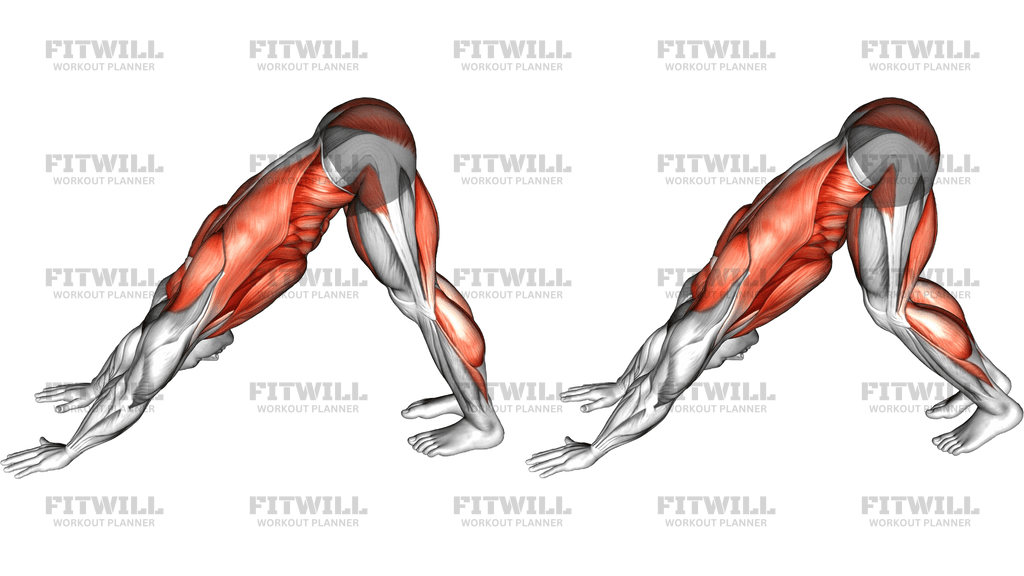
The Downward Dog To Chest Press is a bodyweight flow that links two opposing positions into one continuous movement. You begin in a downward dog with hips high and an inverted V shape, then shift your weight forward over your hands, lowering your chest toward the floor as if slipping under a low bar. From there you press the floor away and glide back into the starting downward dog. The image shows both ends of that path: the chest lowered between the hands, and the hips driven back up with heels reaching toward the floor.
This movement trains far more than a standard push-up. The forward shift loads the shoulders and chest through a long range, while the drive back to downward dog demands strength from the triceps, lats, and serratus anterior as you push the floor away and lift the hips. Your core stays switched on the entire time to keep the spine long as your body travels over your hands. Because you never touch your thighs or hips to the floor, the shoulders do a large share of the stabilizing work.
The setup matters more than people expect. Hands should be planted slightly wider than shoulder width with fingers spread, because the whole body pivots over them during the shift. If your hands are too far forward or your weight sits back in the heels of your palms, the forward glide turns into a sloppy flop and your wrists take the abuse. Start each rep from an active downward dog with a long spine, not a collapsed back.
This exercise suits intermediate trainees who already own solid push-ups and want to build shoulder capacity, mobility, and control in one drill. It is a staple in calisthenics and bodyweight warm-up routines, and it doubles as a preparation exercise for more demanding pressing skills because it teaches you to transfer weight smoothly from the legs to the hands. Gymnasts, martial artists, and desk workers with stiff shoulders all benefit from the combined strength and stretch effect.
Keep the tempo honest. The temptation is to rush the forward shift and let gravity drop the chest, but the value lives in the controlled glide over the hands and the deliberate press back. If your hamstrings are tight, a soft knee bend is acceptable at first; as mobility improves, work toward straighter legs so the calves and hamstrings get their stretch on every rep.
[ Workout Log & Planner ]
Put your next workout in Fitwill
Keep your plan and training log ready when you are.


Instructions
- Place your hands on the floor slightly wider than shoulder width, fingers spread, and walk your feet back until your body forms an inverted V with hips at the highest point.
- Press firmly through the base of each finger, turn the insides of your elbows forward, and let your head hang relaxed between your arms with your neck long.
- Brace your core gently and pull your lower ribs down so your back stays flat as you begin to move.
- Rise onto the balls of your feet and shift your body forward over your hands, gliding your shoulders past your wrists in one smooth line.
- Continue forward until your chest is a few centimeters from the floor, elbows tracking back at roughly 45 degrees, without letting your hips or thighs sag or touch down.
- Press the floor away hard, pushing your hips up and back as your chest lifts out of the low position.
- Return fully to the downward dog, reaching your heels toward the floor and pushing your chest back toward your thighs to complete the rep.
- Inhale as you shift forward and lower the chest; exhale as you press back to downward dog.
- Reset your hand pressure and spinal position at the top of each rep before starting the next one.
Tips & Tricks
- Think of the motion as a long oval over your hands, not two separate moves. If you pause and collapse at the bottom, shorten the forward shift until you can keep tension through the whole loop.
- Wrists complaining is the most common failure here. Grip the floor with your fingertips and keep your weight toward the outside of your palms rather than dumping it into the heel of the hand as you shift forward.
- A sagging lower back at the bottom position means your core disengaged during the shift. Exhale sharply as you arrive at the low point to re-brace before pressing.
- Keep your elbows pointing back and slightly in, not flared wide. Flared elbows turn the chest press into a shoulder-pinching position and bleed pressing power.
- If tight hamstrings pull your lower back into a round at the top, bend your knees deliberately on purpose instead of letting them buckle randomly; straighten them gradually over weeks.
- Drive the return with the hips, not just the arms. Pushing the floor away while lifting the tailbone is what makes the press feel powerful instead of like a grind.
- Slow the eccentric. Count two to three seconds on the forward shift; the control you build there is exactly what transfers to harder pressing skills.
- Scale down by bending the knees during the shift or limiting how far your shoulders travel past the wrists, then progress the range as your shoulders earn it.
Frequently Asked Questions
Which muscles does the Downward Dog To Chest Press work the most?
The front shoulders and chest handle the pressing, with strong support from the triceps and the serratus anterior. The lats and core work to control the shift and pull you back into the downward dog position.
How is this different from a regular push-up?
A push-up moves straight up and down with the hips locked in a plank line. In the Downward Dog To Chest Press your whole body glides forward over the hands and returns to an inverted V, so the shoulders travel through a much larger range and the hamstrings and calves get loaded and stretched as well.
Can beginners do the Downward Dog To Chest Press?
Yes, with a shortened range. Keep the shoulders from traveling too far past the wrists and bend the knees during the shift; once you can complete ten smooth reps, gradually increase how far forward you glide.
Why do my wrists hurt when I shift forward?
Your weight is likely dumping into the heel of your palm as the shoulders pass over the hands. Spread your fingers, grip the floor, and keep pressure on the base of the thumb and fingertips throughout the shift, and warm the wrists up before starting.
Should my chest actually touch the floor at the bottom?
No. The chest hovers a few centimeters above the floor with elbows bent and controlled. Touching down usually means you dropped with gravity instead of gliding under tension.
What can I use as a substitution if the movement is too hard?
Perform the same flow with knees down, or split it into separate downward dog stretches and incline push-ups with hands on a bench. Combine them back into the full Downward Dog To Chest Press once each part feels solid.
How many reps and sets should I do?
Two to four sets of six to twelve controlled reps works well as a strength and mobility drill. Treat it as a warm-up priming movement, use fewer reps at a slower pace.
Is it a problem if my heels cannot reach the floor in the downward dog position?
Not at all. Heel height reflects calf and hamstring flexibility, and the stretch still counts as long as your spine stays long and your weight stays in the hands and balls of the feet.
How do I keep my lower back safe during this exercise?
Keep your ribs drawn down and your abdominal wall engaged so your pelvis does not tip forward when the chest lowers. If your back arches or sags at the bottom, reduce the forward shift and re-brace before pressing back.