Arms Up And Down
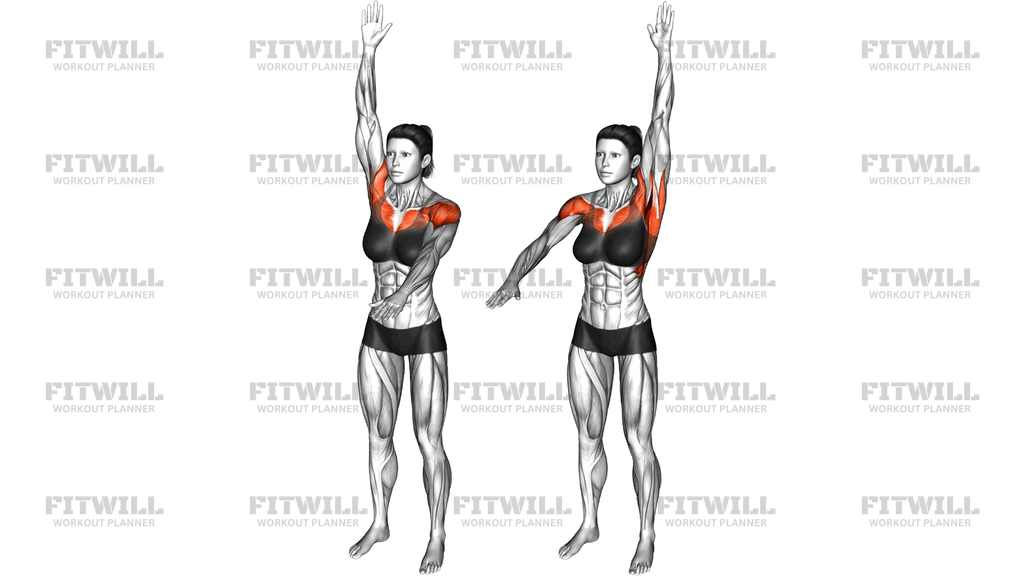
Arms Up And Down is a simple standing bodyweight movement where you alternate raising one arm straight overhead while the other swings down and back, then switch sides in a steady rhythm. Because it uses no equipment and only a small footprint of floor space, it fits easily into warm-ups, shoulder mobility work, low-impact conditioning circuits, or active recovery between harder sets.
The main work falls on the shoulders, especially the front and side portions of the deltoids, as they lift and control the arm through a large arc. The chest and upper back assist by positioning the arm and stabilizing the shoulder blade, while the core stays quietly engaged to keep your torso upright as the arms move. The alternating pattern also creates a natural cross-body rhythm that gently raises your heart rate without any jumping or impact.
Setup matters more than it might seem for such a basic-looking drill. Stand tall with feet about hip-width apart, weight spread evenly across both feet, and your ribs stacked over your pelvis. If you lean back or arch your lower back as the arm travels overhead, you shift work away from the shoulder and into passive positions that do little for strength or control.
To execute it well, drive one arm up in a smooth vertical path until the bicep finishes near the ear with the palm facing inward, while the opposite arm drops down and slightly behind your hip. Reverse the roles with a deliberate, flowing exchange so the hands pass near your sides rather than swinging wide. Keep the movement continuous but controlled, as if your arms are drawing two long arcs in the air.
This exercise suits beginners learning shoulder range of motion, older adults who want joint-friendly movement, desk workers undoing hours of rounded posture, and athletes using it as a warm-up before pressing or overhead work. It is also a reasonable low-impact option in home cardio circuits when repeated for time.
The most common faults are rushing the reps, shrugging the raised shoulder toward the ear, and bending the elbow so the arm shortens instead of reaching fully. Slow the tempo, keep the working arm long, and let the shoulder blade move naturally rather than forcing stillness. Stop short of any pinching sensation at the top of the shoulder and reduce the arc if it appears.
[ Workout Log & Planner ]
Put your next workout in Fitwill
Keep your plan and training log ready when you are.


Instructions
- Stand upright with your feet hip-width apart, knees soft but not bent, and your weight balanced evenly across both feet.
- Let your arms hang relaxed at your sides with palms facing your thighs, and pull your chin back slightly so your head sits over your ribcage.
- Brace your core lightly and exhale as you raise one arm straight up in front of your body, keeping the elbow long and the palm turning to face inward.
- At the same time, let the opposite arm swing down and slightly behind your hip so the hands pass close to your body mid-rep.
- Finish each rep with the raised arm's bicep beside your ear and the hand roughly in line with the shoulder, not drifting forward or back.
- Reverse the motion smoothly: bring the top arm down along the same arc while the low arm rises, so your hands trade positions near hip level.
- Breathe steadily throughout, inhaling on one exchange and exhaling on the next, rather than holding your breath.
- Keep your gaze forward and your torso still; the arms move, but the shoulders, ribs, and hips should stay level.
- Continue alternating for your desired reps or time, then finish with both arms back at your sides and take a breath before the next set.
Tips & Tricks
- If you catch yourself shrugging the lifting shoulder up toward your ear, pause at the top of one rep and consciously settle the shoulder blade down before continuing.
- Bending the elbow turns this into a shorter, easier motion; imagine trying to touch the ceiling with your fingertips to keep the arm fully lengthened.
- Leaning the torso back as the arm goes overhead is a common compensation. Stand with your back near a wall at first and keep your head and shoulder blades lightly touching it.
- If the movement feels rushed, use a two-count up and two-count down tempo until the pattern feels automatic, then speed up gradually.
- Warm shoulders move better; if the top position feels tight, do a few smaller arcs where the arm stops at chest height before going fully overhead.
- Avoid letting the rising hand drift in front of your face. Check from the side that the arm finishes stacked over the shoulder joint.
- For a warm-up, use a light, flowing pace for 30 to 60 seconds; for a strength-endurance set, slow the tempo and pause briefly with the arm overhead.
- If one side feels stiffer or less coordinated, do an extra few reps on that side during your warm-up rather than just matching the smooth side.
Frequently Asked Questions
What muscles does Arms Up And Down work?
The shoulders, particularly the front and side deltoids, do most of the lifting, with the chest and upper back assisting to position the arm and shoulder blade. The core works lightly to keep your torso upright throughout.
Is Arms Up And Down suitable for complete beginners?
Yes. It requires no equipment, places no load on the joints, and can be scaled by adjusting speed, range, and duration. Beginners should start with a smaller arc and stop short of any pinching at the shoulder.
How high should my arm go at the top of Arms Up And Down?
Aim for the arm to finish straight up beside your ear, in line with the shoulder. If overhead range is restricted, lift only as high as you can while keeping the elbow straight and the shoulder relaxed, and increase the range gradually.
Should my palms face forward or inward during Arms Up And Down?
A neutral palm facing inward is the most comfortable and joint-friendly position for most people. Rotating the palm forward slightly increases chest involvement but can feel pinchy for some shoulders, so use it only if it stays comfortable.
Can I count Arms Up And Down as cardio?
It can serve as light, low-impact conditioning when performed continuously for a minute or more, especially in circuit or recovery sessions. It will not replace higher-intensity cardio, but it raises the heart rate gently without impact.
Why do I feel Arms Up And Down in my neck?
That usually means you are shrugging the working shoulder toward your ear or jutting your chin forward. Settle the shoulder blade down, lengthen the back of your neck, and slightly reduce your range until the neck tension disappears.
What can I use instead of Arms Up And Down?
Standing arm circles or alternating front raises with light dumbbells train a similar pattern. If you want a matching rhythm drill with less shoulder range, alternate reaching one arm forward at chest height while the other reaches back.
How many reps of Arms Up And Down should I do?
For a warm-up, 30 to 60 seconds of continuous alternating reps works well. For a strength-endurance focus, try 20 to 30 controlled reps per side with a brief pause at the top of each lift.
Is it safe to do Arms Up And Down with a shoulder injury?
It is generally low-risk because there is no external load, but any recent or ongoing shoulder problem deserves caution. Reduce the arc, slow the tempo, and work within a pain-free range; check with a qualified professional if symptoms persist.