Walking Shoulder Tap
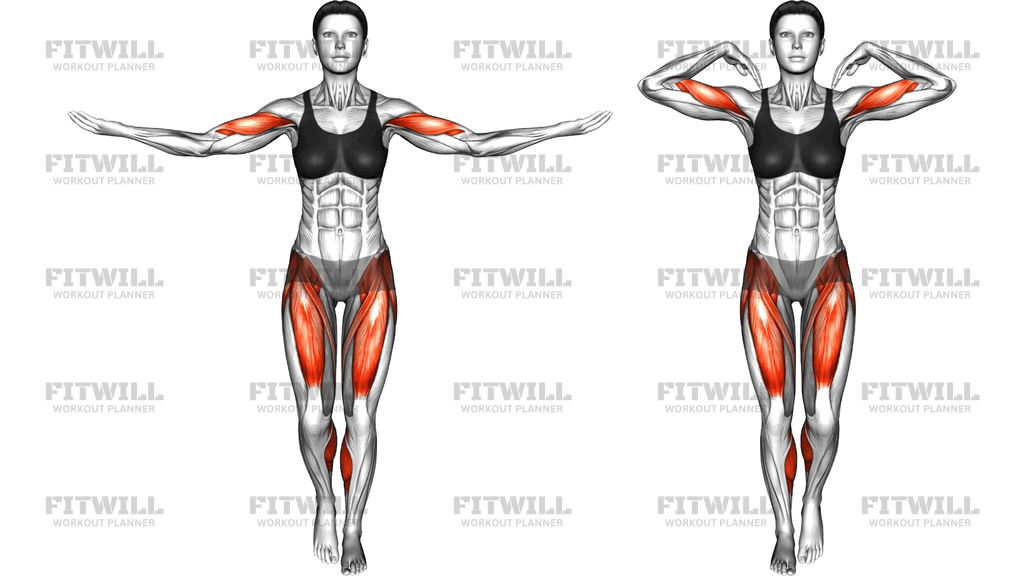
The Walking Shoulder Tap is a standing, body-weight movement that combines a simple arm action with continuous footwork. You stay tall through the torso, lift both arms out to shoulder height, bend the elbows to tap the tops of your shoulders with your fingertips, and then press the arms back out wide — all while walking in place or moving forward with light, steady steps. Because the legs keep moving the entire time, this works as a low-impact warm-up, a shoulder activator, and a gentle cardio drill in one.
The exercise is especially useful as a warm-up before upper-body training, since it raises the heart rate while taking the shoulders through repeated cycles of abduction and elbow flexion. It also suits people who spend long hours sitting, where the shoulders tend to roll forward and the arms rarely move through a full, open range. Coaches often use it in group classes and circuit workouts because it requires no equipment, no floor work, and can be scaled from slow and controlled to brisk and rhythmic.
The primary work comes from the shoulders, particularly the middle and front deltoids, which hold the arms up and control the opening and closing of each rep. The biceps and forearms assist as the elbows bend and the fingertips reach for the shoulders, while the upper back helps keep the chest open. Because you are walking, the calves, hip flexors, and small stabilizing muscles around the hips and ankles stay busy keeping you balanced on each step.
Setup matters more than it looks. A stacked posture — ribs down, shoulders relaxed away from the ears, gaze forward — lets the arms move freely and keeps the taps accurate. If the torso leans back or the shoulders shrug, the movement shortens and the neck picks up work it should not. Keep the steps small at first so the arms and legs can find a rhythm together without your upper body swaying.
To execute it well, think of the arms as the priority and the steps as the metronome. Reach the arms fully out to the sides at shoulder height, tap the shoulders deliberately rather than slapping them, and re-extend fully before the next tap. Breathe in a steady rhythm — one breath every two taps works well — and let the pace stay one you could hold while holding a conversation.
Because there is no impact from jumping and no load on the joints, the Walking Shoulder Tap is appropriate for most trainees, including beginners and older adults. The main safety points are keeping the tapping motion smooth instead of jerky, avoiding shrugging into the ears as fatigue builds, and reducing the pace if your steps and taps fall out of sync.
[ Workout Log & Planner ]
Put your next workout in Fitwill
Keep your plan and training log ready when you are.


Instructions
- Stand tall with your feet together or slightly apart, weight balanced over the middle of each foot, and your arms hanging relaxed at your sides.
- Step one foot forward into a short walking stance, then raise both arms straight out to the sides until they are level with your shoulders, palms facing forward or down.
- brace your core lightly and draw your shoulder blades down so your shoulders stay away from your ears.
- Walk in place with small, controlled steps, lifting each knee just a few inches and rolling from heel to toe.
- As you keep stepping, bend both elbows at the same time and bring your fingertips in to tap the tops of your shoulders.
- Pause for a beat at the tap so the contact is deliberate, keeping your elbows roughly at shoulder height rather than dropping them to your ribs.
- Extend both arms back out wide to the full starting position, keeping them at shoulder height the whole way.
- Continue the cycle — tap, extend, tap, extend — matching one full arm cycle to every two or four steps so your rhythm stays consistent.
- Breathe steadily throughout, inhaling as the arms open and exhaling as they tap in.
- To finish, stop stepping first, then lower your arms slowly to your sides and reset your posture before your next set.
Tips & Tricks
- If your fingertips miss or slap the shoulders, slow the tempo — accuracy at the tap matters more than speed.
- Watch for shrugging: if your upper traps start to creep toward your ears after twenty or thirty seconds, exhale and actively press the shoulders down before continuing.
- Keep the arms from drifting below shoulder height on the extension; a mirror helps you catch the droop that shows up as fatigue sets in.
- Small steps beat big ones here. Long strides pull your torso forward and make the shoulder taps less controlled.
- If your lower back arches when the arms lift, brace your abs and tuck the ribs slightly before starting the set.
- Keep the elbow bend smooth and even on both sides — a common habit is one arm tapping faster or deeper than the other, usually on your tighter side.
- Use light fingertip contact at the shoulders rather than driving the fists in; the tap is a target touch, not an impact.
- When your rhythm falls apart, stop the arms, re-establish a steady walking pace, and layer the taps back in on the next step cycle.
- For a slightly harder version, pause two seconds with arms fully extended between taps; for an easier one, tap one shoulder at a time instead of both together.
Frequently Asked Questions
What muscles does the Walking Shoulder Tap work?
The shoulders, especially the middle and front delts, do most of the work of lifting and controlling the arms. The biceps and forearms assist on each tap, and the calves and hip flexors stay active from the continuous stepping.
Is the Walking Shoulder Tap good for beginners?
Yes. It is low-impact, requires no equipment, and can be slowed down or done without the walking component until the arm pattern feels natural.
Should I tap both shoulders at the same time or alternate?
The standard version taps both shoulders simultaneously with the fingertips, as this keeps the workload even across both shoulders. Alternating taps is a fine easier regression if coordinating both arms at once is difficult.
How high should my arms be during the Walking Shoulder Tap?
Keep your arms at roughly shoulder height both when extended out wide and when the elbows bend to tap. Letting the arms sink toward your hips shortens the range and reduces the work on the delts.
Why do my shoulders shrug up toward my ears during this exercise?
Shrugging usually appears as fatigue builds or when the arms are set too high to begin with. Reset your shoulder blades down and back, and if the shrug returns, shorten the set rather than pushing through it.
Can I do the Walking Shoulder Tap as a warm-up?
It is an excellent warm-up before pressing, pulling, or overhead work because it raises your heart rate while taking the shoulders through many smooth repetitions of abduction and elbow flexion.
How long should a set of Walking Shoulder Taps last?
Start with 20 to 30 seconds of continuous taps and steps, and build toward 45 to 60 seconds as your coordination and shoulder endurance improve.
My steps and taps keep falling out of rhythm. What should I do?
Match one full tap-and-extend cycle to every two steps, and slow everything down until the pattern is automatic. You can also pause the walking briefly, lock in the arm tempo, then add the steps back.
What can I use instead if I cannot stand and step comfortably?
You can perform the same arm pattern — extend wide, tap the shoulders, extend wide — while standing still or seated with a tall posture. The shoulder work stays largely the same; you simply lose some of the calf and hip activity from the stepping.