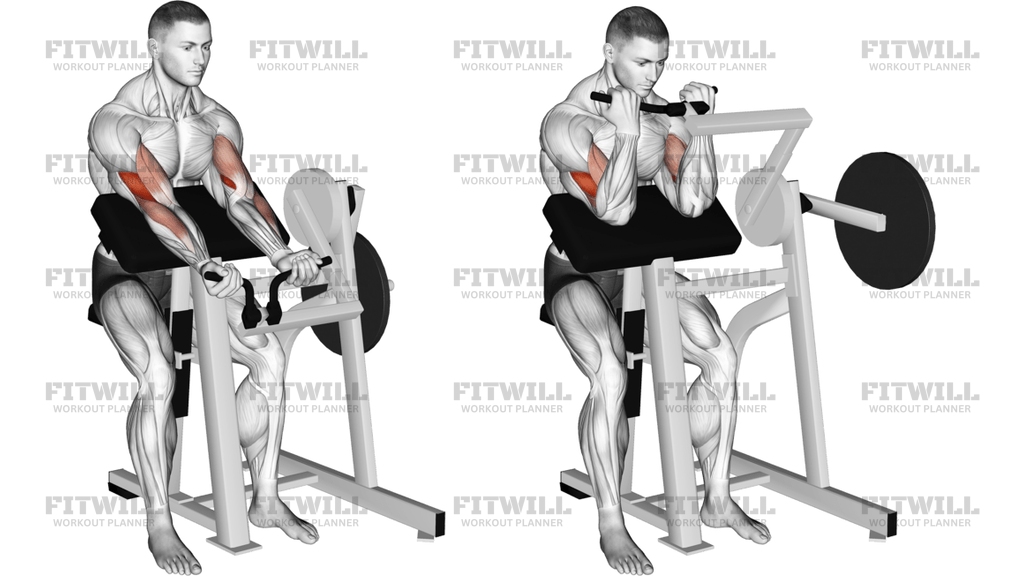
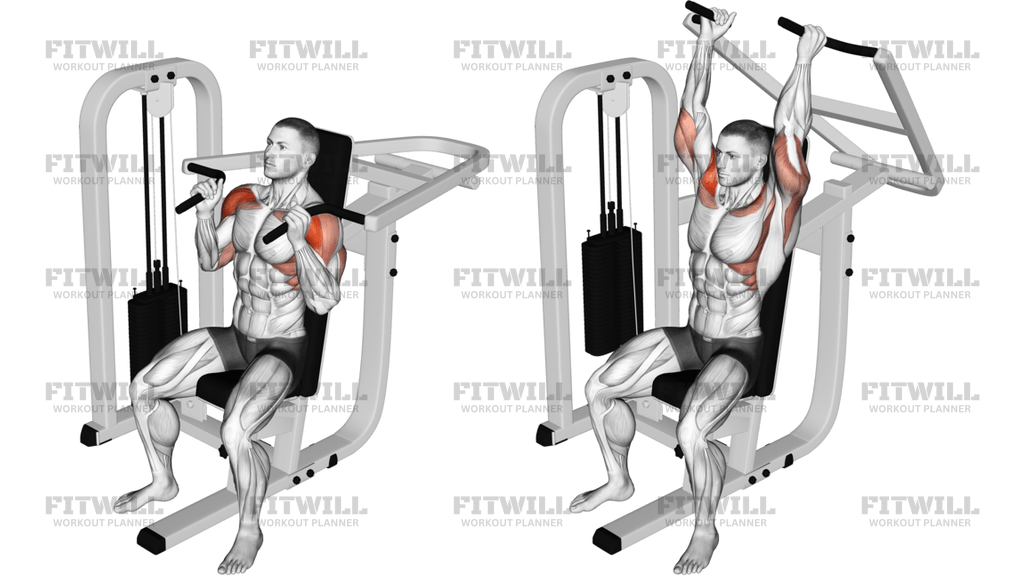
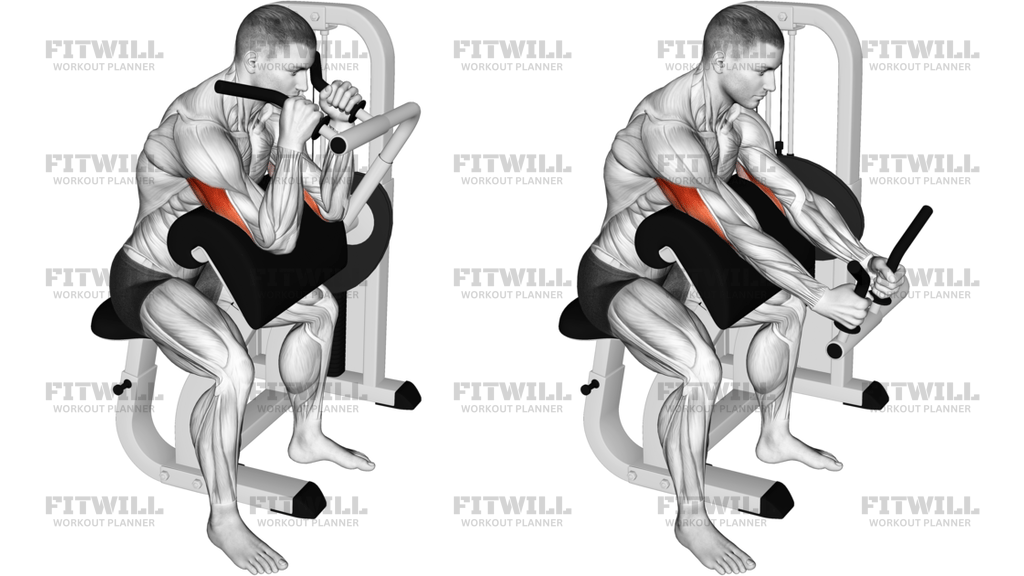
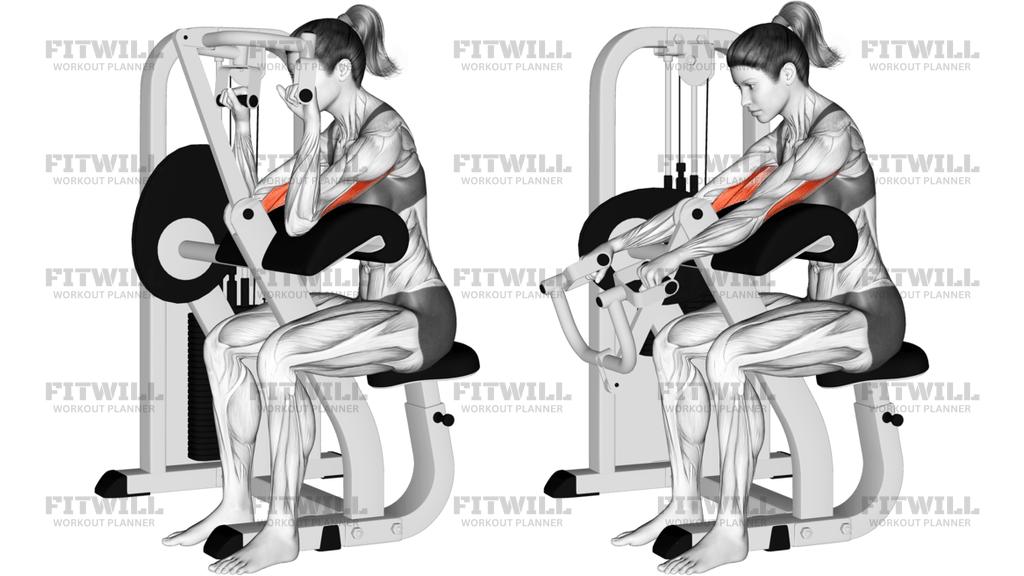
Lever Seated Triceps Extension (Plate Loaded)
The Lever Seated Triceps Extension (Plate Loaded) is a machine-based pressing movement that isolates the triceps through a fixed arc. You sit upright on the machine, rest your upper arms on a support pad, and drive the handles forward and away from your body by straightening your elbows. Because the plate-loaded lever arm dictates the path, your only job is to apply force through the elbow joint, which makes this one of the cleanest ways to train the triceps without stabilizing a free weight overhead.
The setup on this machine is what separates it from a dumbbell or cable extension. Your back stays braced against the seat, your elbows stay pinned to the pad at roughly shoulder height, and the handles start close to your shoulders so the elbows are fully bent. From there you press the handles forward until the arms approach full extension, then let the lever bring them back under control. The pad under your upper arms removes any chance of cheating with body english, so the triceps do the work or the rep doesn't happen.
This movement suits a wide range of lifters. Beginners benefit because the fixed path teaches what a locked-in elbow position feels like without requiring coordination under load. More experienced lifters use it as a heavy primary triceps builder or as a finishing movement after presses, since the plate loading allows small, precise jumps in resistance. It is also a practical choice for anyone with shoulder or lower back issues who finds overhead free-weight extensions uncomfortable, because the press happens in front of the torso rather than above the head.
The triceps, especially the lateral and long heads, do the bulk of the work here, while the front of the shoulder assists as the arm travels forward. The long head gets a strong stretch in the start position, when the elbow is fully bent and the shoulder is slightly flexed, so controlling the first half of the eccentric is worth your attention. Grip strength and wrist position barely factor in, which is another reason the machine version lets you focus purely on elbow extension.
Execution quality comes down to three things: seat height, elbow contact, and range. Set the seat so your elbows rest naturally on the pad without shrugging or reaching, keep the backs of your arms in contact with the pad through every rep, and press to a full but not slamming lockout. Half reps that bounce off the flexed position are the most common fault, and they rob the long head of its most productive stretch.
In practice, treat this like a strength movement: load it moderately heavy for sets of 8 to 12 with strict reps, or use lighter weight and higher reps at the end of an arm or push day to flush the triceps. Because the machine supports your arms, fatigue tends to show up as shortened range rather than form breakdown, so stop the set when you can no longer reach full extension.
If the machine in your gym has adjustable handle or pad positions, choose settings that line the handles up with your shoulders and keep your wrists neutral. A seat set too low pushes your elbows forward and turns the movement into a front-shoulder press; a seat set too high makes the stretch at the bottom uncomfortable. Take thirty seconds to adjust it properly and every set afterwards will feel smoother and hit the triceps harder.
[ Workout Log & Planner ]
Put your next workout in Fitwill
Keep your plan and training log ready when you are.


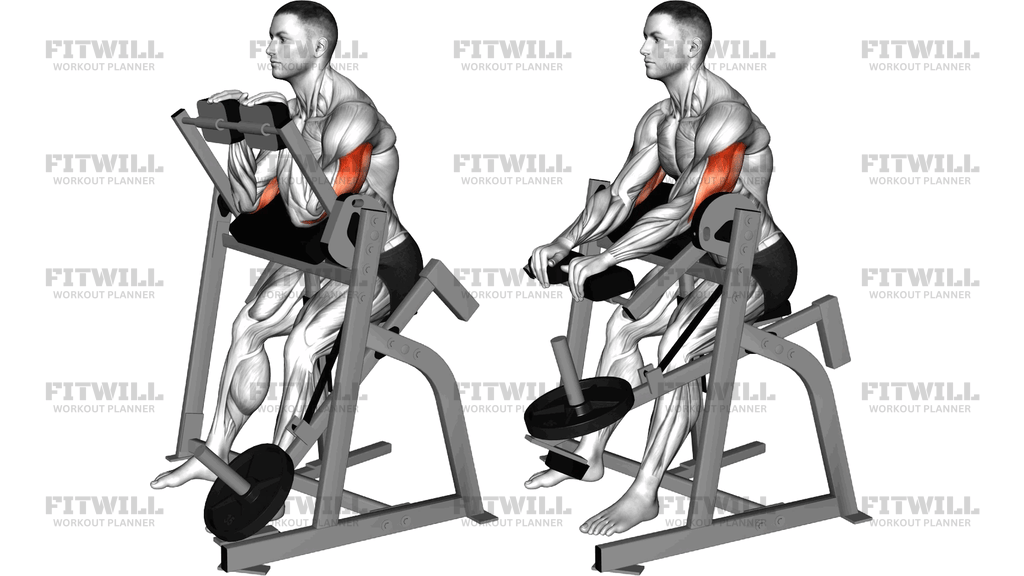
Instructions
- Sit on the machine seat and place your feet flat on the floor about hip-width apart, then adjust the seat height so your elbows rest on the arm pad at roughly shoulder height without shrugging.
- Set the plate load on the weight peg, starting lighter than you think you need until you have felt the resistance curve through a full rep.
- Grip the handles with a neutral or palms-facing grip and let your upper arms rest fully on the pad, with the backs of your arms staying in contact throughout the set.
- Start with your elbows fully bent and the handles close to your shoulders, chest up, and your upper back pressed lightly against the seat back.
- Brace your core and press the handles forward and away from your body by straightening your elbows, exhaling as you extend.
- Continue until your arms are nearly straight at the front of the movement, squeezing the triceps briefly at full extension without locking the elbows hard.
- Inhale and let the handles travel back toward your shoulders under control, keeping tension in the triceps rather than letting the weight stack or lever slam back.
- Stop the eccentric just before the handles reach the start position so the elbows stay loaded, then begin the next press.
- Keep your wrists straight and your elbows pinned to the pad for every rep; if either drifts, the weight is too heavy.
- After the final rep, guide the lever fully back to the resting position before letting go and standing up.
Tips & Tricks
- If your elbows lift off the pad as you press, the seat is probably too high or the load too heavy; fix the setup first, then reduce weight before accepting shortened reps.
- Do not let the handles crash back into the flexed position. The stretch under control is where the long head of the triceps works hardest on this machine.
- Pause for a half second at full extension instead of bouncing at lockout. The resistance drops off near the top of the arc, so a deliberate squeeze keeps the set honest.
- Keep your wrists neutral rather than cocked back. Bending the wrists forward as you press shifts tension away from the triceps and strains the forearm.
- Avoid shrugging your shoulders toward your ears at the start of the press. Pull your shoulder blades down and back before the first rep and hold that position.
- Small plate jumps work better here than big ones. Because the machine stabilizes everything, a jump that feels manageable often breaks your elbow position, so progress in small increments.
- If one arm feels weaker, slow the tempo down and watch your elbow contact in a mirror rather than switching to one-arm reps on most plate-loaded versions of this machine.
- Warm up the elbows with a light set of fifteen to twenty reps before your working weight, since the fully bent start position loads the joint at its end range.
- Do not lean your chest forward to help the handles move. If your back leaves the seat, the front shoulders are taking over and the triceps are no longer the limiter.
Frequently Asked Questions
Which muscles does the Lever Seated Triceps Extension (Plate Loaded) work?
The triceps are the primary mover, with all three heads contributing across the range of motion. The front shoulders assist as the arms press forward, but the elbow joint stays the focus.
Is this machine a good triceps exercise for beginners?
Yes. The fixed path and padded arm support remove the balance and coordination demands of free-weight extensions, so a beginner can learn what a locked-in elbow position feels like with low risk of form drift.
How high should the seat be on the Lever Seated Triceps Extension (Plate Loaded)?
Set it so your elbows rest on the pad at roughly shoulder height while your back stays against the seat. If your elbows slide forward off the pad or the start position strains your shoulders, the seat needs adjusting before you add weight.
Why does my front shoulder take over during this exercise?
This usually happens when you lean your chest forward or shrug to help the handles move. Keep your upper back against the seat and your elbows on the pad, and reduce the load so the triceps alone can drive the press.
Should I fully lock out my elbows on every rep?
Reach full extension and squeeze the triceps, but do not snap the joints into lockout, especially under heavier loads. A controlled pause at the top gives you the contraction without unnecessary joint stress.
Can I substitute the Lever Seated Triceps Extension (Plate Loaded) with cable or dumbbell extensions?
Cable pushdowns and dumbbell skull crushers train the same muscle, but neither provides the same elbow pad and fixed arc, so they demand more stabilization. Use them when the machine is busy, not because they are superior.
How does this compare to an overhead triceps extension for the long head?
The overhead version stretches the long head more because the shoulder sits above the elbow. Here the long head still gets a solid stretch in the fully bent start position, so the difference is real but smaller than many lifters assume.
How many sets and reps should I do on this machine?
Two to four sets of 8 to 12 reps works well as a primary triceps movement, or 12 to 15 with lighter plates as a finisher after pressing. Stop the set when you can no longer reach full extension with your elbows on the pad.
Is the Lever Seated Triceps Extension (Plate Loaded) safe for sore elbows?
The machine reduces joint stress compared to free weights, but a fully bent start position still loads the elbow at its end range. Warm up with light, higher-rep sets, and if discomfort persists during normal daily movement, get it assessed before loading it further.