Sitting Lotus Pose Hand Behind Side Bend
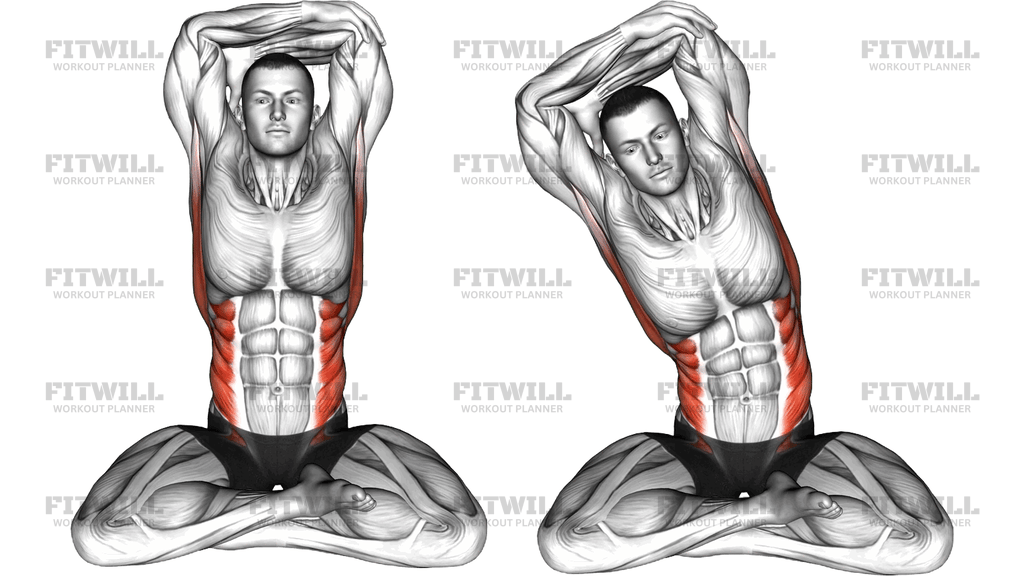
The Sitting Lotus Pose Hand Behind Side Bend is a seated lateral stretch performed from a cross-legged or lotus position with the hands clasped behind the head. Instead of reaching one arm overhead the way you would in a standing side bend, both hands stay anchored behind your head, and the entire upper body tips sideways as one unit. This keeps the elbows wide and creates a long, continuous stretch along the side of the torso, from the obliques up through the latissimus dorsi and into the muscles between the ribs.
This setup is especially useful because the crossed-leg position locks the hips and pelvis in place. When you cannot shift or hike a hip to cheat the movement, the side bend has to come from the spine itself, which is exactly what you want if your goal is to open up the lateral line of the trunk. People who spend long hours sitting, lifters whose obliques and lats get tight from heavy carries and pulling work, and yoga practitioners working toward deeper lotus positions will all get something out of it.
The primary area targeted is the lateral core, mainly the external and internal obliques, with the quadratus lumborum in the lower back and the lats contributing heavily on the stretched side. The bottom leg, ankle, and hip of the lotus position also get a gentle opening, and the shoulders work simply to hold the hands behind the head with the elbows pulled back.
To execute it well, sit tall before you bend anywhere. A common error is collapsing forward or rotating the chest toward the floor instead of bending purely sideways. Keep both sitting bones weighted evenly, imagine the crown of your head travelling in an arc out and over, and let the stretch live along the side of your waist rather than in the neck or lower back. The elbows should stay lifted and wide; letting them drop forward turns the stretch into a neck pull.
Because no equipment is involved and the range is self-determined, this movement is easy to slot into a warm-up, a cooldown, or a midday desk break. If full lotus is not available to you, a simple cross-legged seat gives you nearly the same spinal stretch, and that is a perfectly valid version of the exercise. Hold each side for 20 to 30 seconds, breathe steadily, and keep the effort at a level where you feel a firm pull but never pain.
As with any seated floor stretch, come into it slowly and out of it slowly. Rushing into a deep side bend with cold muscles, or bouncing at the end range, is where strains tend to happen. Treat this as a mobility and flexibility drill, not a strength or conditioning effort, and it will serve you well for years.
[ Workout Log & Planner ]
Put your next workout in Fitwill
Keep your plan and training log ready when you are.


Instructions
- Sit on the floor or an exercise mat and fold your legs into lotus or a comfortable cross-legged position, resting each foot on the opposite thigh with knees dropping toward the floor.
- Sit up tall over your sitting bones so your weight is distributed evenly on both sides of your pelvis, and lengthen the back of your neck.
- Clasp your hands behind your head with fingers interlaced at the base of the skull, and draw your elbows out wide so they point to the sides, not forward.
- Brace lightly through the trunk, keep your chest lifted, and fix your gaze straight ahead to keep the head from leading the bend.
- Keeping the hips square and both sitting bones down, lean your entire upper body sideways to one side in a smooth arc, letting the opposite elbow point up toward the ceiling.
- Continue until you feel a firm stretch along the side of your waist, ribs, and armpit, and pause there for 20 to 30 seconds without bouncing.
- Exhale as you lower into the bend and inhale slowly while you hold, letting each breath expand the ribs on the stretched side.
- Rise back up to a tall seated position under control, keeping the hands behind the head, then repeat the bend to the opposite side.
- Complete 2 to 3 holds per side, then release the hands, uncross the legs gently, and shake out the hips before standing.
Tips & Tricks
- If your knees sit high off the floor in lotus, sit on the edge of a folded blanket or a low cushion so the pelvis tips slightly forward and the spine can stay neutral.
- The most common mistake is rotating the chest toward the floor instead of bending sideways. Watch that your collarbones stay facing forward as you lean.
- Do not pull on the neck with the hands. The clasp behind the head is a frame for the elbows, not a lever to crank the bend deeper.
- Keep both sitting bones glued to the floor. If one hip lifts as you bend, you are shortening the stretch and probably loading the lower back instead of the obliques.
- Think of the movement as an arc through the crown of the head rather than a collapse at the waist. This keeps the spine long and the stretch even from hip to armpit.
- If you feel a sharp or pinching sensation in the lower back, come out of the bend a few degrees and re-tallen your posture before going further.
- Full lotus is optional. A simple cross-legged seat delivers the same lateral trunk stretch, so choose the leg position your hips can actually hold.
- Warm the torso first with a few gentle standing side bends or cat-cow reps. Cold obliques and lats resist the stretch and make you compensate elsewhere.
- Match the hold to your breath. Twenty to thirty seconds with slow nasal breathing works far better than a quick 5-second dip in and out.
Frequently Asked Questions
What muscles does the Sitting Lotus Pose Hand Behind Side Bend stretch?
It primarily targets the external and internal obliques along the side of the waist. On the stretched side it also lengthens the lats, the quadratus lumborum in the lower back, and the intercostal muscles between the ribs.
Why are the hands clasped behind the head instead of one arm reaching overhead?
With the hands behind the head and elbows wide, the whole upper body bends as one rigid unit, so the stretch is distributed evenly down the side of the torso. Reaching one arm shifts more of the work into the lat and shoulder and makes it easier to rotate or collapse.
I cannot sit in full lotus. Can I still do this exercise?
Yes. A simple cross-legged seat works well because the purpose of the leg position is to anchor the pelvis, not to test your hips. If even that is uncomfortable, sit on a cushion or fold into an easy seated position with the shins crossed loosely.
Should I feel this stretch in my neck?
No. If you feel strain in the neck, your hands are probably pulling on your head or your elbows have drifted forward. Keep the clasp light at the base of the skull, lift the elbows, and let the side of the torso, not the neck, take the load.
How long should I hold each side bend?
Aim for 20 to 30 seconds per side, repeating 2 to 3 rounds. Breathe slowly through the hold rather than holding your breath, and let the range deepen slightly on each exhale.
Is this a strength exercise or a flexibility exercise?
It is a flexibility and mobility drill. The obliques work lightly to control the lean, but the goal is to lengthen the lateral torso, not to build muscle or load the spine.
One side bends much further than the other. Is that a problem?
Side-to-side differences are common, especially if you favor one arm in training or sit asymmetrically at a desk. Spend a little extra hold time on the tighter side, but do not force it to match; consistency usually narrows the gap over weeks.
When is the best time to use this stretch?
It fits well in a cooldown after lifting or running, or as a midday reset after long periods of sitting. Because it demands some hip mobility, it is gentler on warm muscles than on a completely cold body.
Are there any safety concerns with this movement?
Move into and out of the bend slowly, avoid bouncing at the end range, and stop if you feel sharp pain anywhere in the spine or hips. If you have a current lower back injury or significant knee or ankle limitations from the lotus position, choose the cross-legged variation and keep the range modest.