Seated Shoulder Anti Clockwise Circle
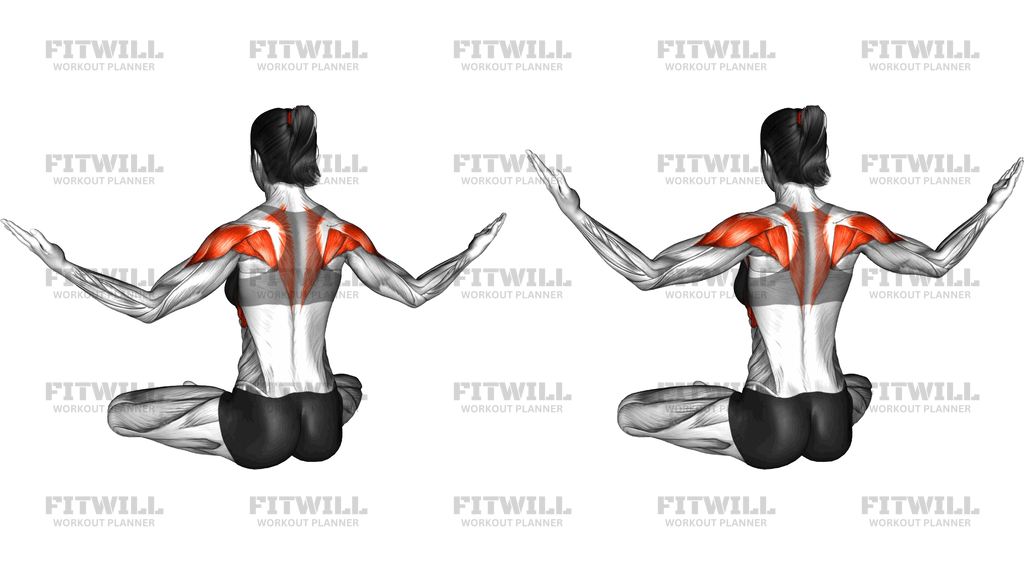
The Seated Shoulder Anti Clockwise Circle is a simple body-weight mobility and activation drill performed sitting cross-legged on the floor. You lift both arms out to the sides, bend the elbows, and sweep the arms and shoulders through smooth anti-clockwise circles, keeping the torso tall and still throughout. Because the hands stay empty and the body is supported by the floor, all of your attention can go to how the shoulder joints actually move rather than on balancing or controlling a load.
This movement primarily works the deltoids and the rotator cuff muscles that steer the upper arm in its socket, with the muscles between the shoulder blades and the upper traps helping to control the shoulder blades as the arms travel. The seated cross-legged position also quietly asks something of your hips and lower back: sitting tall without a chair back forces you to hold your own upright posture for the duration of the set.
The setup matters more than it looks. Sitting on the floor with legs crossed lowers your center of gravity and removes any temptation to lean back or swing the ribs forward to fake extra range. If your torso stays quiet, the circles have to come from the shoulder joints themselves, which is exactly what makes this drill useful for warming up before pressing, pulling, or overhead work.
To perform it well, raise the arms to roughly shoulder height with elbows bent, then begin tracing circles in an anti-clockwise direction, letting the movement flow from the shoulders through the elbows and hands. Keep the circles even in size, the neck relaxed, and the breathing steady. Start with small circles and gradually let them widen as the shoulders feel freer, then reverse direction if your routine calls for it.
You will see this drill used as a warm-up before upper-body training, as a movement break during long desk days, and in rehabilitation-style or general mobility routines where the shoulders need gentle, pain-free motion. It suits beginners well because the position is stable and there is no equipment to learn, and it suits experienced lifters too, since a few controlled circles are an efficient way to wake the shoulders up before loading them.
Treat it as a quality-over-speed exercise. Fast, jerky arm swings defeat the purpose, and forcing the circles larger than the joint wants to go usually shows up as shrugging or rib flare. Smooth, moderate circles with a tall spine will do more for how your shoulders feel under a barbell or in daily life than any hurried set ever will.
[ Workout Log & Planner ]
Put your next workout in Fitwill
Keep your plan and training log ready when you are.


Instructions
- Sit on the floor with your legs crossed comfortably and your sitting bones grounded, spine tall and shoulders stacked over your hips.
- Raise both arms out to the sides to about shoulder height and bend your elbows so the forearms point upward, palms facing forward.
- Draw your shoulder blades gently down and together so your shoulders sit away from your ears before you start moving.
- Brace your core lightly to keep the torso still, and let your gaze stay forward with the neck relaxed.
- Begin tracing circles in an anti-clockwise direction: sweep the hands outward and down, rotate the elbows back, and bring the arms around and up to the start of the circle.
- Keep the circle size consistent, moving from the shoulder joints rather than flicking at the wrists or shrugging the shoulders.
- Exhale smoothly through part of each circle and inhale on the remainder, keeping the breath continuous rather than held.
- Complete the intended number of repetitions, then stop in the raised starting position rather than letting the arms drop.
- Reset your posture, check that the shoulders have not crept up toward the ears, and either repeat the set or switch direction as your routine requires.
Tips & Tricks
- If you catch yourself shrugging, shrink the circles. Oversized circles are the most common reason the upper traps take over in this drill.
- Keep the elbows from collapsing toward the ribs; holding them near shoulder height keeps the work on the shoulders instead of the chest.
- Picture the hands drawing a round clock face on the wall beside you. If the shape turns into an oval or a wiggle, slow down.
- Sit on a folded mat or thin cushion if your hips are tight. A tilted pelvis from a cramped cross-legged position will show up as a rounded lower back.
- Do not let the head drift forward to follow the hands. The neck stays quiet while the shoulders do the circling.
- Gradually widen the circles over the first few repetitions rather than starting at your maximum range on rep one.
- Both arms should circle together at the same speed. If one side lags, that is a useful signal about which shoulder is stiffer.
- Stop the set while the movement is still smooth. Once the shoulders fatigue, form degrades into swinging faster than it improves.
- For desk workers, breaking the circles into two or three short sets spread through the day often feels better than one long set.
Frequently Asked Questions
What muscles does the Seated Shoulder Anti Clockwise Circle work?
The deltoids and rotator cuff muscles control the circular motion, while the middle traps and muscles between the shoulder blades stabilize the shoulder blades. The core contributes lightly to keeping the torso upright while seated on the floor.
Is the Seated Shoulder Anti Clockwise Circle suitable for beginners?
Yes. It requires no equipment, the cross-legged position is very stable, and the resistance is only your own arms. Beginners should simply start with smaller circles and fewer repetitions.
Why is this exercise done seated cross-legged instead of standing?
Sitting removes the balance demands of standing and makes it harder to lean, swing, or use momentum from the legs and hips. That keeps the movement honest in the shoulder joints and lets you focus purely on the circling path.
Should I also do the clockwise version of the circle?
In most warm-up routines, yes. Circling in both directions covers the full range of the shoulder joint more evenly, so many people do the clockwise variation immediately after finishing the anti-clockwise reps.
How big should the circles be?
Start small, roughly the size of a dinner plate, and let them grow only as the shoulders loosen. If you have to shrug or arch your back to complete the circle, the size has outgrown your current range.
Can I do the Seated Shoulder Anti Clockwise Circle every day?
For most people, yes, since it is a light mobility and activation drill rather than a heavy strength exercise. If a shoulder is currently irritated, keep the circles small and pain-free and reduce the frequency until it settles.
What is the most common mistake with this exercise?
Rushing and turning the circles into arm swings, which lets momentum do the work. Shrugging toward the ears and letting the lower back round are close behind, all fixed by slowing down and sitting tall.
Can I do this movement standing if I cannot sit cross-legged?
Yes, standing with feet hip-width apart is a reasonable substitute, and sitting on a chair works too. Just preserve the key elements: arms at shoulder height, elbows bent, torso still, and controlled anti-clockwise circles.
When should I do this drill in my workout?
It fits best at the start of an upper-body session as a warm-up, or on rest days as standalone shoulder mobility work. Doing it before pressing or pulling helps the shoulders move smoothly once load is added.
Should I feel any discomfort in my shoulders during the circles?
No. Smooth, comfortable motion is the goal, and any sharp or pinching sensation means the circle is too large or too fast. Reduce the range, slow down, and if the discomfort continues, have it assessed before loading the shoulder.