Sitting Swimmer On A Chair
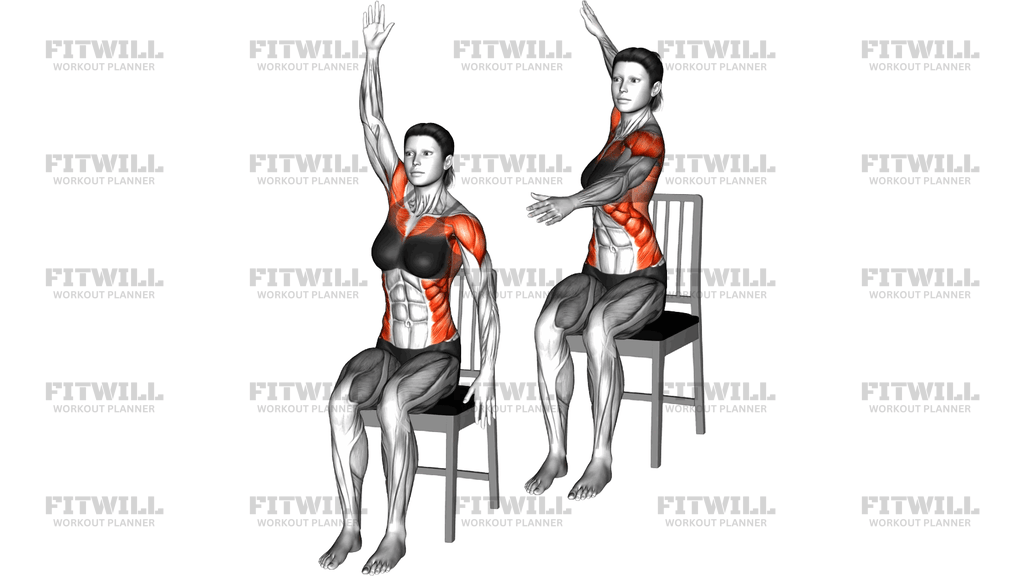
Sitting Swimmer On A Chair is a seated, bodyweight movement that reproduces the alternating arm pattern of swimming strokes while your lower body stays planted on a chair. One arm reaches up and forward overhead while the other travels down and behind the hip, then the arms trade positions in a continuous, flowing rhythm. Because you are sitting, the legs and hips are taken out of the equation, so all of the motion has to come from the shoulders, arms, and trunk.
The main work falls on the shoulders, particularly the deltoids as they lift and lower each arm through a long arc, with the rotator cuff and upper back helping control the path. Your chest assists as the arm pulls down from overhead, and your abdominals and obliques stay quietly busy the whole time to keep your torso from rocking and twisting with every arm swing. It looks simple, but holding a tall spine while the arms move asymmetrically is a real coordination challenge.
This is a great option for people who cannot get on the floor or stand for long periods: office workers, older adults, anyone in rehab or post-partum returning to upper body movement, or swimmers who want a dryland pattern they can run through during a desk day. It also works well as a shoulder warm-up before pressing, pulling, or actual swimming, since it takes the joints through a large but unloaded range.
The setup matters more than it seems. Sit toward the middle or front edge of a sturdy chair with feet flat on the floor and sit bones grounded, because a slouched or sideways-leaning seat position turns the exercise into a torso swing instead of a shoulder drill. Sit tall, ribs stacked over the pelvis, and let the arms do the traveling.
To execute it well, keep the arm movements long and smooth rather than fast and jerky. Reach genuinely overhead and behind the ear on the upswing, and let the opposite hand sweep down past the hip as if pulling through water. The temptation is to shrug the shoulders up toward the ears as the arms tire; keep the shoulder blades settling down as the arms rise. Move at a pace you can sustain with clean positions, and stop when your form starts to lean or bob.
Practically, run this for time or for controlled repetitions, thirty seconds to a minute per round is typical. It pairs nicely with seated torso rotations or band pull-aparts as part of a low-impact upper body circuit. There is no equipment beyond a stable chair, but respect the basics: no rolling chair, no hunching forward, and no cranking the arms into painful ranges. If a position pinches at the shoulder, shorten the arc rather than forcing the reach.
Fitwill
Log Workouts, Track Progress & Build Strength.
Achieve more with Fitwill: explore over 9600 exercises with images and videos, access built-in and custom workouts, perfect for both gym and home sessions, and see real results.
Start your journey. Download today!




Instructions
- Sit on a stable, non-rolling chair with your feet flat on the floor about hip-width apart and your sit bones firmly planted.
- Sit tall with your chest lifted, ribs stacked over your pelvis, and your gaze forward; let both arms hang relaxed at your sides.
- Brace your abdominals lightly as if bracing for a gentle nudge, so your torso stays quiet while your arms move.
- Raise one arm up and slightly forward, reaching overhead so the arm passes close to your ear, palm facing inward.
- As that arm reaches the top, sweep it down and back past your hip while the opposite arm swings up into the overhead reach, like alternating freestyle strokes.
- Keep the moving arm long and elbow mostly extended; the shoulder should drive the motion, not a bent-elbow flick.
- Continue alternating in a smooth, steady rhythm, keeping your torso upright and preventing it from rocking side to side with each arm swing.
- Exhale as an arm lifts overhead and inhale as it sweeps down; keep the breathing even rather than holding your breath.
- Complete a set of 10-20 alternating cycles or work for 30-60 seconds, then rest with both hands on your thighs before the next round.
- Finish the set by returning both hands to your lap, sitting still for a breath, and checking that your shoulders have dropped away from your ears.
Tips & Tricks
- The most common fault is shrugging: as the arm tires, the upper traps creep up toward the ear. Before each reach, think about sliding the shoulder blade down your back first, then lifting the arm.
- If your torso starts twisting with every stroke, squeeze your glutes gently into the chair seat. Locking the hips down gives your obliques a stable base and forces the motion into the shoulders.
- Avoid swinging from the lower back. If you feel your waist arching as the arm goes overhead, reduce the reach to a point where your ribs stay stacked over your pelvis.
- Speed is the enemy here. A slow, water-like tempo turns this into a shoulder and core drill; rushing it makes it a mindless arm flail with almost no training effect.
- If your shoulder pinches at the very top of the reach, angle the arm slightly forward instead of straight up beside the ear, or shorten the arc by a few inches.
- Keep the non-working side honest too: the hand sweeping down should pass close to your hip rather than drifting out wide, mirroring a real pull-through in the water.
- Use a chair without armrests so the descending arm has a clear path past your side, and never use one with wheels.
- If you want more demand, slow each arm cycle to a 3-4 count per stroke, or hold a very light object like a water bottle in each hand once your form is consistent.
- Warm shoulders tolerate the overhead arc better; if you are starting cold, do a few smaller circles with the arms before going to the full overhead reach.
Frequently Asked Questions
What muscles does Sitting Swimmer On A Chair work?
The shoulders, especially the deltoids, do most of the visible work as each arm travels overhead and down. Your abs and obliques stabilize the trunk against the twisting pull of the alternating arms, and the chest and upper back assist through the arm path.
Is Sitting Swimmer On A Chair good for beginners?
Yes, it is one of the most accessible overhead shoulder drills because it uses no load and can be done from a chair. Beginners should start with slower, smaller arcs and only extend to the full overhead reach once the torso stays still.
Why is this done seated instead of standing?
Sitting removes the legs and hip drive, so the work stays in the shoulders, arms, and trunk, and you cannot cheat by swaying or stepping. It also makes the movement usable for people who cannot stand or get on the floor comfortably.
How do I stop my body from twisting during the arm swings?
Plant your sit bones and feet, brace your abdominals, and think of your torso as a fixed pillar that the arms move around. If twisting persists, slow down and reduce the reach until you can keep the chest facing forward.
Can Sitting Swimmer On A Chair help with swimming performance?
It can reinforce the overhead and pull-through arm pattern and keep the shoulders mobile on days away from the pool, but it is unloaded, so it complements rather than replaces actual stroke work or strength training.
What kind of chair should I use?
Use a stable, armless chair with a flat seat and no wheels so the descending arm has a clear path past your hip and the seat cannot move under you. Sit toward the front or middle edge with feet flat on the floor.
How many repetitions should I do?
A practical range is 10-20 alternating arm cycles per set, or 30-60 seconds of continuous smooth strokes. Stop the set when your shoulders shrug or your torso starts rocking, since those are the signs the quality has gone.
My shoulder pinches when my arm goes overhead. What should I do?
Angle the reaching arm slightly in front of your body instead of straight out to the side, and shorten the top of the arc. Stay in a pain-free range, and if the pinching continues, skip the overhead portion and check with a qualified professional.
Can I add resistance to Sitting Swimmer On A Chair?
Yes, once your form is solid you can hold very light objects like small water bottles in each hands to add gentle load. Keep the added weight minimal, because the long lever of an extended arm makes even light objects feel heavy overhead.
Is this a cardio or strength exercise?
Performed slowly with controlled strokes it is a strength and mobility drill for the shoulders and trunk. Done continuously for longer intervals at a brisk but controlled pace, it can also raise your breathing rate into light aerobic territory.