Body Rock To Down Dog
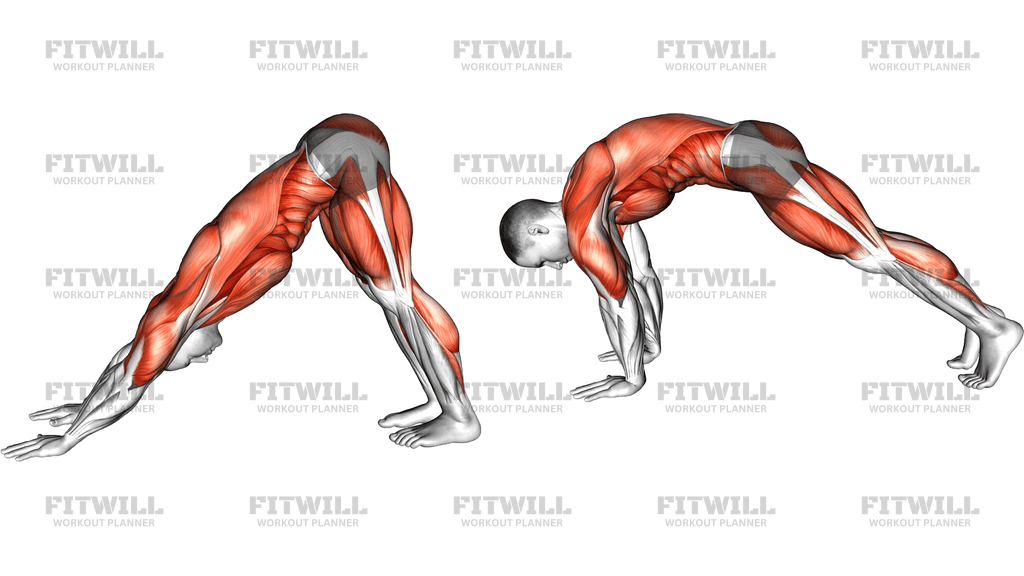
Body Rock To Down Dog is a bodyweight flow that links two positions most people train separately: a forward rock over the shoulders, where your weight shifts over or slightly past your hands, and the downward-facing dog position, where your hips lift high and your body forms an inverted V. Moving between the two with control turns a simple floor drill into a demanding shoulder and core exercise that also stretches the calves, hamstrings, and lats every time you push back.
The movement is popular in gymnastics strength training, calisthenics warm-ups, and mobility work because it loads the shoulders through a large range while teaching you to move as one connected piece. When you rock forward, the front delts, triceps, and serratus anterior work hard to keep your shoulder girdle stable as your center of mass travels over your hands. When you press back to down dog, the lats and shoulders drive the return while the core controls the transition, so nothing sagging or collapsing gets a free ride.
Setup matters more than it looks. Your hands and feet set the track your body travels on, so placing them about shoulder-width and slightly wider than hip-width apart gives you room to rock forward without your feet getting in the way. Press the floor away from the very first rep, keep the elbows straight but not locked, and let the movement come from the shoulders and hips rather than from bending the arms or rounding the lower back.
To execute it well, start in a pike with hips high, shift your weight forward so your shoulders travel past your wrists and your head lowers toward the space in front of your hands, then reverse the path by pushing through the palms and lifting the hips back into down dog. Think of it as one smooth arc, not two separate poses. The rock should feel like a controlled lean, and the return should feel like a deliberate press, not a collapse back onto the feet.
This drill fits well at the start of an upper body session as a shoulder preparation exercise, or as a strength set on its own for people building toward straight-arm work like wall handstands, planche leans, and pseudo planche push-ups. Because it requires only floor space, it travels easily and can be scaled by limiting how far forward you rock.
For safety, keep the wrists warm and the load gradual. If you feel pinching at the front of the shoulder or pressure in the lower back, reduce the forward range before anything else. Straight arms are the point of the exercise, but they should feel braced and active, never jammed.
Fitwill
Log Workouts, Track Progress & Build Strength.
Achieve more with Fitwill: explore over 9600 exercises with images and videos, access built-in and custom workouts, perfect for both gym and home sessions, and see real results.
Start your journey. Download today!




Instructions
- Place your hands on the floor shoulder-width apart with fingers spread, and set your feet slightly wider than hip-width so your body can rock forward between them.
- From a push-up position, walk your feet in and lift your hips until your body forms a high pike, arms and legs straight, heels reaching toward the floor.
- Press the floor away and brace your core so your shoulders, spine, and hips move as one unit before you shift your weight.
- Keeping the elbows straight, lean forward slowly and let your shoulders travel past your wrists so your head lowers toward the space in front of your hands and your body angles toward a shallow incline.
- Hold the forward rock for a moment with the shoulder girdle actively pushing the floor away, avoiding any sagging through the chest or lower back.
- Reverse the path by pushing firmly through the palms, pulling the hips up and back, and straightening into a full down dog with a long spine and heels reaching down.
- Breathe out as you press back to down dog and breathe in as you rock forward, keeping the rhythm even across all reps.
- Pause in down dog for a second, reset the hand pressure and hip height, then flow into the next forward rock.
- Complete your set with slow, controlled transitions, and step the feet back to a standing position or child's pose when finished.
Tips & Tricks
- Most people bend the elbows during the forward rock, which turns the drill into a push-up. Lock in straight arms and move the weight with the shoulders instead.
- If your heels cannot reach the floor in down dog, do not force them; a slight bend in the knees keeps the spine long and the hamstrings working without strain.
- The most common failure point is letting the head dump toward the floor at the end of the rock. Keep pushing the floor away so the neck stays in line with the spine.
- Warm up the wrists with circles and gentle stretches first, because the wrists take your full bodyweight at an angle they rarely see otherwise.
- Control the speed deliberately: a fast rock uses momentum to skip past the shoulder strength this exercise is meant to build.
- If the lower back arches when you rock forward, squeeze the glutes slightly and shorten the range until the ribs stay down and the trunk holds still.
- Spreading the fingers and gripping the floor reduces wrist pressure far more effectively than resting passively on the palms.
- To make it easier, rock only until the shoulders reach the wrists; to make it harder, pause two seconds at the furthest point of the forward lean.
- Keep the feet planted throughout; lifting the heels during the rock usually means the hands are set too close to the feet.
Frequently Asked Questions
What muscles does Body Rock To Down Dog work?
The shoulders, especially the front delts, do most of the stabilizing work during the forward rock, supported by the triceps, lats, and upper back. The core stays engaged the whole time to control the transition between positions.
Is Body Rock To Down Dog suitable for beginners?
Yes, as long as beginners shorten the range. Rocking only until the shoulders stack over the wrists builds the same strength with far less demand, and the range can grow as shoulder and wrist tolerance improve.
Why should my arms stay straight during the Body Rock To Down Dog?
Straight arms shift the work to shoulder stability and straight-arm pressing strength, which is the whole purpose of the movement. Bending the elbows turns it into a push-up variation and reduces the carryover to skills like handstands and planche leans.
How far forward should I rock in the Body Rock To Down Dog?
Rock only as far as you can keep the elbows straight, the shoulders pressing away, and the lower back neutral. For most people that means the shoulders travel from behind the wrists to slightly past them.
My wrists hurt when rocking forward. What should I change?
Spread your fingers and actively grip the floor, warm the wrists up beforehand, and reduce how far past the wrists you shift your weight. If discomfort continues, elevate the hands slightly on a low surface to reduce the angle.
Can I substitute another exercise for Body Rock To Down Dog?
Pike push-up holds, wall slides, and shoulder taps train similar straight-arm shoulder stability, while plain down dog with heel pulses covers the flexibility component. None combine both as directly, so the closest option is a controlled planche lean.
How does Body Rock To Down Dog help with handstand training?
It teaches you to hold weight over extended shoulders with an open shoulder angle, which is exactly the position a handstand demands. The forward rock also builds awareness of shifting your center of mass over your hands safely.
Should I hold the down dog position between reps?
A brief one-second pause in down dog is useful because it lets you reset hand pressure and hip height, and it adds a calf and hamstring stretch to every rep. Rushing through it usually means the transition gets sloppy.
How many reps of Body Rock To Down Dog should I do?
Start with 2 to 3 sets of 5 to 8 slow repetitions, focusing on smooth transitions rather than volume. The movement is demanding on the shoulders and wrists, so quality reps beat high numbers here.