Lying Side Bend
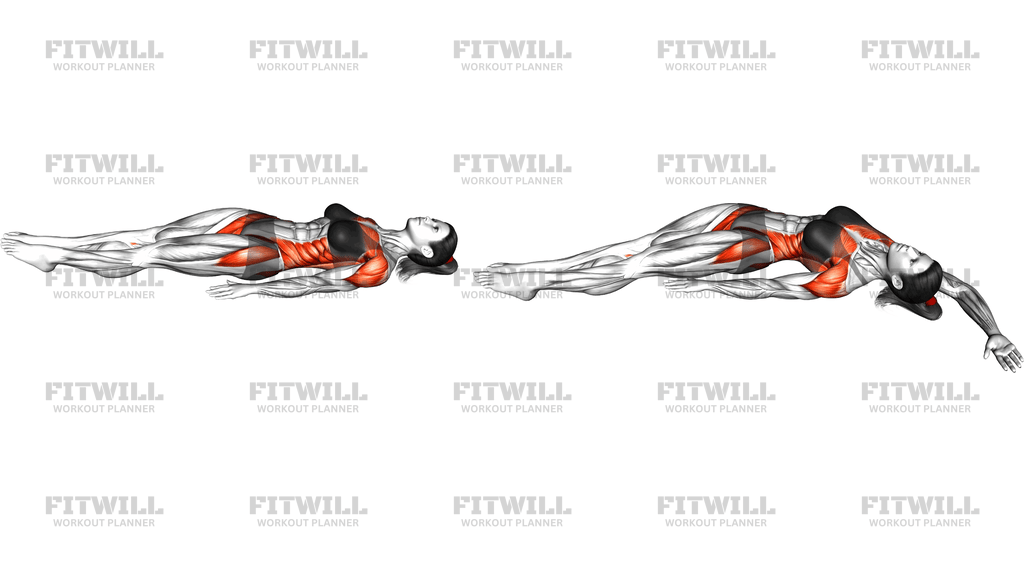
The Lying Side Bend is a bodyweight core exercise performed face-up on the floor, with the legs held together and swept to one side while the shoulders and upper back stay pinned to the ground. The side-to-side travel of the legs comes almost entirely from the waist, which makes it one of the simplest ways to load the obliques and the deep muscles along the side of the spine without any equipment beyond a mat.
The setup is what separates this from a generic lying leg swing. Because your shoulders stay flat and your arms rest out at your sides for balance, the torso acts as an anchor while the pelvis rotates. That anchored position forces the obliques — especially the external and internal obliques on the working side — to control the lowering of the legs and then pull them back to center. The quadratus lumborum and lower abdominals assist, and the hip flexors help move the weight of the legs.
This movement suits a wide range of trainees. Beginners can use it to learn what true oblique contraction feels like, since the floor removes most balance demands. More experienced lifters often use it as a burnout finisher after heavier rotational or anti-rotation work, or as part of a low-back-friendly core circuit because the spine stays supported throughout. It is also popular in Pilates-style and rehabilitative settings for controlled lateral trunk mobility.
Execution quality comes down to range and control, not speed. Lower the legs only as far as you can keep both shoulders in contact with the floor; the moment one shoulder peels up, you have gone past the range your waist can actually control. Move slowly through the bottom portion and use the obliques — not momentum from swinging the legs — to return to center before repeating on the other side.
Because the exercise is done supine with bodyweight only, the main safety considerations are spinal control and breathing. Keep the movement smooth, exhale on the return, and avoid yanking the legs from side to side. If you feel the work shifting into your lower back or hip joints rather than your waist, reduce the range or bend the knees slightly to shorten the lever.
[ Workout Log & Planner ]
Put your next workout in Fitwill
Keep your plan and training log ready when you are.


Instructions
- Lie flat on your back on an exercise mat with your legs extended straight and held tightly together.
- Extend your arms out to your sides at roughly shoulder height, palms down, so your shoulders and upper back stay pressed into the floor as anchors.
- Brace your core gently and press your lower back toward the mat so your ribs stay down before you start moving.
- Keeping your legs together and as straight as possible, sweep both legs to the right while your shoulders stay flat on the ground.
- Lower the legs to a point where you feel tension through the left side of your waist, stopping before your right shoulder lifts off the floor.
- Pause briefly at the end range, then pull the legs back to the starting position using the muscles along your waist rather than momentum.
- Exhale as you return the legs to center and inhale as you lower to the next side.
- Repeat the same lowering path to the left side, keeping the pelvis moving as one piece with the legs.
- Continue alternating sides for your target number of reps, resetting your brace and shoulder contact at center before each rep.
Tips & Tricks
- The most common breakdown is a shoulder lifting off the floor as the legs travel — this means the range exceeds your waist strength, so shorten the arc until both shoulders stay planted.
- If your lower back feels pinched rather than worked, bend your knees to a 90-degree angle; the shorter lever shifts load toward the obliques and away from the lumbar spine.
- Avoid letting the top hand press into the floor to rotate the torso back — the arms are for balance, not for cranking your ribcage.
- Slow the tempo down on the return to center. Most people lower slowly but swing back up, which turns a waist exercise into a hip-swinging momentum drill.
- Keep the legs glued together for the entire set. Letting them separate makes the leg sweep easier and takes tension off the side of the waist.
- Think of rotating from the pelvis, not from the ribcage — imagine your hips pivoting around your spine rather than your whole body rolling.
- If you feel most of the work in the front of your hips, point your toes toward the ceiling and move slightly slower so the hip flexors stop dominating the leg path.
- Place a folded towel under the hips if your hip bones press uncomfortably into the floor during the rotation.
Frequently Asked Questions
What muscles does the Lying Side Bend work?
The primary muscles are the obliques on the sides of your waist, supported by the lower abdominals and the quadratus lumborum along the side of your lower back. The hip flexors also contribute because they help move the weight of the legs.
Why do my shoulders keep lifting off the floor during the Lying Side Bend?
That usually means you are lowering the legs past the range your obliques can control, so the ribcage rotates to keep the legs moving. Reduce how far the legs travel and keep your arms spread wider for a more stable base.
Should my legs be straight or bent in the Lying Side Bend?
Straight legs make the exercise harder because they lengthen the lever your waist has to move. Bend the knees toward your chest if you are newer to the movement or want to keep the emphasis off the lower back.
How is the Lying Side Bend different from a lying spinal twist or leg drops?
A spinal twist is usually held as a stretch, and leg drops emphasize the lower abs while the pelvis stays relatively stable. In the Lying Side Bend, the pelvis and legs rotate together as one unit with the goal of loading and controlling the sides of the waist.
Is the Lying Side Bend good for beginners?
Yes. The floor supports the spine and there is no balance or equipment requirement, so beginners can focus on feeling the obliques contract. Start with a small range of motion and fewer reps per side.
How many reps should I do on each side?
Somewhere between 8 and 15 controlled reps per side works well for most people. Prioritize keeping the shoulders down over adding volume, since sloppy reps past your controllable range do little for the obliques.
Can I make the Lying Side Bend harder once it feels easy?
Yes — straighten the legs fully, slow the lowering phase to a three-second count, or hold a small medicine ball between your feet to add load at the end of the lever. Progress range only if your shoulders stay flat.
Can I substitute the Lying Side Bend if lying on my back is uncomfortable?
Standing side bends or side planks train the same waist muscles without lying down. If you want to stay horizontal, a kneeling or standing cable or band rotation is another option that keeps the spine supported in a different position.
Is it safe to do the Lying Side Bend every day?
For most people, yes, as long as the movement stays controlled and pain-free. Treat it like any core training and give your muscles a recovery day if you are training with high reps or added load.