Lying Side Lift Free Lateral Flexion
The Lying Side Lift Free Lateral Flexion is a bodyweight exercise that trains the side of your waist through its natural movement: lateral flexion, or side bending of the spine. You lie on the floor with your body in a long, straight line, then curl sideways, drawing your ribcage and hips toward each other along one edge of your body. Because there is no external load, the challenge comes entirely from controlling your own torso against gravity, which makes it easy to scale but also easy to rush through if you are not paying attention.
The main workers here are the external and internal obliques on the side you are bending through, with the quadratus lumborum and the deep core helping to stabilize and control the motion. Unlike a standard crunch, which flexes the spine forward, this movement bends it sideways, so the contraction feels distinctly along your flank rather than down the front of your stomach. That makes it a useful complement to planks and forward curls for anyone who wants balanced trunk strength.
This exercise suits people who want to strengthen their obliques without equipment, beginners building basic trunk control, and lifters who train rotations and carries and want dedicated work for the side-bending pattern. It is also a common choice in rehab-style and general fitness programs because the range is short and the body stays supported on the floor throughout. Because the spine is unloaded, most people can learn it safely with a little coaching on tempo.
Setup matters more than it looks. Your body should be aligned in one plane, with hips and shoulders stacked and legs extended, so that the only movement is a clean sideways bend through the trunk. If your hips drift forward or backward, or if you push off the floor with your hand, you steal work from the obliques and turn the rep into a momentum-driven shimmy. Keep the movement small and deliberate: a few centimeters of true lateral flexion, done with tension, beats a large rocking motion every time.
To execute it well, lie on your side with your legs extended and stacked, your bottom arm resting along your body or extended on the floor, and your top hand placed lightly in front of your torso for balance only. Exhale as you bend sideways, lifting your head, shoulders, and upper body off the floor while your hips and legs stay anchored. Pause briefly at the top, feel the squeeze along your waist, then lower back down slowly until your side returns to the floor before starting the next rep. Complete your set on one side, then roll over and match the work on the other.
A few practical points will keep this exercise productive. Move at a tempo you could pause at any point during, keep your neck relaxed so the lift is driven by the trunk rather than by cranking your head up, and stop the set as soon as you feel yourself rocking instead of bending. If floor contact bothers your shoulder or hip, a thin mat or folded towel under your side solves it. Treat this as a quality-over-quantity movement: two or three tight sets per side are worth more than a high-rep set performed by swinging.
Fitwill
Log Workouts, Track Progress & Build Strength.
Achieve more with Fitwill: explore over 9600 exercises with images and videos, access built-in and custom workouts, perfect for both gym and home sessions, and see real results.
Start your journey. Download today!




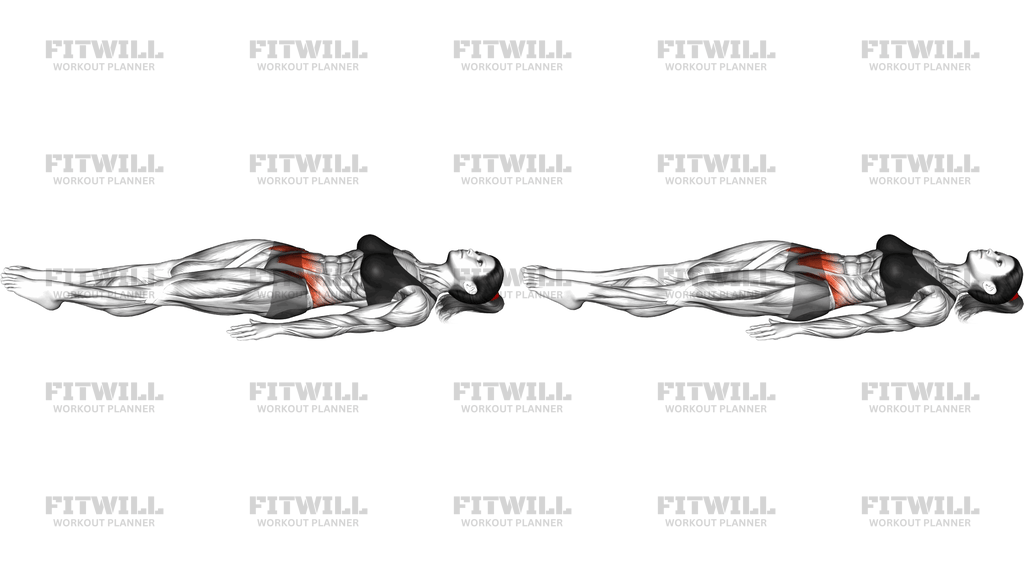
Instructions
- Lie on your side on an exercise mat with your legs fully extended and stacked, one hip resting directly on top of the other, and your whole body forming a straight line from head to heels.
- Place your bottom arm along your body or resting flat on the floor, and set your top hand lightly on the floor in front of your waist for balance only, with no pushing through it.
- Engage your trunk so your ribs, hips, and legs feel connected, and keep your neck in line with your spine rather than jutting your chin forward.
- Exhale and bend sideways through your waist, lifting your head, shoulders, and upper torso up and over toward your top hip in a smooth arc of lateral flexion.
- Continue the side bend until your trunk is lifted as high as your obliques can take it while your hips and both legs remain in contact with the floor.
- Pause for a beat at the top and squeeze the muscles along the upper side of your waist before lowering.
- Inhale as you lower your torso back down with control until your side rests fully on the floor again, then begin the next repetition.
- Complete all repetitions on one side, roll over to the opposite side, and perform the same number of reps so both sides of your waist get equal work.
Tips & Tricks
- If your torso will not lift off the floor, the most common cause is pushing off with the top hand instead of bending through the waist; use that hand for balance only and let the obliques drive the lift.
- Watch for your hips rolling forward or back as you lift, which turns the side bend into a twist; brace your trunk and imagine your hips glued to one spot on the floor.
- A small, clean bend beats a big rocking motion here. If you need to swing to get up, reduce the range or move to the easier version where only your head and shoulders lift.
- Do not pull on your head or crane your neck upward; the lift comes from the side of your ribcage bending toward your hip, and your head should travel as a passenger.
- Keep your legs relaxed and stacked. Tensing or scissoring your legs usually means the trunk is running out of strength and borrowing from elsewhere.
- Match the lowering phase to the lifting phase. Dropping your torso back to the mat removes half the muscle work, since the obliques also control the descent.
- If the bony part of your hip or shoulder presses uncomfortably into the floor, slide a folded towel or thicker mat under your side rather than shifting your alignment to compensate.
- Count a one-second pause at the top of each rep. This simple cue prevents the fast, momentum-based reps that make this movement feel easy when it should not be.
Frequently Asked Questions
Which muscles does the Lying Side Lift Free Lateral Flexion work?
The primary muscles are the external and internal obliques on the side of the waist you are bending through. The quadratus lumborum and deeper trunk stabilizers assist to control the side-bending motion.
How is the Lying Side Lift Free Lateral Flexion different from a regular crunch?
A crunch bends the spine forward, while this exercise bends it sideways through lateral flexion. That is why the work is felt along the flank of the waist instead of the front of the stomach.
Is the Lying Side Lift Free Lateral Flexion suitable for beginners?
Yes. Because it uses only bodyweight and the floor supports your hips and legs throughout, the range is naturally short and easy to learn. Beginners should focus on slow tempo and equal reps per side rather than height of lift.
Why do my hip flexors fatigue during the Lying Side Lift Free Lateral Flexion?
This usually happens when the hips lift or the legs tense up during the bend. Keep your hips and legs fully anchored to the floor and let only the trunk move, so the obliques do the lifting.
Can I do the Lying Side Lift Free Lateral Flexion without a mat?
You can perform it on a firm floor, but a mat or folded towel under your hip and shoulder makes the position far more comfortable. Comfort matters here, because discomfort tends to make people twist or shift out of alignment.
How many repetitions of the Lying Side Lift Free Lateral Flexion should I do?
Start with two or three sets of 8 to 12 controlled repetitions per side. If the last reps require swinging or pushing off your hand, cut the set shorter instead of forcing extra volume.
What is the most common mistake in the Lying Side Lift Free Lateral Flexion?
The most common mistake is turning the side bend into a rocking motion, using the top hand to push and momentum to lift. Fix it by using that hand for balance only and slowing the tempo until every rep is a true lateral bend.
Can I make the Lying Side Lift Free Lateral Flexion harder once it feels easy?
Yes. You can add a longer pause at the top, slow the lowering phase to a three-second count, or progress toward lifting the legs and trunk toward each other at the same time once your basic form is solid.
Should I feel the Lying Side Lift Free Lateral Flexion on both sides?
You will primarily feel the working side that is doing the bending, so you perform equal reps on each side. A strong pull on only one side across both sets usually means one side is weaker or your alignment drifts to that side.