Standing Slight Bent Top Clap Back Clap
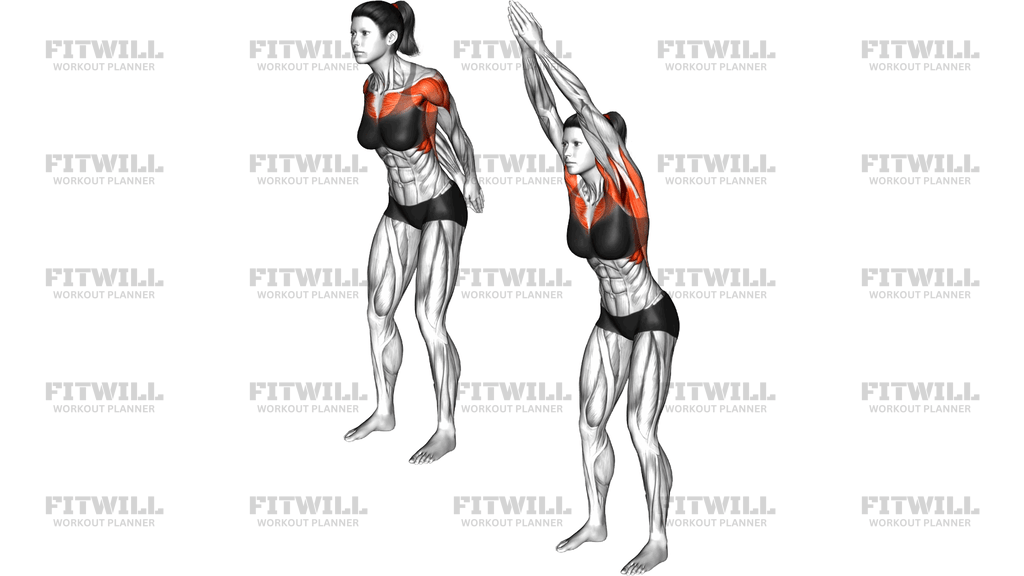
The Standing Slight Bent Top Clap Back Clap is a dynamic bodyweight drill where you stay in a standing position with a slight forward lean and soft knees, swing both arms up overhead to clap above your head, then immediately swing them down and behind your body to clap behind your back. The two claps are linked into one continuous, rhythmic cycle, so the arms are always traveling in a wide arc in front of or behind the torso. It looks simple, but the speed and range make it a demanding coordination and shoulder-endurance movement.
This exercise primarily challenges the shoulders, especially the front delts that drive the arms up and forward, along with the chest, which works as the arms sweep into each clap. The upper back and rear shoulder area control the swing behind you, while the core stabilizes your torso against the momentum of the arms. Because there is no external load, the training effect comes from speed, range of motion, and repetition rather than heavy resistance.
The setup matters more than people expect. The slight forward lean and soft knee bend keep your hips underneath you and give you a stable base, so the claps come from the shoulders and upper back rather than from arching or throwing your lower back around. Feet stay about hip-width apart, and your gaze stays forward, which keeps your neck relaxed while the arms travel through a big range.
To execute it well, think of the arms as relaxed whips rather than stiff bars. Swing them up so the hands meet directly overhead, then let them fall naturally into the arc behind you and clap at the level of your lower back or hips. The rhythm should feel continuous: clap up, clap back, repeat. If you slow down too much, the movement turns into an awkward stretch; if you rush, form breaks into shrugging and leaning.
This drill fits well as a shoulder warm-up before pressing or pulling workouts, as a mobility flow piece in general fitness routines, and as a conditioning move when repeated for time. It is also useful for anyone who spends long hours sitting, because it takes the shoulders through extension and overhead flexion in one pattern. Athletes in throwing or racquet sports often use similar arm-swing claps to prep the shoulder girdle for fast, full-range arm actions.
Keep the effort honest and controlled. If you cannot clap cleanly overhead or behind your back, shorten the swing and work on the range first. Stop if you feel pinching in the shoulders, and avoid craning your neck as the arms pass your ears. Done with good rhythm and posture, this exercise builds shoulder mobility, coordination, and muscular endurance without any equipment.
Fitwill
Log Workouts, Track Progress & Build Strength.
Achieve more with Fitwill: explore over 9600 exercises with images and videos, access built-in and custom workouts, perfect for both gym and home sessions, and see real results.
Start your journey. Download today!




Instructions
- Stand with your feet about hip-width apart and let a slight bend settle into your knees.
- Hinge forward a small amount from the hips so your torso leans slightly ahead of vertical, then brace your core lightly to hold that position.
- Relax your arms at your sides with your hands open and your shoulders pulled gently down away from your ears.
- Swing both arms out to the sides and up in a smooth arc, then clap your palms together directly overhead with your arms close to your ears.
- Without pausing, open your hands and let the arms swing down and behind your body, clapping your palms together behind your back at roughly hip to lower-back height.
- Continue the cycle, flowing straight from the back clap into the next overhead clap so the rhythm stays continuous.
- Exhale as you swing up into the top clap and breathe naturally through the back swing; avoid holding your breath.
- Keep your gaze forward and your torso angle constant, letting the arms do the moving rather than your hips or lower back.
- Perform your target number of reps or time interval, then stop the swings and let your arms settle at your sides to reset before the next set.
Tips & Tricks
- Most people lose the slight forward lean as they tire and start arching backward on the overhead clap; check your torso angle every few reps and reset it before continuing.
- If the behind-the-back clap is hard to reach, aim first for a light touch near your hips instead of forcing the hands together at the lower back.
- Keep the arms slightly soft at the elbows. Locked, stiff arms slow the swing down and strain the elbow joints at the clap.
- Do not let your shoulders ride up toward your ears as the hands pass overhead; shrugging turns a shoulder exercise into a neck exercise.
- Your feet should stay planted. If you are rocking heel to toe to generate the swing, the movement is coming from momentum instead of shoulder control.
- Start with a smaller arc and build speed gradually. Fast claps with a cold shoulder are a common cause of a strained front delt.
- Think about clapping with the whole palm meeting flat rather than slapping fingertips together, which keeps the wrists neutral and comfortable.
- If one side keeps missing the back clap, that usually signals tighter chest or shoulder muscles on that side; slow that side's swing down and let it find the range.
- Place this drill early in your workout, before heavy pressing or pulling, when the shoulders are fresh enough to move freely.
Frequently Asked Questions
Which muscles does the Standing Slight Bent Top Clap Back Clap work?
The front shoulders drive the overhead clap, the chest and rear shoulders control the swings, and the upper back and core stabilize the torso. The arms assist throughout, but the shoulder girdle does most of the work.
Is the Standing Slight Bent Top Clap Back Clap suitable for beginners?
Yes, as long as beginners reduce the speed and accept a smaller clap range. If the behind-the-back clap is not reachable, swing the hands back as far as feels comfortable and build toward contact over time.
Why does the exercise use a slight forward lean instead of standing fully upright?
The lean shifts your center of mass over a stable base so the arm swings come from the shoulders rather than from arching the lower back. It also helps keep the spine neutral while the arms travel through a large range.
How fast should I perform the claps?
Use a controlled, rhythmic pace you can maintain without your form collapsing. Speed can increase as your coordination improves, but the swing should never feel wild or jerky.
Can I use the Standing Slight Bent Top Clap Back Clap as a warm-up?
It works very well as a shoulder warm-up before pressing, pulling, or throwing movements because it takes the shoulders through both overhead flexion and extension in one continuous pattern.
What is the most common mistake in this exercise?
Shrugging the shoulders toward the ears and arching backward on the overhead clap. Keep the shoulders drawn down and the slight forward lean fixed so the arms, not the torso, do the swinging.
I cannot clap behind my back. What can I substitute or adjust?
Shorten the range and simply swing the hands behind your hips as far as they comfortably go, working toward a light touch first. Chest and shoulder mobility work can also help close the gap over time.
How many reps or how long should I do this drill?
For a warm-up, 15 to 30 seconds or 10 to 20 continuous clap cycles is usually enough. For conditioning, repeat in longer intervals while keeping the rhythm clean.
Is it safe for people with shoulder problems?
Anyone with a current or recent shoulder injury should get clearance before attempting fast claps overhead and behind the back. If the movement causes pinching or sharp discomfort, stop and use a slower, smaller-range arm swing instead.